For plastic charger plates, Impresión UV vs Calcomanía de papel mainly comes down to how the decorative image is added to the product. UV printing normally places ink directly onto the plastic surface and cures it quickly with ultraviolet light. A paper decal uses a separately printed decorative layer that is transferred, bonded, or otherwise applied to the plate. The finished appearance, durability, cost, MOQ, and production efficiency can therefore be quite different.
The right choice depends on what you’re selling.
A distributor supplying event companies may care most about cost and rich decorative patterns. A private-label brand may need low-volume customization and fast artwork changes. A retailer may put greater value on consistent colors and a premium surface appearance.
That means your purchasing decision should consider more than the artwork itself.
You should ask:
- How many designs will be ordered?
- How many pieces are required per design?
- Is the decoration simple or highly detailed?
- Will the plate be reused many times?
- How much rubbing or cleaning will it receive?
- Is a photographic design required?
- How important is color consistency between repeat orders?
- Will the design change frequently?
Another important factor is the plastic material. Charger plates may be made from PP, PS, or other plastics. Some plastics are easier to print than others.
For example, polypropylene has relatively low surface energy. Certain UV ink systems therefore require surface treatment before printing to achieve reliable adhesion. Technical ink manufacturers specifically recommend pretreatment for PP and PE substrates rather than assuming that ink will bond correctly to untreated plastic. citeturn428714search24turn428714search25
For overseas buyers, this is why the decoration process should be evaluated together with the substrate, artwork, order quantity, testing requirements, and target market.
UV Printing vs Paper Decal for Plastic Charger Plate
Although the two methods can create similar-looking finished products from a distance, the production processes are quite different.
How Direct UV Printing Works
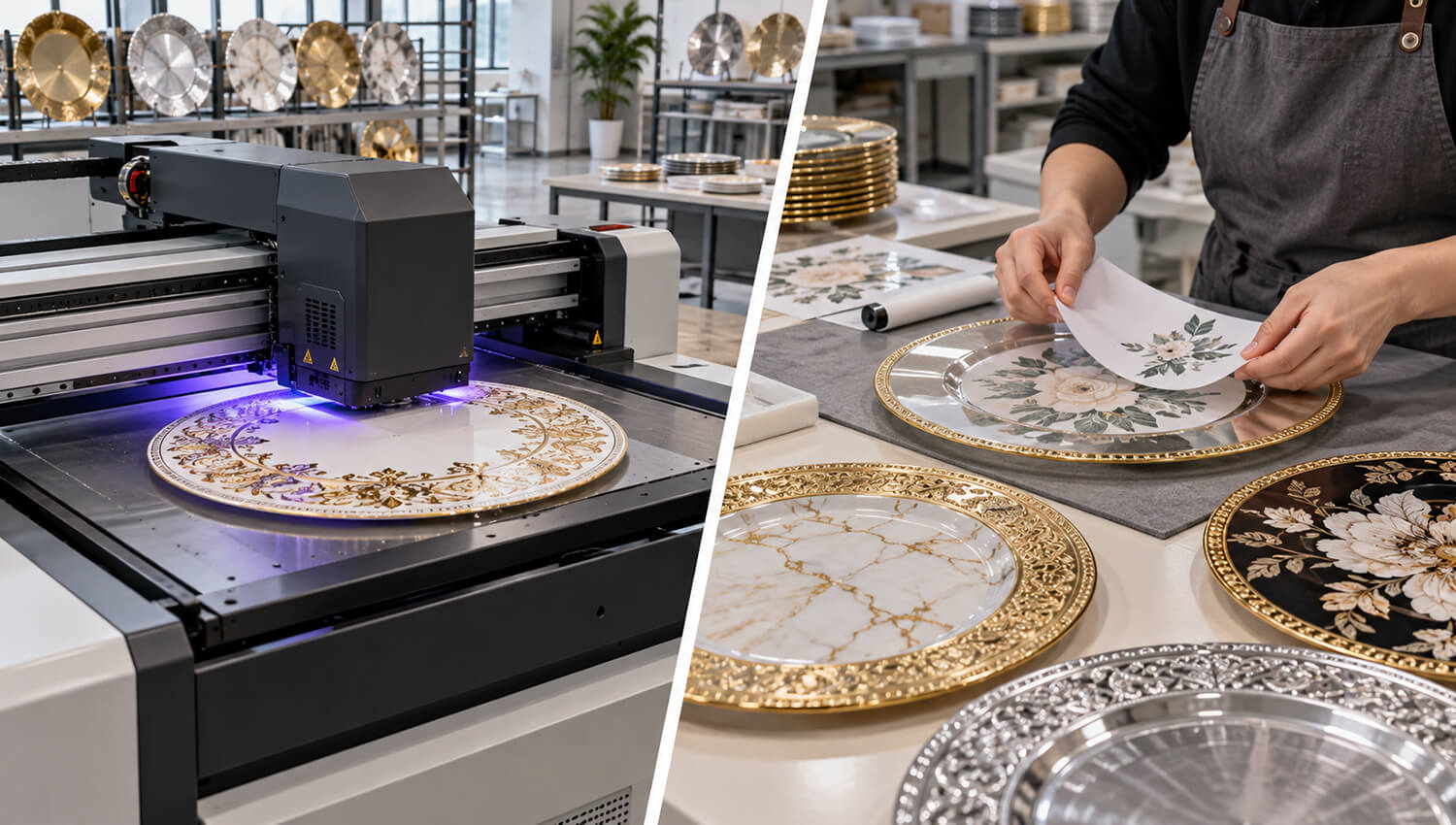
With direct UV printing, the molded charger plate is positioned in a printer or printing fixture. Ink is deposited onto the surface according to the digital artwork. Ultraviolet energy then cures the ink.
This gives manufacturers an important production advantage: there is no need to wait for conventional ink to air-dry for a long period.
The U.S. Environmental Protection Agency notes that UV-curable inks are cured by exposure to ultraviolet light and that curing can occur very quickly. UV-curable systems are also commonly classified among low- or no-VOC coating technologies, although actual formulations and emissions vary. citeturn114001search0turn114001search1
For charger plates, digital UV printing is especially useful when artwork contains:
- logos;
- personalized names;
- gradients;
- photographs;
- multicolor patterns;
- small text;
- short seasonal collections;
- multiple designs within one purchase program.
How a Paper Decal Process Works
A paper decal begins as a separately printed decorative element.
Depending on the production system, the printed paper or transfer layer may be bonded, transferred, laminated, coated, or protected on the charger plate surface. The exact structure varies by supplier, so buyers shouldn’t assume that all products called “paper decal” use the same construction.
The biggest benefit is decoration freedom at an economical production scale.
Complex marble patterns, floral graphics, holiday themes, wood effects, abstract artwork, and traditional motifs can all be prepared separately and applied during production.
For this reason, paper-based decorative processes remain practical for many high-volume decorative tableware programs.
The important point is simple:
Compare finished-product performance, not only printing terminology.
Ask the manufacturer to explain the complete decoration structure before approving the order.
Print Quality, Color and Design Flexibility
Print appearance matters because charger plates are highly visual products. They are frequently used for weddings, hotels, restaurants, catering companies, event rental businesses, holiday collections, and home décor.
A small difference in finish can strongly affect perceived value.
Where UV Printing Has an Advantage
Digital UV printing is particularly strong when the artwork contains fine details.
Because the design is generated digitally, a supplier can reproduce:
- complex logos;
- gradients;
- small decorative elements;
- multicolor artwork;
- photographic images;
- customized text;
- personalized layouts.
Artwork changes can also be easier.
Imagine that a buyer needs six wedding charger plate patterns. Each design uses the same plate shape but different graphics. A digitally controlled process may allow the manufacturer to switch artwork without producing a completely different printing system for every variation.
That flexibility can be valuable for private-label businesses testing new collections.
Where Paper Decal Performs Well
Paper decoration can also produce very detailed designs.
In fact, for certain large decorative patterns, the result may be excellent because the artwork is printed on a flat medium before being applied to the three-dimensional plate.
It can work particularly well for:
- floral patterns;
- marble effects;
- festive designs;
- vintage artwork;
- geometric prints;
- luxury decorative themes.
The final result, however, depends heavily on registration, transfer quality, coating, edge treatment, and the shape of the plate.
Don’t Approve Color Only From a Computer Screen
This is a common sourcing mistake.
RGB screen colors aren’t the same as printed colors.
Before mass production, B2B buyers should approve a physical sample or production color standard whenever color accuracy matters.
For custom projects, send:
- AI or PDF vector artwork when available;
- Pantone references for important brand colors;
- high-resolution images;
- dimensions of the printable area;
- a marked layout showing artwork position.
That small step can prevent a very expensive misunderstanding after several thousand plates have already been produced.
Durability, Adhesion and Surface Performance
A beautiful pattern isn’t enough if it scratches during packing, shipment, cleaning, or normal use.
This is where manufacturing control becomes critical.
For UV decoration, adhesion depends on the relationship between the ink, plastic substrate, surface cleanliness, pretreatment, curing energy, and printing parameters.
Polypropylene deserves particular attention.
Technical ink guidance for PP and PE repeatedly states that these plastics may require flame or corona pretreatment to improve surface energy and ink adhesion. One Marabu technical sheet notes that suitable surface treatment can raise surface tension to around 44 mN/m for reliable printing conditions. citeturn428714search24
This doesn’t mean every PP charger plate requires exactly the same treatment.
It means the manufacturer should validate the complete system instead of assuming compatibility.
Typical factory checks should include:
- surface cleanliness;
- print adhesion;
- curing condition;
- scratch resistance;
- rubbing resistance;
- water exposure;
- uniformidad del color;
- edge integrity.
Paper decal durability works differently.
The printed layer may depend more strongly on the adhesive, transfer process, protective coating, and sealing quality.
Poor processing can result in problems such as:
- lifting edges;
- bubbles;
- wrinkles;
- uneven bonding;
- arañazos;
- moisture damage;
- visible registration errors.
A well-controlled decal process can still perform reliably for its intended application.
Therefore, don’t ask only:
“Which printing method is more durable?”
Ask instead:
“What durability tests does this exact plate construction pass?”
That’s a much more useful purchasing question.
For reusable products, request testing on actual production samples rather than unprinted material plaques.
Also tell the supplier how your customers will use and clean the product. A decorative event plate used beneath dinnerware has different performance demands from a product exposed to frequent aggressive washing.
Cost Structure for Wholesale Charger Plate Orders
Price comparison between the two decoration methods isn’t as simple as saying one is cheaper.
Total cost depends heavily on order structure.
UV Printing Cost Factors
UV printing may involve:
- printer setup;
- plate positioning fixtures;
- pretreatment;
- ink consumption;
- printing time;
- curing;
- quality inspection.
Digital printing can become attractive when a buyer has several artworks or relatively small quantities for each SKU.
For example, consider two sourcing projects.
Project A
- 3,000 pieces;
- one design;
- no customization.
Project B
- 3,000 pieces;
- ten different designs;
- frequent artwork changes.
Even though total quantity is identical, the most economical production method may differ.
Paper Decal Cost Factors
Paper decoration may involve:
- artwork preparation;
- decal printing;
- transfer materials;
- application labor;
- protective coating;
- drying or curing;
- inspection.
At larger quantities of one repeated design, the preparation cost can be spread across more pieces.
This can make the method commercially attractive for stable, high-volume programs.
Think in Total Landed Cost
For B2B purchasing, unit price alone isn’t enough.
Calculate:
Product Cost + Printing Cost + Setup Cost + Packaging + Freight + Expected Defect Risk = Real Purchasing Cost
A difference of a few cents per plate may look important on a quotation.
But if the lower-cost option increases rejected pieces, delayed shipment, or customer complaints, the apparent saving disappears quickly.
The most useful RFQ therefore gives the manufacturer:
- plate diameter;
- plastic material;
- design quantity;
- quantity per design;
- artwork;
- packaging requirement;
- destination country;
- expected usage.
With this information, a factory can recommend the more economical decoration process instead of quoting blindly.
MOQ and Production Flexibility for OEM Projects
MOQ has become increasingly important for importers.
Many brands no longer want to purchase one huge quantity of one design. They prefer several smaller collections and then reorder the best-selling patterns.
Digital decoration can fit this model well.
If the factory’s equipment and fixture system allow economical short runs, UV printing may support:
- market testing;
- limited editions;
- seasonal launches;
- personalized products;
- promotional projects;
- multiple SKUs.
This is particularly useful for online retailers and importers that want to reduce inventory risk.
Suppose you’re preparing a Christmas charger plate collection.
Instead of committing all inventory to one design, you might launch several patterns:
| Diseño | Trial Quantity |
|---|---|
| Snowflake | 500 pcs |
| Christmas Tree | 500 pcs |
| Gold Star | 500 pcs |
| Red Berry | 500 pcs |
| Winter Forest | 500 pcs |
If one pattern performs exceptionally well, you can reorder it.
That reduces the risk of carrying thousands of slow-moving pieces.
Paper decal production can also support multiple designs, but preparation economics may favor larger repeated quantities depending on the supplier’s process.
Therefore, buyers should ask manufacturers to quote two scenarios:
Scenario 1: Lowest MOQ per design.
Scenario 2: Best unit price per design.
The answers may be very different.
For distributors, this creates an important sourcing strategy.
Don’t automatically choose the lowest price at the highest MOQ.
Sometimes paying slightly more per unit for smaller initial quantities produces better cash flow, faster product testing, and less dead stock.
That can be far more valuable than saving a small amount on manufacturing.
Production Speed and Lead-Time Considerations
Lead time isn’t only the number written on a quotation.
You should understand where time is being spent.
A custom charger plate project may include:
Artwork → Sample → Approval → Raw Material → Molding → Decoration → Inspection → Packing → Shipping
Printing is only one part of the schedule.
UV technology can provide an advantage because curing happens rapidly. EPA technical guidance has described UV ink curing as nearly instant in suitable printing operations, which supports high-speed manufacturing. citeturn114001search1
However, rapid curing doesn’t automatically mean the entire order will ship faster.
The actual production rate also depends on:
- printer capacity;
- number of printing passes;
- fixture loading;
- surface pretreatment;
- artwork complexity;
- plate size;
- number of SKUs;
- inspection requirements.
Paper decal production has its own schedule.
Before application begins, the decorative material may need to be prepared and printed. Additional coating, bonding, drying, or finishing may follow.
For large repeat orders, that workflow can be very efficient.
For frequent design changes, the preparation steps may become more noticeable.
What Buyers Should Request
Instead of asking only for a total lead time, request a simple production timeline:
| Stage | Buyer Should Confirm |
|---|---|
| Artwork review | File format and printable area |
| Sampling | Sample production time |
| Approval | Color and positioning standard |
| Producción en serie | Estimated production window |
| QC | Inspection method |
| Packing | Carton and protection requirements |
| Envío | Ready-to-ship date |
This gives purchasing teams much better control.
It also prevents one of the most common B2B problems: assuming production starts immediately after a purchase order while artwork or sample approval is still incomplete.
Which Process Works Better for PP and PS Charger Plates?
Material should be confirmed before choosing a printing system.
Two plates may look almost identical but behave very differently during printing.
PP Charger Plates
Polypropylene offers useful manufacturing properties, but its low surface energy can make printing adhesion more difficult.
Pretreatment may therefore be necessary.
Industry technical documentation for printing inks recommends flame or corona treatment for many PP applications and emphasizes that trial printing is necessary because printability can vary even within the same substrate family. citeturn428714search25turn428714search26
That’s an important lesson for buyers:
Never qualify printing performance only by resin name.
Color additives, recycled content, molding conditions, surface texture, release agents, and other variables can affect the finished surface.
PS Charger Plates
Polystyrene often provides a rigid surface suitable for decorative tableware.
However, ink compatibility still needs to be confirmed with the specific resin and finish.
A glossy plate, matte plate, metallic-coated plate, and textured plate shouldn’t automatically use identical printing settings.
Paper Decal Considerations
Paper decoration is also affected by substrate shape and surface characteristics.
Deep curves, embossed rims, or highly textured surfaces can make positioning more difficult.
For this reason, the correct manufacturing sequence should be developed around the actual plate design.
When sourcing a custom model, send the factory a 3D drawing, reference sample, or existing plate if possible.
A manufacturer can then evaluate:
- printable area;
- curvature;
- rim design;
- registration;
- adhesion;
- fixture requirement;
- possible distortion.
This approach is much safer than selecting decoration before the product geometry is finalized.
Quality Control Tests B2B Buyers Should Request
Decoration quality should be measurable.
A supplier saying “the printing is good” isn’t enough for an OEM program.
Before mass production, establish an approved sample and basic QC criteria.
Visual Inspection
Comprueba:
- color difference;
- missing ink;
- contamination;
- blurry edges;
- artwork position;
- registration;
- arañazos;
- bubbles;
- wrinkles;
- coating defects.
Adhesion Testing
For directly printed surfaces, a controlled tape or adhesion test can help detect weak bonding.
The test procedure must be agreed in advance.
The same tape, pressure, conditioning time, and evaluation method should be used if results will be compared between batches.
Rubbing and Scratch Testing
Products rub against packaging and other plates during handling.
A surface that looks perfect immediately after production may show damage later.
Manufacturers should therefore test representative samples after the decoration has fully stabilized.
Water and Cleaning Exposure
If the product will be wiped or washed, confirm what cleaning conditions are acceptable.
Never describe a product as dishwasher-safe unless the complete finished product has been tested for the intended dishwasher conditions.
Golden Sample Approval
For repeat orders, keep one approved reference sample.
It becomes the physical standard for:
- color;
- brillo;
- artwork position;
- decoration quality;
- overall appearance.
This is especially helpful when a buyer reorders six months later.
Digital files alone don’t always capture the true physical appearance.
From a factory quality-control viewpoint, the best result comes when buyer and manufacturer define acceptance standards before mass production—not after a shipment has already arrived.
UV Printing vs Paper Decal Comparison Chart
The following chart gives purchasing managers a practical overview.
| Factor | Direct UV Printing | Calcomanía de papel |
|---|---|---|
| Fine detail | Excelente | Excelente |
| Photographic artwork | Very suitable | Very suitable |
| Artwork changes | Generally flexible | Depends on decal preparation |
| Small custom runs | Often advantageous | Process-dependent |
| Large repeated runs | Suitable | Often commercially attractive |
| Curing/drying | Very fast UV curing | Depends on decal and finishing process |
| PP adhesion | May require pretreatment | Depends on bonding system |
| Curved surfaces | Fixture/process dependent | Application-process dependent |
| Personalization | Strong advantage | Less convenient in many workflows |
| Motivos decorativos | Excelente | Excelente |
| Surface durability | Depends on ink/substrate system | Depends on decal/protective layer |
| Setup economics | Strong for multiple digital designs | Strong for stable repeat designs |
| QC priority | Ink adhesion and curing | Bonding, registration and coating |
Simple Buyer Decision Chart
Choose UV printing when:
★★★★★ Multiple artwork versions
★★★★★ Short-run customization
★★★★★ Fine digital graphics
★★★★★ Frequent design changes
★★★★☆ Fast print curing
★★★★☆ Personalized branding
Consider paper decal when:
★★★★★ Decorative full-surface patterns
★★★★★ Repeated designs
★★★★★ Large coordinated collections
★★★★☆ High-volume production
★★★★☆ Traditional decorative effects
★★★★☆ Stable long-term artwork
These ratings aren’t universal production specifications.
They are purchasing guidance.
Actual results depend on the plate material, design, factory equipment, ink or decal system, order size, and required finish.
That’s why physical sampling remains essential.
How to Choose the Right Decoration Method for Your Market
The strongest purchasing decision starts with the customer, not the printer.
Ask who will buy the finished charger plate.
For Event Supply Distributors
Your priorities may include:
- attractive visual designs;
- competitive wholesale price;
- reliable repeat orders;
- carton protection;
- multiple seasonal patterns.
A paper decorative system may work very well for stable large collections, while direct digital printing may help you test new designs.
For Online Private-Label Brands
Your priorities may be different:
- more SKUs;
- smaller inventory per SKU;
- fast design updates;
- branded collections;
- personalized graphics.
UV decoration can become particularly interesting here.
For Hotel and Restaurant Suppliers
Consistency may matter more than constant artwork changes.
You should prioritize:
- repeatability;
- scratch performance;
- stable color;
- easy cleaning;
- packaging protection;
- long-term supply.
For Promotional Projects
A customer may need a logo, event date, sponsor name, or campaign artwork.
Digital direct printing can reduce the complexity of producing highly customized graphics.
The main lesson is that decoration should support your business model.
A manufacturing method that saves $300 on one purchase order isn’t necessarily the best option if it forces you to hold $10,000 of additional inventory.
Likewise, paying for unnecessary short-run flexibility makes little sense when you purchase the same design by the container.
Tell the supplier how you sell the product.
A good manufacturer can then recommend the production process that fits the commercial goal instead of simply recommending whichever process happens to be easiest for the factory.
Working With a Plastic Charger Plate Manufacturer
A successful custom project starts with a clear RFQ.
Sending only a picture and asking “How much?” rarely produces the most reliable quotation.
Provide enough information for the manufacturer to understand the product.
Recommended RFQ Information
Send:
- charger plate diameter;
- material requirement;
- target weight if known;
- surface finish;
- color;
- artwork file;
- quantity per design;
- total order quantity;
- packaging requirement;
- target market;
- destination port or country.
If you’re uncertain whether direct printing or paper decoration is better, ask for both options.
The manufacturer can compare:
- MOQ;
- setup cost;
- unit price;
- sampling requirements;
- expected appearance;
- production lead time;
- recommended durability testing.
Approve a Physical Sample
For custom decorative products, physical sampling is one of the most valuable steps in the purchasing process.
A sample allows you to examine:
- true color;
- brillo;
- artwork position;
- surface feel;
- plate rigidity;
- print sharpness;
- packaging compatibility.
It also gives your sales team something tangible to show customers before committing to a larger purchase.
After approval, the signed or confirmed sample should become the production reference.
For repeat orders, retain artwork files, color standards, product specifications, and sample references.
That creates a repeatable OEM program rather than treating every purchase as a brand-new project.
For further technical background, the U.S. Environmental Protection Agency provides information about low/no-VOC inks and UV-cured coating technology. U.S. EPA guidance on low/no-VOC inks and coatings
Preguntas frecuentes
Is UV printing better than paper decal for charger plates?
Not in every case. UV printing is often attractive for detailed artwork, multiple designs, shorter customized runs, and fast artwork changes. Paper decal decoration can remain very competitive for repeated decorative patterns and larger production programs.
Which printing method is more durable?
Durability depends more on the complete construction than on the process name. Ink type, plastic material, pretreatment, curing, bonding, protective coating, and cleaning conditions all affect performance. Always test actual finished production samples.
Can UV printing be used on PP charger plates?
Yes, suitable ink systems can be used on polypropylene, but PP may require surface pretreatment to improve adhesion. Ink manufacturers often recommend flame or corona treatment and preliminary testing before commercial production. citeturn428714search24
Is UV printing suitable for small custom orders?
It can be. Digital artwork changes don’t always require the same preparation used by traditional decoration methods, making direct printing attractive for trial orders, multiple SKUs, seasonal designs, promotional graphics, and personalized collections.
Can paper decal charger plates have photographic designs?
Yes. High-resolution decorative paper can reproduce photographs, marble textures, floral artwork, geometric patterns, and other complex graphics. Final quality still depends on printing resolution, transfer accuracy, bonding, coating, and the shape of the plate.
Which method gives a lower wholesale price?
There is no universal answer. Order quantity, number of artworks, plate size, decoration coverage, setup requirements, labor, protective finishing, and production speed all affect cost. Request quotations using the same artwork and quantities.
Should I request samples before placing a bulk order?
Yes. A production sample lets you inspect color, adhesion, artwork position, gloss, surface defects, and packaging compatibility. For large B2B orders, sample approval can prevent costly disagreements after mass production.
Are printed charger plates suitable for direct food contact?
Don’t assume they are. Decorative charger plates are commonly placed beneath dinnerware rather than used as the direct food-contact surface. Food-contact suitability depends on the complete material and decoration system and applicable market regulations.
Conclusión
The choice between direct UV decoration and paper decal should be based on your product strategy rather than one isolated technical feature.
UV printing can be especially valuable when you need detailed graphics, multiple SKUs, smaller customized runs, rapid artwork changes, or personalized products.
Paper decal decoration remains practical when you need complex decorative effects, stable repeated artwork, or economical large production runs.
For B2B buyers, four questions matter most:
- What finished appearance do you need?
- How many pieces are required per design?
- What durability does your market expect?
- Which process gives the lowest commercial risk?
Most importantly, evaluate the finished charger plate, not merely the printing method.
Request actual samples. Test the decoration. Confirm the substrate. Establish an approved color and quality standard before production.
If you’re developing a new plastic charger plate collection, send your artwork, target plate size, quantity per design, packaging requirement, and target market to the manufacturer. A factory can then evaluate the most appropriate decoration process and prepare a more accurate OEM quotation.