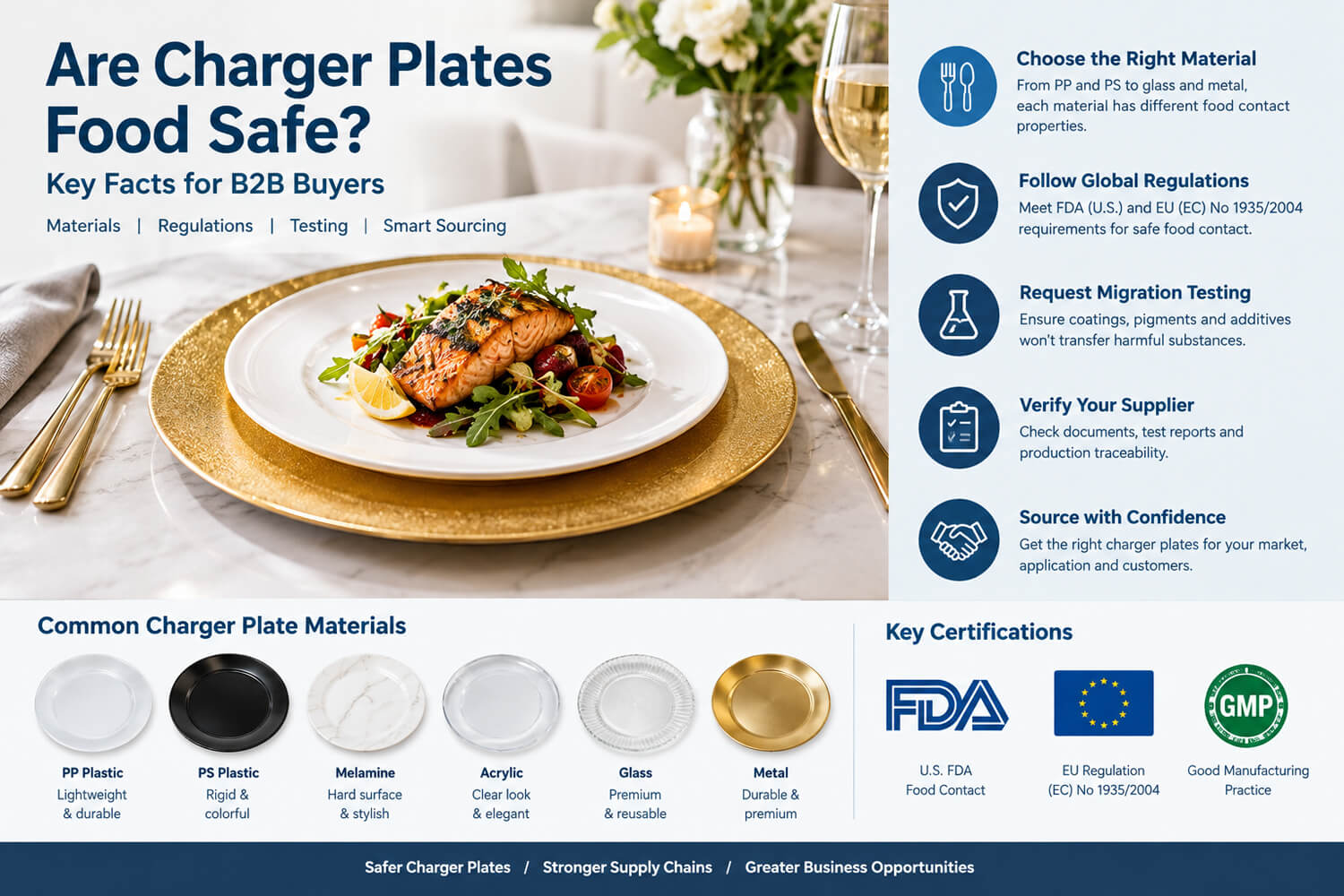
Zaxira lag'onlari oziq-ovqat uchun xavfsizmi?
Yes, charger plates can be food safe, but not every charger plate is designed or tested for direct food contact. A charger plate is traditionally used underneath a dinner plate as a decorative base. Because food normally doesn’t touch it, many decorative models aren’t manufactured to the same requirements as plates intended for serving food directly.
That distinction is important for importers, distributors, event suppliers, restaurants, and private-label tableware brands.
The material itself is only one part of the answer. A polypropylene, or PP, charger plate may use a polymer suitable for food-contact applications. However, the finished plate can also contain pigments, additives, coatings, printed decoration, metallic finishes, or other components. Those components must also be suitable for the intended food-contact use when direct contact is expected.
The U.S. FDA defines food-contact substances broadly as substances used in materials that contact food without being intended to have a technical effect on the food. FDA also explains that the regulatory status of a finished food-contact material depends on the substances that make up that material and their intended conditions of use.
The European Union follows a similar risk-based principle. Food-contact materials placed on the EU market must meet Regulation (EC) No 1935/2004. They must also be manufactured according to applicable Good Manufacturing Practice requirements.
For a B2B buyer, therefore, the safer question isn’t simply:
“Is this charger plate food safe?”
It should be:
“Has this exact material, color, finish, and product construction been evaluated for my intended food-contact use and target market?”
That question makes supplier qualification much more reliable.
Food-Safe Charger Plates vs Decorative Charger Plates
The terms bezakli idish, xizmat idishi, and ostki plastina usually describe the product’s function rather than its food-contact status.
Traditionally, a charger sits underneath another plate. It adds color, texture, and visual depth to a table setting while helping define each place setting. In that application, food doesn’t normally touch the charger.
A food-contact plate has a different purpose. Its surface is expected to contact food during normal use. Therefore, its material formulation and manufacturing process need to be suitable for that intended application.
| Product Type | Normal Use | Direct Food Contact | Food-Contact Verification |
|---|---|---|---|
| Decorative charger | Oziq-ovqat idishlari bo'limida | Odatda yo'q | Depends on intended use |
| Food-contact charger | Serving or holding food | Ha | Should be verified |
| Kechki ovqat tanchasi | Serving food | Ha | Normally required |
| Display plate | Bozor bezagi | Yo'q | Usually not intended for food |
| Serving tray | Carrying/serving food | Often yes | Depends on construction and use |
This distinction becomes especially important with highly decorative plates.
A metallic gold charger, for example, might use a decorative surface finish that looks luxurious but wasn’t developed for direct contact with hot, oily, acidic, or wet foods. Another visually similar model could use a different coating system and have completely different test results.
That’s why buyers shouldn’t rely on photographs or product names.
Likewise, terms such as “BPA-free,” “non-toxic,” “food-grade material,” and “eco-friendly” aren’t substitutes for food-contact compliance documentation. They describe different characteristics.
From a sourcing perspective, tell the manufacturer the intended use before requesting a quotation.
If your customers will only place dinner plates on the chargers, say so. If they may put bread, fruit, appetizers, desserts, or other food directly onto the surface, tell the supplier that as well.
The second situation requires much closer evaluation.
Clear application information helps a manufacturer select the right resin, additives, decoration process, testing conditions, packaging, and quality-control requirements before mass production begins.
How Charger Plate Materials Affect Food Contact Safety
Charger plates can be made from many materials. Common examples include polypropylene, polystyrene, melamine-based materials, acrylic, glass, stainless steel, and other decorative composites.
Plastic charger plates are especially popular in the B2B market because they’re lightweight, cost-efficient, easy to transport, and available in many colors and surface patterns.
However, you shouldn’t judge food-contact suitability from the resin name alone.
Polypropylene Charger Plates
PP is widely used in food containers and other food-contact articles because appropriate polypropylene formulations can be used in regulated food-contact applications.
The FDA’s food-contact inventory lists polypropylene-related substances under applicable provisions including 21 CFR 177.1520. Authorization, however, depends on the specific substance and conditions of use.
For buyers, PP can offer several practical advantages:
- relatively low weight;
- good toughness;
- resistance to moisture;
- good chemical resistance for many ordinary applications;
- efficient injection-molding production;
- wide possibilities for colors, textures, and shapes.
Polystyrene Charger Plates
PS is another common decorative-tableware material. It provides good rigidity and can reproduce detailed patterns efficiently.
FDA’s food-contact inventory also contains polystyrene under several food-contact provisions. Again, being listed doesn’t mean every finished PS product is automatically suitable for every food-contact condition.
Other Materials
Glass and some properly manufactured metal tableware can also be suitable for food contact. Decorative coatings still need consideration.
Melamine-based products have their own regulatory requirements and use conditions. Painted, resin-coated, or composite charger plates require evaluation of the complete construction.
So, when requesting a food-contact product, don’t simply write:
“Need PP charger plate.”
Specify the application, market, temperature, expected food type, repeated-use requirements, surface decoration, and any testing standard you expect.
Material specification is the beginning of compliance—not the end.
FDA and EU Food Contact Requirements for Charger Plates
Food-contact regulations vary by destination market, so international B2B buyers should define compliance requirements before approving mass production.
In the United States, FDA regulates substances used in food-contact applications through several regulatory pathways.
FDA states that a food-contact substance requiring authorization must be authorized for its intended use before being marketed. Depending on the substance and application, authorization may come from regulations in Title 21 of the Code of Federal Regulations, an effective Food Contact Notification, a Threshold of Regulation exemption, or another applicable regulatory basis.
FDA also maintains an inventory covering substances authorized in Title 21 CFR for food-contact uses.
Buyers can review the official FDA Food Contact Substances information when establishing U.S. sourcing requirements.
For the European Union, the framework is different.
Regulation (EC) No 1935/2004 establishes general requirements for materials and articles intended to contact food. The European Commission explains that food-contact materials must comply with this framework when they’re placed on the EU market.
Good Manufacturing Practice requirements under Commission Regulation (EC) No 2023/2006 also apply. Plastic food-contact materials are additionally covered by specific EU legislation, including Regulation (EU) No 10/2011 and its amendments.
For a purchasing manager, one lesson matters most:
“FDA compliant” and “EU compliant” aren’t interchangeable specifications.
Your purchase order should identify the destination market and required testing.
A buyer distributing products across the United States, European Union, United Kingdom, Australia, and other markets may need different supporting documentation.
Before ordering, discuss these requirements with the manufacturer and, when necessary, an accredited testing laboratory or regulatory specialist.
Why Coatings, Paints, Pigments, and Metallic Finishes Matter
The base resin often gets most of the attention during purchasing. Yet decorative charger plates can be more complicated than an ordinary molded plastic article.
Gold, silver, bronze, pearl, antique, wood-grain, marble, glitter, metallic, and high-gloss effects may involve additional materials or processing steps.
Depending on the product design, decoration may come from:
- color masterbatch mixed into the resin;
- spray coatings;
- printed inks;
- vacuum metallization;
- electroplated-looking decorative processes;
- protective topcoats;
- films;
- decals;
- pigments or effect powders.
This matters because FDA explains that the regulatory status of a food-contact material depends on the substances making up the finished article that may reasonably migrate into food under its intended use.
In simple terms, a compliant base polymer doesn’t automatically make an unknown coating compliant.
Imagine two PP charger plates produced from the same molding resin.
Plate A uses an approved color system incorporated into the plastic.
Plate B receives a metallic decorative coating after molding.
They may look similar from a distance, but they’re no longer identical food-contact constructions.
For decorative-only service, that distinction may be less important because food is separated from the charger by dinnerware.
For direct-food-contact applications, however, buyers should tell the factory exactly which surfaces may contact food.
This is especially important for OEM projects.
Suppose your private-label collection contains six colors: white, black, transparent, metallic gold, metallic silver, and antique copper. Don’t automatically assume that a report for the white version covers all six finishes.
Ask whether differences in pigments or coatings require additional evaluation.
For a manufacturer, locking the approved material and decoration specification is also essential. Once a food-contact version has passed the required evaluation, uncontrolled substitution of coatings, masterbatch, additives, or suppliers can create unnecessary compliance risk.
Food Contact Testing and Migration Tests Buyers Should Request
Food-contact testing isn’t simply a badge added to a product page. The purpose is to evaluate whether substances can transfer from a material into food, or food simulants, under defined conditions.
FDA notes that its safety assessment of food-contact substances considers migration information as well as toxicological information when evaluating intended food-contact uses.
Migration is important because contact conditions change how a material behaves.
A plate holding dry bread briefly isn’t exposed in the same way as a plate holding hot, oily food for several hours.
Testing conditions may consider factors such as:
| Test Factor | Nega bu muhim |
|---|---|
| Food type or simulant | Fatty, acidic, aqueous, and other foods interact differently with materials |
| Contact temperature | Higher temperatures can increase migration |
| Contact time | Longer exposure may represent a more demanding use |
| Repeated use | Reusable articles may require different evaluation |
| Surface area | Contact area affects exposure calculations |
| Material formulation | Resin, additives, pigments, and coatings may differ |
| Mo'ljallangan bozor | Regulatory requirements vary by country or region |
FDA’s industry guidance discusses migration testing approaches and identifies food simulants used when evaluating various polymers. For example, its chemistry guidance addresses polyolefins and polystyrene under specified test approaches.
EU plastic food-contact rules also use migration concepts and defined testing conditions.
As a B2B buyer, ask suppliers for documents that clearly identify the tested product.
A useful report should allow you to compare details such as material, model, color or finish, test method, test conditions, test date, laboratory, and result.
Don’t accept a random report merely because the words “food contact” appear on the first page.
The tested sample needs to represent the goods you’re actually purchasing.
How B2B Buyers Can Verify Food-Safe Charger Plates
Importers and distributors can reduce sourcing risk by treating food-contact compliance as part of supplier qualification instead of checking it after production.
Start with intended use.
Tell the manufacturer whether the charger will be decorative only or whether food may be placed directly on it. Also identify the destination country.
Then review the exact product specification.
A practical procurement check should cover the base material, additives, color, decoration, surface coating, intended temperature, type of food contact, repeated-use expectations, and regulatory market.
Next, request supporting documents that match the product.
For direct-food-contact applications, useful documentation may include relevant test reports, declarations or compliance documentation appropriate to the market, raw-material information, and traceability records where required.
Check the details rather than only the test conclusion.
B2B Food-Contact Verification Checklist
- Confirm the exact resin or material used.
- Confirm whether the product is decorative-only or intended for direct food contact.
- Match the test report to the same material and finish you’re ordering.
- Check the report issue date and testing laboratory.
- Review the test standard and destination-market requirements.
- Verify whether metallic coatings, paints, inks, or masterbatch are covered.
- Confirm intended temperature and contact conditions.
- Ask whether the product is designed for repeated use.
- Lock approved materials into the purchase specification.
- Request production traceability for large or recurring orders.
- Consider independent pre-shipment testing when your risk level requires it.
There’s another important point: avoid treating phrases such as “FDA approved factory” as complete evidence.
FDA generally regulates food-contact substances and their intended uses; a broad marketing statement about an entire factory doesn’t establish that every finished charger plate produced there meets a specific food-contact requirement.
Good procurement separates the supplier’s general capability from the compliance status of the exact product you’re buying.
That small distinction can prevent big problems later.
When Should Food Be Placed Directly on a Charger Plate?
Food should only be placed directly on a charger plate when the product has been manufactured and evaluated for that intended use.
If the product is sold strictly as a decorative underplate, use a dinner plate, bowl, napkin, liner, or other appropriate food-contact article between the food and charger.
This is particularly important for elaborate decorative finishes.
Some chargers are designed to create a visual table-setting effect rather than function as dinnerware. Their large diameter, textured rims, metallic surfaces, and decorative patterns often make their purpose obvious—but not always.
For B2B customers, clear labeling and product instructions can therefore be valuable.
Consider several typical applications.
Wedding and event rental: A decorative charger normally remains underneath a dinner plate. Direct food contact isn’t required for its basic function.
Hotel and restaurant: Staff may occasionally place bread, appetizers, desserts, or garnishes directly on a charger. If that behavior is predictable, the buyer should source accordingly rather than assume decorative-only use.
Retail tableware: Consumers may use products differently from the merchandising photograph. Clear use instructions can help prevent misunderstanding.
Buffet and catering: Food-contact duration, temperature, and oily or acidic foods may make the use more demanding.
Hot food deserves particular attention. A material suitable for one contact condition shouldn’t automatically be assumed suitable for every temperature.
The same applies to microwave and dishwasher use.
Food-contact suitability does not automatically mean microwave-safe, oven-safe, dishwasher-safe, freezer-safe, or suitable for boiling liquids.
These are separate performance claims.
From a manufacturer-buyer perspective, the best approach is to define expected use conditions before product development. That’s much safer than choosing a decorative product first and asking whether it can be repurposed later.
Manufacturer Quality Control for Food-Contact Charger Plates
For manufacturers, food-contact compliance starts well before finished plates reach a testing laboratory.
Material control is the foundation.
A stable production program should identify approved raw-material suppliers and approved resin grades. Color masterbatch, additives, coatings, printing materials, and decoration systems should also follow controlled specifications when they’re relevant to compliance.
Incoming materials should then be matched against purchase specifications and supplier documentation.
During molding, manufacturers normally monitor key production variables that influence product consistency. These can include material preparation, molding temperature, cycle conditions, product weight, dimensions, surface appearance, warpage, and other model-specific requirements.
Decorated plates require additional control.
For example, a metallic finish may need visual inspection for uneven coating, scratches, exposed areas, adhesion problems, or contamination. If the finish is part of a validated food-contact construction, production should use the approved process rather than an unreviewed substitute.
Traceability is equally valuable for B2B buyers.
A purchase order, production batch, raw-material lot, color, and inspection record should be connected well enough that a manufacturer can investigate a problem if one appears later.
This becomes more important for distributors placing repeat orders over several years.
A common sourcing risk occurs when the first production passes testing but future orders silently change resin, masterbatch, coating, or subcontracted decoration.
That’s why serious buyers shouldn’t treat compliance as a one-time certificate collection exercise.
It should become part of change control.
If a critical material or decorative process changes, ask whether existing documentation remains applicable or whether additional testing is appropriate.
From a factory standpoint, this also makes production more efficient. Approved specifications reduce arguments, minimize unexpected substitutions, and give both supplier and buyer a clear quality benchmark.
Food-Safe Charger Plate Comparison Chart
There’s no universal material that makes every charger plate safe for every food-contact application. Still, comparing common options can help buyers decide what questions to ask.
| Charger Plate Type | Typical Strength | Typical Concern | Direct Food Contact Decision |
|---|---|---|---|
| PP plastic | Tough, lightweight, moisture resistant | Additives, pigments, surface decoration | Verify complete formulation and intended use |
| PS plastic | Rigid, easy to decorate and mold | Heat conditions, additives, coatings | Verify intended conditions and finished article |
| Melamine-based | Hard surface, tableware appearance | Material-specific migration and temperature restrictions | Confirm applicable compliance and use limitations |
| Acrylic-style plastic | Clear appearance and decorative potential | Exact polymer and additives | Confirm exact material and relevant testing |
| Shisha | Hard, reusable surface | Decoration, coatings, breakage | Check decorated surfaces and applicable standards |
| Metall | Durable and premium appearance | Metal composition and surface coatings | Verify construction and applicable requirements |
| Decorative coated plastic | Wide range of metallic finishes | Coating migration and durability | Requires careful finished-product evaluation |
This comparison illustrates why procurement specifications matter more than general product descriptions.
Take a gold charger plate.
A buyer might ask three factories for a “13-inch gold plastic charger.” All three suppliers could quote visually similar products.
Yet one may use PP with an integrated pigment. Another may use PS with a metallic coating. A third may use a molded plate with a separate decorative film or painted finish.
From a purchasing viewpoint, those aren’t interchangeable products.
If your application is decorative-only, you can focus heavily on appearance, scratch resistance, flatness, durability, packing efficiency, and price.
If direct food contact is required, additional factors move up the priority list: composition, intended-use conditions, regulatory documentation, test reports, traceability, and change control.
That doesn’t mean a food-contact charger must be complicated or expensive.
It simply means its intended use should be designed into the product from the beginning.
For OEM and wholesale projects, giving the manufacturer your destination market and end-use requirements during RFQ preparation usually produces a much more useful quotation than requesting a generic charger plate and adding compliance requirements later.
Common Buyer Mistakes When Sourcing Charger Plates
The first common mistake is assuming that a material name proves compliance.
“Made of PP” isn’t the same statement as “this finished article is suitable for our specified food-contact application.”
The second mistake is relying on an unrelated report.
Imagine that a factory has tested a plain white PP plate. You’re ordering a gold-coated version. Unless the documentation and regulatory assessment appropriately cover the changed construction, the white product’s report may not answer the question you actually have.
The third mistake is ignoring intended conditions of use.
Cold fruit, hot soup, oily meat, acidic sauce, dry bread, and decorative-only service don’t create identical exposure conditions.
FDA explicitly evaluates food-contact substances according to intended use and migration considerations rather than treating every application as the same.
The fourth mistake is using a test report forever.
Regulations can change. Product formulations can change. Suppliers of resin, pigments, or coatings can change. Testing requirements may also be updated.
Build document review into ongoing supplier management.
The fifth mistake is waiting until after mass production.
Suppose you’ve already manufactured 50,000 customized chargers with your logo and packaging. If compliance testing then reveals that the selected coating doesn’t meet your requirement, your options become expensive very quickly.
The better sequence is:
Application → Market → Material → Decoration → Compliance Review → Sample → Testing Where Required → Approval → Mass Production.
That’s a much safer workflow.
Finally, don’t over-specify either.
If the charger is genuinely decorative and your customers never place food directly on it, tell your supplier that. You can then develop and label the product for its actual function rather than creating unnecessary requirements.
Good B2B sourcing isn’t about collecting the largest number of certificates.
It’s about matching the product, evidence, and quality controls to the real application.
FAQs About Charger Plate Food Safety
To'g'ridan-to'g'ri bezakli laganda ustidan yeyishingiz mumkinmi?
Only when the charger plate is specifically suitable for direct food contact under its intended conditions. Decorative chargers shouldn’t automatically be used as dinner plates. Check the manufacturer’s specifications and relevant compliance documentation before placing food directly on the surface.
Are plastic charger plates food safe?
Some plastic charger plates can be suitable for food contact, while others are designed only as decorative underplates. The polymer, additives, pigments, coatings, manufacturing process, intended temperature, and destination-market requirements all affect the final determination.
Are polypropylene charger plates food safe?
Appropriate polypropylene formulations can be used for food-contact applications, and FDA regulations cover certain polyolefin uses. However, a PP label alone doesn’t prove that every finished charger is suitable. Buyers should verify the complete formulation and intended-use documentation.
Are gold charger plates safe for food?
It depends on how the gold appearance is produced. A gold pigment incorporated into plastic and a metallic surface coating aren’t necessarily equivalent. If food will touch the surface, verify that the exact decorative system is suitable for that application.
Does FDA compliant mean a charger plate is safe everywhere?
No. U.S. requirements aren’t automatically equivalent to EU or other national food-contact rules. Importers should identify each destination market and confirm the appropriate regulatory requirements before approving the product for sale.
What documents should I ask a charger plate manufacturer for?
For a food-contact application, ask for documentation relevant to your target market and exact product construction. Depending on the project, this can include test reports, material information, compliance declarations, specifications, and production traceability records.
Does BPA-free mean a charger plate is food safe?
No. BPA-free addresses one specific substance concern. It doesn’t establish compliance for every resin, additive, pigment, coating, ink, or intended-use condition. Food-contact suitability requires a broader assessment of the finished article.
Can the same food-contact test report cover every charger plate color?
Not necessarily. Different colors may contain different pigments, masterbatch formulations, coatings, or decorative materials. Buyers should confirm with the manufacturer or testing specialist whether the report reasonably covers each product variation.
Conclusion: Choosing Safer Charger Plates for Your Market
So, Zaxira lag'onlari oziq-ovqat uchun xavfsizmi? The most accurate answer is: some are, and some aren’t intended to be.
A decorative charger used underneath a dinner plate doesn’t perform the same job as food-contact tableware. That’s why buyers should avoid making purchasing decisions based solely on appearance or resin names such as PP or PS.
For direct food contact, evaluate the complete finished product.
That includes the base material, additives, pigments, coating, metallic decoration, intended food type, temperature, contact duration, repeated-use conditions, and destination-market requirements.
FDA’s framework makes the intended use and regulatory status of food-contact components central to the assessment. EU requirements similarly regulate materials and articles intended to contact food and require appropriate manufacturing practices.
For importers, wholesalers, tableware brands, hospitality suppliers, and event-product distributors, the purchasing process can therefore be reduced to five practical questions:
| Buyer Question | Nega bu muhim |
|---|---|
| What will the plate actually be used for? | Defines decorative vs direct-food-contact requirements |
| Which market will receive it? | Determines applicable regulations |
| What is the complete product construction? | Identifies potential material and coating risks |
| Does documentation match the exact product? | Prevents relying on irrelevant certificates |
| Can production remain consistent after approval? | Protects repeat-order compliance |
If you’re developing an OEM charger plate collection, discuss these points with your manufacturer before confirming materials and surface finishes.
For B2B projects, send the required size, material preference, colors, surface finish, order quantity, destination market, packaging requirements, and whether direct food contact is required. A manufacturer can then evaluate the appropriate production and compliance route before sampling and mass production.
That approach gives you something far more valuable than a vague “food-grade” claim: a charger plate specification built around the way your customers will actually use the product.