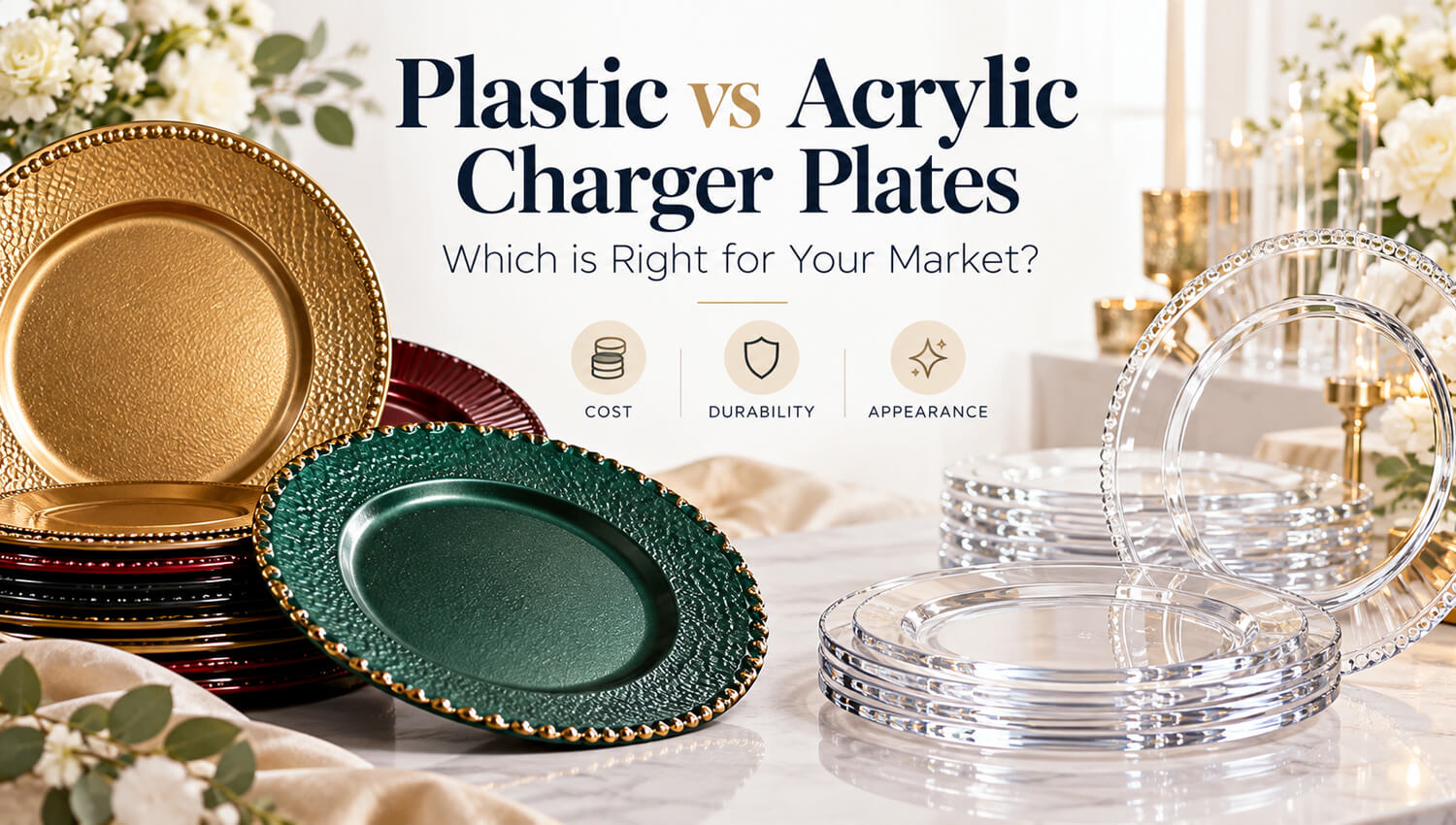
Customizing plastik to'ldiruvchi plastinkalar means defining the plate’s material, dimensions, color, surface finish, logo, packaging, and quality requirements before mass production. For B2B buyers, the most successful projects usually start with a clear specification sheet and an approved sample. The more accurately you communicate your target market, quantity, design, and branding requirements, the easier it is for a manufacturer to control cost, consistency, and production risk.
For distributors, party-supply brands, wholesalers, event-tableware companies, retailers, and hospitality suppliers, customization is about much more than putting a logo on a plate.
You’re creating a product that needs to look consistent across hundreds or thousands of units. It should fit your target price point, survive shipping, stack properly, match your brand identity, and arrive in packaging suitable for your distribution channel.
That makes early decisions important.
A metallic gold charger designed for a wedding-rental distributor may need completely different production specifications from a matte-black charger sold as part of a premium home décor collection.
From a manufacturer’s perspective, many avoidable problems begin before production. Buyers may send only a product photo and request, “Make something like this in our color.” That’s enough for an initial discussion, but it isn’t enough for controlled production.
A strong OEM project converts the visual idea into measurable specifications.
This guide explains how to do that.
Customize Plastic Charger Plates: What Should You Define First?
Before discussing molds or printing methods, define what you’re actually trying to sell.
This sounds obvious, but it’s one of the most important parts of a custom charger plate project.
A buyer supplying event-rental companies may care about durability, stackability, repeated handling, and replacement availability. A retailer selling seasonal Christmas table décor may focus more heavily on appearance, packaging, shelf presentation, and landed cost.
A premium wedding brand may accept a higher unit cost for an unusual edge profile or special metallic finish.
Your target customer affects almost every production decision.
Start by defining:
- Target country or market
- Main sales channel
- Intended application
- Desired retail or wholesale positioning
- Approximate annual demand
- Expected first-order quantity
- Target appearance
- Required packaging
- Logo or private label requirements
- Applicable testing requirements
- Expected delivery date
Here’s a simple development flow:
Brand Concept → Product Specification → Factory Feasibility → Quotation → Sample → Approval → Mass Production → Inspection → Shipment
This sequence prevents you from spending money on details before the basic commercial model makes sense.
For example, imagine you’re building a collection for hotel banquet suppliers. You may want six colors, three rim designs, individual packaging, and an embossed logo.
Technically, all of that may be possible.
Commercially, however, splitting a 3,000-piece order across 18 combinations could make production much less efficient. A manufacturer may instead recommend one shared structure with several surface treatments or a phased launch.
That’s why we recommend discussing the business objective before finalizing the product specification.
You’re not simply buying plastic plates. You’re developing an SKU that must work in your supply chain.
Choose the Right Plastic Material for Your Charger Plate Project
Material selection affects weight, stiffness, impact performance, appearance, molding behavior, and cost.
For decorative charger plates, manufacturers may work with materials such as polystyrene and other suitable thermoplastic resins depending on the design, market requirements, manufacturing process, and desired finish.
There isn’t one universally correct plastic.
The right choice depends on what you expect the finished plate to do.
| Talab | What to Discuss With the Manufacturer |
|---|---|
| High-gloss decorative surface | Resin behavior and coating compatibility |
| Metallic appearance | Base material plus finishing process |
| Frequent handling | Impact resistance and plate structure |
| Lower product weight | Wall thickness and structural reinforcement |
| Premium hissi | Weight, rim design, finish and rigidity |
| Complex molded texture | Mold design and material flow |
| Special compliance requirement | Resin declaration and testing scope |
| Recycled-content request | Material availability and applicable claims |
One common sourcing mistake is selecting material solely by price per kilogram.
That doesn’t tell you the finished product cost.
A lower-cost resin might require a heavier structure, different molding parameters, or more finishing work. Meanwhile, a slightly higher material cost may improve molding stability or surface appearance.
The plate’s geometry matters too.
Wide rims, embossed patterns, deep textures, thin areas, ribs, and unusual edges can change how the plastic flows inside the mold. That’s why material and mold structure should be evaluated together rather than separately.
You should also tell your manufacturer exactly how the product will be marketed.
A charger plate intended only as a decorative base under dinnerware shouldn’t automatically be described as suitable for direct food contact.
If direct food contact is part of your intended use, tell the supplier before material selection. Different regulatory and testing requirements may apply.
The European Commission, for example, maintains specific requirements for plastic materials intended to contact food, including composition rules and migration limits.
European Commission — Food Contact Materials Legislation
Select the Size, Shape, Rim, and Structural Design
Once the material direction is clear, move to the plate itself.
Diameter is only one dimension.
A technically useful charger plate specification should describe the overall diameter, inner serving area, height, rim width, thickness strategy, bottom structure, edge profile, and decorative features.
If you’re copying the general style of an existing sample, don’t assume photographs provide enough information.
Physical measurements are much safer.
Your manufacturer may need to confirm items such as:
| Design Feature | Nega bu muhim |
|---|---|
| Umumiy diametr | Table setting compatibility |
| Inner diameter | Dinner plate placement |
| Jami balandlik | Appearance and stacking |
| Rim kengligi | Visual design and usable center area |
| Edge profile | Appearance and handling |
| Bottom support | Stability on the table |
| Rib structure | Stiffness and weight |
| Surface texture | Molding and finishing |
| Logo location | Branding and tooling |
| Stak balandligi | Carton and warehouse efficiency |
A few millimeters can matter more than buyers expect.
Consider stacking.
If one plate is only 2 mm taller when nested, that difference becomes 40 mm across twenty plates. Multiply that across inner cartons, master cartons, pallets, and containers, and a small design decision may affect freight efficiency.
Structural design is another reason not to compare products only by gram weight.
Two plates with similar overall dimensions can behave differently because their ribs, curves, wall distribution, and bottom supports are different.
For a new OEM project, provide the manufacturer with reference samples, measurements, sketches, CAD files, or marked photographs whenever available.
If you’re creating an exclusive design, request confirmation of critical dimensions before mold construction.
The goal is straightforward: convert aesthetic preferences into specifications that can actually be inspected.
“Make the edge elegant” isn’t measurable.
“Use the approved drawing and signed sample as the reference” is.
That distinction becomes extremely important during production.
Develop Custom Colors That Match Your Brand Identity
Color is one of the easiest customization requests to describe and one of the easiest to misunderstand.
Saying “champagne gold,” “rose gold,” “ivory,” or “navy blue” may communicate a direction, but it doesn’t establish a manufacturing standard.
Different people interpret these names differently.
Lighting makes the issue worse.
A gold plate photographed under warm hotel lighting may look completely different under a warehouse LED lamp. Phone screens and computer monitors add another layer of variation.
For custom production, use a more controlled reference whenever possible.
This may include:
- Pantone reference
- Approved physical color sample
- Existing product sample
- Coating sample
- Signed color swatch
- Customer-approved production sample
Pantone references can be useful for communication, but you should understand what they can and can’t do.
Plastic resin, paint, metallic powder, plating-style coatings, printed inks, matte surfaces, and glossy surfaces reflect light differently. Matching a printed color book to a metallic charger plate perfectly may therefore be unrealistic.
For metallic finishes, the visual result can also change with:
Base color + coating formulation + application thickness + surface texture + gloss level + curing conditions
This is why physical sample approval remains important.
For larger branded programs, build a simple color standard:
| Banda | Approval Reference |
|---|---|
| Base color | Approved code/sample |
| Metallic tone | Signed physical sample |
| Yaltirash darajasi | Approved sample |
| Texture | Reference plate |
| Acceptable variation | Agreed inspection standard |
For repeat orders, ask the factory to retain production records and reference samples where practical.
From a buyer’s point of view, this can be far more valuable than chasing an unrealistic promise of “100% identical color.”
Manufacturing needs tolerances.
Your goal should be controlled, repeatable, commercially acceptable color consistency.
Add Your Logo and Private Label Branding
Branding transforms a generic decorative plate into a product that belongs to your collection.
There are several ways to achieve this.
The correct choice depends on where the logo appears, how visible it should be, production volume, budget, surface finish, and whether the branding needs to survive repeated handling.
Common possibilities include:
- Molded logo
- Embossed logo
- Debossed logo
- Printed logo
- Hot-stamped logo
- Back-side brand marking
- Sticker or label
- Branded retail packaging
- Barcode or SKU labeling
A molded logo can be attractive for long-term branded products because the branding becomes part of the physical structure.
However, it may require tooling modification.
Printing or hot stamping may offer more flexibility for artwork changes, but compatibility must be evaluated with the substrate and surface coating.
Think about brand placement carefully.
A large logo in the center of a charger plate may interfere with the decorative appearance when the dinner plate is removed.
For many B2B programs, subtle back-side branding gives distributors the identification they need without disturbing the table presentation.
Ask yourself:
Who needs to see the brand?
For a consumer retail product, visible branding and packaging matter.
For event rentals, an underside identification mark may be more practical.
For private-label wholesalers, the packaging may carry most of the branding while the plate remains visually neutral.
Before production, provide vector artwork whenever possible. AI, EPS, PDF, SVG, or another production-compatible vector format is generally more useful than a small JPG screenshot.
You should also define:
- Logo dimensions
- Lavozim
- Orientation
- Rang
- Print method
- Artwork version
- Packaging logo
- Karton belgilar
Never approve branding based only on an email description.
Put the approved logo position into your specification sheet or artwork proof.
Compare Surface Finishes and Decorative Effects
For charger plates, surface treatment often creates most of the perceived value.
The molded plastic provides the structure. The finishing process creates the visual personality.
A single basic plate shape can look dramatically different when produced with different decorative effects.
Possible finishes may include:
- High-gloss solid color
- Mat pardoz
- Metallic gold
- Metallic silver
- Rose-gold effect
- Antik pardoz
- Distressed effect
- Marble pattern
- Glitter effect
- Transparent or translucent effect
- Textured surface
- Two-tone treatment
This gives B2B buyers an important development strategy.
You don’t always need a new mold to create a new collection.
If an existing mold already fits your target market, changing color and surface treatment can help you develop multiple SKUs while avoiding unnecessary tooling investment.
Consider this example:
| Collection | Mold | Yakunlash | Branding |
|---|---|---|---|
| Classic Gold | Same | Bright metallic gold | Back logo |
| Vintage Gold | Same | Antique gold | Back logo |
| Modern Black | Same | Mat qora | Back logo |
| Winter Silver | Same | Metallic silver | Branded packaging |
| Wedding White | Same | Pearl white | Private label |
Five commercial products can potentially come from one structural platform.
This approach is especially useful for distributors testing new markets.
Surface finishing also needs quality control.
Buyers should discuss:
- Coverage consistency
- Chiziqlar
- Pinholes
- Dust contamination
- Uneven metallic appearance
- Edge coverage
- Color difference
- Adhesion expectations
- Packing protection
Decorative finishes can be sensitive during stacking and shipping.
Adding protection between plates may increase packaging cost, but it can also reduce surface rubbing.
The cheapest packaging arrangement isn’t always the lowest-cost solution once damage and customer complaints are considered.
Understand Custom Molds, Tooling, and OEM Development
One of the first questions we hear in OEM projects is whether a new mold is necessary.
Often, it isn’t.
If an existing charger plate structure already meets your requirements, you may customize color, decoration, logo, labeling, or packaging without creating a completely new product tool.
This is normally the fastest route for a new collection.
A new mold makes more sense when you require:
- Exclusive shape
- Unique rim design
- Special embossed texture
- Different diameter
- Custom structural dimensions
- Integrated branding
- Proprietary design language
Tooling development should begin with an approved product definition.
The basic process usually looks like this:
Concept → Drawing → Design Review → Tooling Quotation → Tooling → Trial → Sample Evaluation → Adjustment → Approval → Production
Do not rush from a rendering directly into steel.
Changes become more expensive after tooling begins.
Before approving a custom mold, confirm issues such as:
| Tooling Question | Buyer Decision |
|---|---|
| Overall dimensions | Approved |
| Shakl | Approved |
| Rim pattern | Approved |
| Logotip | Approved |
| Texture | Approved |
| Material | Tasdiqlandi |
| Expected weight | Reviewed |
| Qolip egaligi | Contractually defined |
| Sample procedure | Agreed |
| Modification responsibility | Agreed |
Mold ownership deserves special attention in international purchasing.
If you’re paying tooling charges for an exclusive design, clarify whether the tool is exclusively assigned to your company, where it will be stored, how long it will be maintained, and what happens if it is inactive for several years.
These details are easier to discuss before payment.
For new importers, an existing mold plus custom finishing is often a sensible starting point. Once sales data proves the design, moving into proprietary tooling becomes easier to justify.
Build a Reliable Sampling and Approval Process
Sampling isn’t just about seeing whether you like the product.
It’s part of production control.
A good sample creates a physical reference that connects the buyer’s expectation with the factory’s manufacturing instructions.
Depending on customization complexity, the process may involve more than one type of sample.
Color or Finish Sample
This confirms the appearance before committing to a full product run.
It may be particularly useful for metallic, antique, marble, pearl, or unusual decorative finishes.
Pre-Production Sample
This should represent the agreed combination of material, dimensions, appearance, logo, and packaging as closely as practical.
Once accepted, it can become the reference for mass production.
The buyer should review more than appearance.
Tekshirish:
- Diametr
- Height
- Weight where specified
- Plate stability
- Edge quality
- Yuzaning ko'rinishi
- Rang
- Logo placement
- Logo size
- Printed information
- Stacking
- Qadoqlash
- Barcode accuracy
- Karton belgilar
For important OEM programs, keep an approved sample on both sides.
The buyer keeps one.
The manufacturer keeps another.
That gives both parties a common reference if someone later asks whether a production lot matches the agreed product.
Written approval matters as well.
Instead of saying:
“Looks good.”
A better approval record identifies the sample or specification version being approved.
Masalan:
PP Sample Version B, approved for color, logo placement, dimensions and finish. Packaging artwork remains pending.
Small changes should be recorded too.
Otherwise, version confusion can appear months later during a reorder.
One employee may be looking at Version A while your purchasing department assumes Version C is current.
The sample isn’t simply something nice to put on your desk.
It’s part of the quality system.
Plan MOQ, Pricing, Packaging, and Production Lead Time
Buyers often ask one question first:
What’s your MOQ?
It’s important, but MOQ shouldn’t be evaluated alone.
The economically efficient quantity depends on how much customization you add.
Imagine you request:
- Four colors
- Two logos
- Three packaging designs
- Mixed quantities
- Special labels
A supplier may technically accept the total volume, yet each variation creates a smaller production batch.
That affects setup efficiency, finishing, inspection, packaging, material preparation, and inventory management.
Think about MOQ per SKU, not merely total purchase quantity.
Pricing works the same way.
A customized charger plate quotation may be influenced by:
| Cost Driver | Potential Effect |
|---|---|
| Material | Base manufacturing cost |
| Mahsulotning vazni | Resin consumption |
| Design complexity | Processing efficiency |
| Yangi qolip | One-time tooling investment |
| Yuzaning silliqligi | Additional processing |
| Logo method | Setup and unit cost |
| Order quantity | Ishlab chiqarish samaradorligi |
| Color quantity | Changeover frequency |
| Qadoqlash | Materials and labor |
| Inspection/testing | Project-specific cost |
| Carton configuration | Yuk tashish samaradorligi |
Lead time also has several components.
A standard-color repeat order using an existing structure may move relatively quickly. A project requiring tooling, custom coatings, packaging development, sample revisions, and third-party testing needs more planning.
For seasonal products, work backward from the required warehouse date.
Include:
Factory production + inspection + export preparation + international transport + customs + local delivery + safety buffer
Don’t place an order based solely on the date you need goods to leave the factory.
You need them available when your customers want to buy them.
Good forecasting can also help your manufacturer reserve materials and capacity for repeat orders.
Control Quality Before Mass Production and Shipment
Quality control starts before production, not after it.
The final inspection can identify defects, but it can’t efficiently repair a poorly defined product specification.
That is why the sample, drawing, artwork, packaging file, and inspection criteria should be aligned before the production run begins.
A practical QC plan for customized charger plates may include several stages.
Incoming and Pre-Production Checks
Confirm resin, color formulation, packaging materials, artwork versions, and production instructions.
Jarayon ichidagi tekshiruv
Production teams can monitor molding appearance, dimensions, deformation, surface defects, finishing quality, and other agreed checkpoints.
Final Inspection
Finished goods may be checked for:
- Correct model
- Miqdor
- Rang
- Diametr
- Ko'rinish
- Deformation
- Cracks
- Sharp or rough areas
- Yuzaki nuqsonlar
- Qoplama konsistensiyasi
- Printing position
- Logo accuracy
- Qadoqlash
- Yorliqlar
- Barcodes
- Carton markings
The exact checklist should reflect your project.
An antique-finish product shouldn’t be judged with the same visual criteria as a plain glossy plate because intentional variation may form part of the desired appearance.
That’s another reason an approved physical sample is valuable.
You can also define major, minor, and critical defects before inspection.
For significant orders, some buyers use their own inspection company or an independent third-party service before shipment.
From a purchasing perspective, quality control should answer one clear question:
Does the production shipment reasonably match what we agreed to buy?
A measurable specification provides a much stronger answer than subjective phrases such as “premium quality” or “nice finish.”
Check Compliance Requirements for Your Target Market
Compliance should be discussed according to the actual product, destination, and intended use.
Avoid asking a supplier simply:
“Is this certified?”
Certified for what?
Different markets and claims may require different documentation.
A more useful request identifies:
- Boriladigan mamlakat
- Product material
- Intended use
- Direct or indirect food contact
- Restricted-substance requirements
- Retailer-specific requirements
- Required laboratory
- Required test standard
- Required report validity
For goods placed on the EU market, REACH considerations may be relevant. ECHA explains that substances on the REACH Candidate List can trigger legal obligations for producers, importers, or suppliers when certain conditions are met.
ECHA — Candidate List Substances in Articles
For plastic products specifically intended for direct food contact in the EU, Regulation (EU) No 10/2011 establishes rules including permitted substances, restrictions, and migration requirements.
That does not mean every decorative charger plate automatically falls under exactly the same testing program.
The intended use matters.
If your charger plate is marketed only as a decorative base underneath separate dinnerware, communicate that clearly.
If customers are expected to place food directly on it, tell the manufacturer at the beginning of product development.
Testing after thousands of pieces have already been produced is the wrong sequence.
A better workflow is:
Target Market → Product Claim → Applicable Requirement → Material Selection → Sample → Testing → Production
Buyers should also be cautious about vague sustainability claims.
If recycled content, recyclability, BPA-related claims, or other environmental or chemical statements will appear on your packaging, confirm that you have evidence appropriate to the market where the products will be sold.
Create Retail-Ready and Wholesale Packaging
Qadoqlash mahsulotning bir qismidir.
For international B2B orders, it has three jobs:
Protect the plates, support logistics, and communicate your brand.
The right packaging therefore depends heavily on your sales channel.
A wholesale distributor shipping case quantities to event companies may prefer simple inner protection and strong master cartons.
A consumer retail brand may require:
- Printed boxes
- Rangli yorliqlar
- Product photographs
- SKU numbers
- Barcodes
- Country-of-origin information
- Usage instructions
- Multilingual text
- Xususiy brendlash
E-commerce creates another challenge.
Packaging designed for palletized wholesale distribution may not survive individual parcel delivery.
Before finalizing packaging, calculate how products nest.
Masalan:
Plate diameter × stack height × pieces per inner pack × packs per carton
Then consider carton weight and handling.
Sometimes adding more pieces per carton appears to save packaging cost but creates an awkward or excessively heavy carton.
Protection between decorated plates is also important.
A glossy solid-color plate may tolerate stacking differently from a delicate metallic or distressed finish.
Possible solutions include:
- Tissue paper
- Thin protective sheets
- Bags
- Ko'pikli ajratgichlar
- Ichki karton qutilar
- Molded protection
- Custom inserts
Don’t automatically add every protective material available.
Packaging should solve a documented risk while remaining commercially sensible.
For branded programs, give your supplier final artwork rather than asking the factory to recreate logos or packaging from screenshots.
Before printing thousands of boxes, approve a packaging proof.
Check spelling carefully.
A beautifully manufactured product can still create expensive problems if the barcode, SKU, model number, quantity, or brand name is wrong.
Avoid Common Custom Charger Plate Development Mistakes
Most customization problems aren’t caused by some mysterious manufacturing failure.
They’re often caused by unclear expectations.
One common mistake is developing too many SKUs at once.
A buyer may see low factory unit prices and immediately request twelve colors. But every color creates forecasting, inventory, packaging, photography, listing, warehousing, and sales complexity.
For a new collection, fewer well-selected SKUs may be commercially stronger.
Another mistake is skipping physical sample approval because the buyer wants to save time.
Digital photos are useful.
They’re not a complete replacement for physical evaluation when color, metallic appearance, surface texture, or size matters.
Other mistakes include:
- Selecting products only by unit price
- Sending low-resolution logos
- Changing artwork after production starts
- Ignoring carton dimensions
- Forgetting barcode verification
- Using undefined color names
- Assuming compliance without specifying the market
- Ordering custom molds before design approval
- Ignoring replacement and repeat-order consistency
- Comparing quotations with different specifications
The last issue is especially important.
Supplier A may quote a heavier plate with individual protection and custom cartons.
Supplier B may quote a lighter construction with bulk packaging.
The prices aren’t directly comparable.
Create an RFQ specification and send the same requirements to each manufacturer.
Then compare like with like.
A serious sourcing decision should consider:
Product Cost + Tooling + Packaging + Quality Risk + Freight Efficiency + Supplier Communication + Repeatability
Unit price matters.
It just isn’t the whole equation.
When your purchasing team evaluates the entire landed product instead of one number on a quotation, supplier comparisons become much more useful.
How to Work Efficiently With a Plastic Charger Plate Manufacturer
The fastest way to receive an accurate quotation is to send an accurate RFQ.
You don’t need a complicated 30-page sourcing document.
You need the information that affects manufacturing.
A useful inquiry can include:
| RFQ Item | Example |
|---|---|
| Mahsulot | Plastic charger plate |
| Diametr | 13 in / specified mm |
| Shakl | Doira |
| Material | Factory recommendation requested |
| Dizayn | Existing mold or attached reference |
| Rang | Pantone/reference sample |
| Yakunlash | Antique gold |
| Logotip | Back-side molded or printed logo |
| Miqdor | 5000 dona |
| Colors | 2 |
| Qadoqlash | 12 pcs/inner, custom master carton |
| Market | United States / EU / other |
| Ariza | Decorative table setting |
| Testing | Specify buyer requirement |
| Delivery | Required destination date |
| Incoterm | Request EXW/FOB/etc. as applicable |
If you already have CAD drawings, packaging dielines, vector logos, or reference samples, provide them early.
For repeat programs, forecasts help too.
Suppose your first order is 3,000 pieces, but your expected annual volume is 40,000 pieces. Tell the manufacturer.
The production plan for a market test may be different from the plan for an established recurring program.
Also distinguish between must-have requirements and preferences.
If 330 mm diameter is mandatory because your existing packaging requires it, say so.
If you’re flexible between 328 and 332 mm, say that too.
Flexibility gives the engineering team room to recommend existing tooling, which could reduce unnecessary development cost.
Good OEM relationships become easier when both sides are working from the same controlled information.
A Practical Customization Decision Chart
Use this quick decision chart before sending your RFQ.
| Your Situation | Recommended Starting Point |
|---|---|
| Testing a new market | Existing mold + custom color |
| Building a private-label range | Existing mold + finish + logo + packaging |
| Need visual differentiation | Custom finish or rim style |
| Need exclusive design | Yangi qolip |
| Multiple seasonal collections | Shared mold + different finishes |
| Small initial quantity | Minimize tooling and SKU count |
| Large recurring program | Consider proprietary tooling |
| Premium positioning | Focus on structure, finish and packaging |
| Wholesale distribution | Prioritize consistency and carton efficiency |
| Retail/e-commerce | Add branded consumer packaging |
A simple rule works surprisingly well:
Customize only what creates commercial value for your customer.
You don’t need a proprietary mold just because custom tooling is available.
Likewise, you shouldn’t automatically choose a standard mold when distinctive product design is central to your brand.
Start with the buyer’s reason for choosing your product.
If your competitive advantage is a distinctive rim design, invest development resources there.
If your advantage is fast seasonal color launches, a flexible existing tooling platform may be more valuable.
If your customers care primarily about price and availability, excessive decorative complexity can work against you.
That is what effective OEM development looks like from the customer’s side.
The question isn’t:
“How many things can we customize?”
Yaxshiroq savol shuki:
“Which customization will help this product sell?”
FAQs About How to Customize Plastic Charger Plates for Your Brand
What is the MOQ for custom plastic charger plates?
MOQ depends on the mold, color, finish, logo process, packaging and factory production setup. Existing molds with simple customization normally provide more flexibility than completely new molded designs. Ask for the MOQ per color and per SKU, not only the total order MOQ.
Can I put my own logo on plastic charger plates?
Yes. Depending on the product and design, branding may be created through printing, hot stamping, molded logos, embossing, debossing, labels, or branded packaging. Send vector artwork and confirm the final logo position with an approved sample before production.
Can a manufacturer match my Pantone color?
Pantone references can provide a useful color target, but plastic resin, metallic coatings, gloss levels and surface textures can alter perceived color. For critical colors, approve a physical sample and use that approved sample as the production reference.
Do I need a custom mold for private-label charger plates?
Not necessarily. If an existing mold meets your size and design requirements, you can often differentiate your product through custom color, finish, logo and packaging. A new mold becomes more valuable when you need proprietary dimensions, shapes or textures.
How long does custom charger plate production take?
Lead time depends on tooling, sampling, coating, packaging, quantity, production schedule and required testing. A repeat order using an approved design is generally simpler than a completely new OEM project, so confirm the schedule after specifications are finalized.
Can I customize the packaging as well as the plate?
Yes. B2B buyers can develop private labels, printed boxes, barcode labels, inserts, inner cartons and master-carton markings. Packaging should be designed around your sales channel, shipping method and protection requirements rather than appearance alone.
Can custom plastic charger plates be used for direct food contact?
Do not assume this automatically. Intended use, resin, additives, coatings, printing and destination-market regulations all matter. If direct food contact is required, tell the manufacturer before development and determine the appropriate compliance and testing requirements.
How can I reduce the cost of a customized charger plate project?
Start with an existing mold, limit initial colors, standardize packaging and avoid unnecessary design variations. Concentrating volume into fewer SKUs usually improves production efficiency while allowing you to test market demand before investing in proprietary tooling.
What should I send a manufacturer to receive an accurate quotation?
Send the quantity, dimensions, target material or application, reference design, colors, finish, logo artwork, packaging requirements, destination market, testing requirements and delivery target. CAD files or physical reference samples are helpful for more complex projects.
Conclusion: Build a Charger Plate That Works for Your Brand and Your Supply Chain
Learning how to Customize Plastic Charger Plates isn’t simply about choosing a color and adding a logo.
A successful B2B project connects product design with manufacturing reality.
Start by understanding your market. Then define the material, dimensions, structure, finish, color, branding, packaging, compliance needs, quantity, and quality standards.
Use an existing mold when it gives you the product differentiation you need.
Invest in custom tooling when exclusive structure creates real commercial value.
Most importantly, approve measurable specifications before mass production.
The strongest development sequence is:
Market Need → Product Specification → Manufacturer Review → Quotation → Sampling → Compliance Check → Approval → Production → QC → Shipment
For purchasing managers and distributors, this process reduces uncertainty.
For manufacturers, it provides clear production targets.
And for your customer, it creates something far more important: a consistent product they can confidently order again.
Ready to Develop Your Own Custom Charger Plate?
If you’re sourcing plastic charger plates for a retail brand, distributor, event-supply company, hospitality supplier, or wholesale program, prepare the following information:
- Reference photo or drawing
- Required size
- Target quantity
- Preferred colors
- Yuzaning silliqligi
- Logo artwork
- Qadoqlash talablari
- Boriladigan mamlakat
- Required delivery date
- Applicable testing requirements
Send your product reference, artwork, dimensions, and expected quantity to the manufacturer’s OEM team. A complete RFQ allows the factory to evaluate suitable molds, customization methods, tooling requirements, sampling, packaging, and production costs much faster.
NOTE: Final material, coating, food-contact, chemical-compliance, and testing requirements should always be confirmed according to the product’s intended use and destination market before mass production.