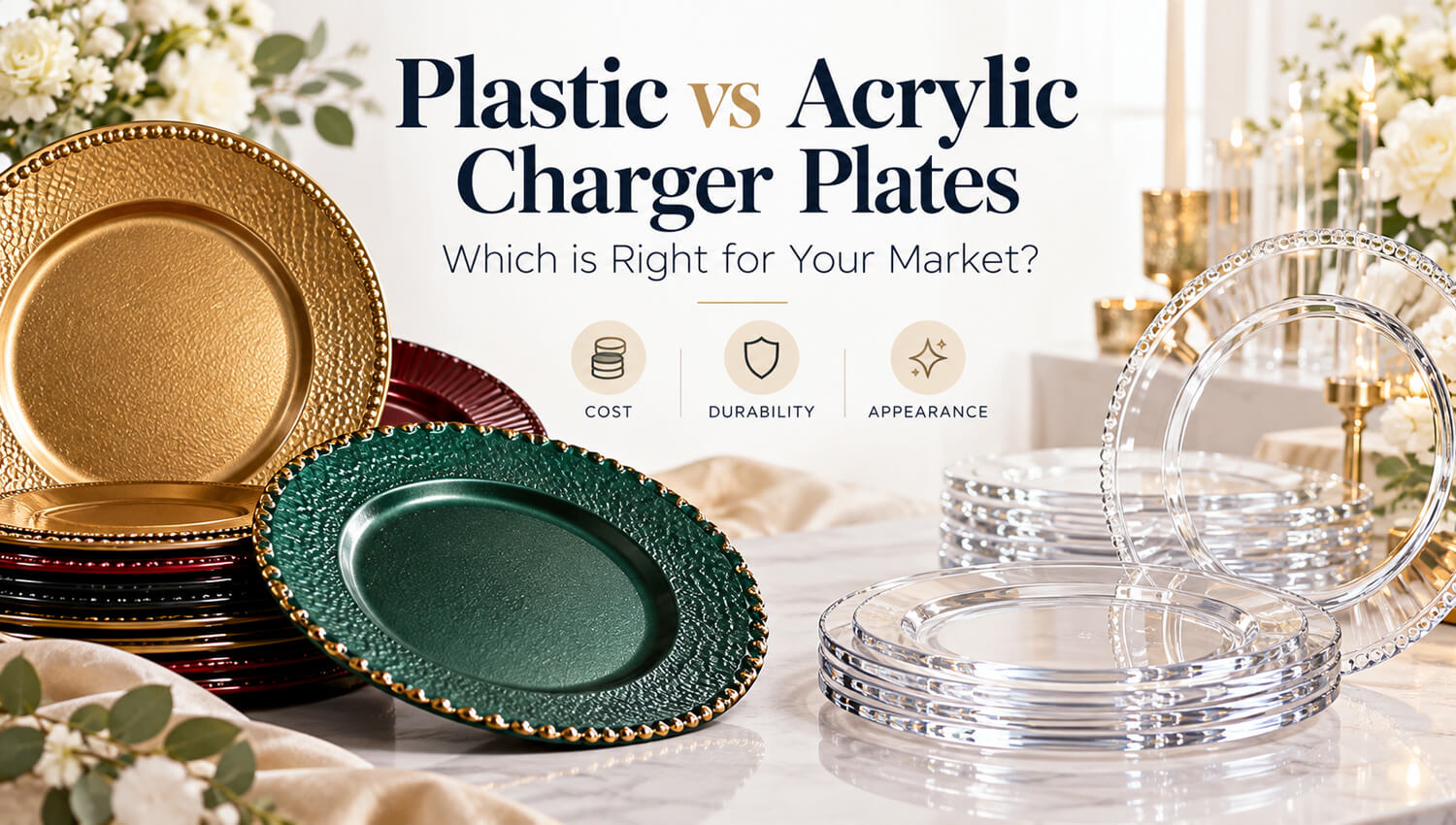
Plastic and acrylic charger plates can both create attractive table settings, but they serve different buying needs. Standard molded plastic chargers usually offer lower cost, easier mass production, lighter shipping weight, and broad design flexibility. Acrylic, normally PMMA, can provide excellent clarity, a more glass-like appearance, and a premium visual effect. However, acrylic is also a type of thermoplastic, so the real buying decision isn’t simply “plastic versus non-plastic.” It is about choosing the right polymer, construction, finish, production method, and price level for your market.
For a buyer, this difference matters. A charger plate may look beautiful in a showroom yet perform poorly after repeated event use. Another design may appear simple but deliver better margins, lower freight costs, and fewer breakage claims.
That’s why purchasing managers should evaluate more than appearance. You need to consider:
- Target retail or wholesale price
- Required visual effect
- Order quantity
- Impact and scratch resistance
- Carton weight
- Private-label requirements
- Packaging method
- Cleaning expectations
- Intended food-contact conditions
- Replacement rate
- Reorder consistency
From a manufacturer’s point of view, the best material is the one that matches the commercial application. A wedding rental company may prioritize reusable appearance and scratch management. A seasonal retailer may care more about attractive finishes and competitive unit cost. A premium décor brand may accept a higher cost for optical clarity and a heavier visual presence.
So, which option should you buy? There isn’t one universal winner. The better choice depends on your product positioning, distribution channel, quality target, and total landed cost.
This guide breaks those factors down from a practical sourcing perspective.
What Are Plastic and Acrylic Charger Plates Made From?
One of the biggest misunderstandings in this category is the word “plastic.”
Acrylic is plastic too.
Acrylic commonly refers to polymethyl methacrylate, or PMMA, which is a thermoplastic material. Published technical data for PMMA shows a density of about 1.19–1.20 g/cm³, while exact mechanical and thermal properties depend on the grade and manufacturing process.
In the charger plate market, however, buyers usually use “plastic charger plate” to mean a conventional molded plate made from a lower-cost resin system. The exact polymer should always be confirmed with the supplier rather than assumed from a product title.
That distinction is important.
A buyer might send an RFQ saying:
“We need 20,000 plastic charger plates.”
That request doesn’t tell the factory enough.
A professional quotation should eventually define the resin or agreed performance requirement, dimensions, plate weight, surface decoration, packaging, and intended use.
Why does the resin matter?
Different polymers behave differently during molding, decoration, storage, cleaning, and transport. The resin also affects:
- Qattiqlik
- Ta'sir samaradorligi
- Surface hardness
- Ochiqlik
- Og'irlik
- Issiqlik xulq-atvori
- Coloring
- Qoplama yopishishi
- Mold flow
- Tsikl vaqti
- Final product cost
For transparent products, PMMA is often chosen because of its optical qualities. For decorative mass-market charger plates, another moldable resin may provide a better commercial balance.
This is why buyers shouldn’t approve a project from photographs alone.
Ask the manufacturer to specify the material on the quotation, sample approval sheet, or product specification. If a particular material grade is important to your compliance program, require supporting documentation as well.
The material name is only the beginning. The product’s real performance also depends on wall thickness, rib design, rim structure, additives, pigments, coatings, and manufacturing control.
Appearance, Clarity, Finish, and Premium Presentation
Appearance is often the first reason buyers compare standard molded chargers with acrylic models.
Acrylic can create a clean, transparent, crystal-like presentation. This is especially attractive for weddings, luxury events, modern restaurants, photography styling, and premium home décor collections.
Clear acrylic also allows designers to work with visual depth.
Possible concepts include:
- Clear bodies with colored rims
- Transparent tinted plates
- Embedded-looking decorative effects
- Frosted surfaces
- Bosma naqshlar
- Gold-edged designs
- Minimalist transparent styles
- Geometric or contemporary shapes
Standard decorative plastic chargers can compete differently. They are especially effective when the project depends on surface decoration instead of optical transparency.
For example, molded products can be designed with:
| Visual Direction | Typical Commercial Appeal |
|---|---|
| Metallic gold | Weddings, banquets, Christmas collections |
| Metallic silver | Hotels, events, modern dining |
| Antik pardoz | Vintage weddings and rustic décor |
| Wood-look surface | Farmhouse and outdoor themes |
| Urib ishlangan tekstura | Premium decorative collections |
| Marjonli chet | Traditional weddings and banquets |
| Marble effect | Home décor and contemporary events |
| Solid colors | Seasonal or brand-specific ranges |
For importers, the question isn’t simply which material looks more expensive.
You should ask which material delivers the required look reliably at your selling price.
Acrylic’s clarity may create a strong premium impression, but a well-designed injection-molded charger with controlled metallic finishing can also look highly decorative.
Finish consistency becomes especially important in repeat orders.
A buyer should approve more than a master color chip. It is wise to define acceptable differences for color, gloss, metallic appearance, pattern placement, and visible defects.
For gold, silver, antique, or other decorated products, inspect samples under more than one lighting condition. Metallic surfaces can look very different under warehouse lighting, daylight, and warm event lighting.
That small step can prevent large disputes later.
Durability, Impact Resistance, Scratches, and Breakage Risk
“Which one is stronger?” sounds like a simple question, but it isn’t.
Strength depends on the polymer grade, wall thickness, plate geometry, process conditions, and how the product is handled.
PMMA is relatively rigid. Technical data from Ensinger, for example, lists a tensile modulus around 3,000–3,300 MPa for an extruded acrylic sheet product. The same technical sheet reports comparatively limited elongation at break. Those values describe that particular material product rather than every charger plate, but they illustrate why acrylic behaves differently from tougher, more flexible polymers.
For buyers, a more useful approach is to think about the failure mode.
Acrylic-related concerns may include
- Edge chipping after hard impact
- Cracking when dropped
- Visible scratching on clear surfaces
- Stress around thin decorative areas
- Higher rejection impact when premium appearance is required
Conventional molded plastic concerns may include
- Warping when the structure is too thin
- Surface scratching
- Coating wear
- Rim deformation
- Color variation
- Brittleness when unsuitable resin or processing is used
A thicker plate isn’t automatically better either.
Extra weight raises material use and freight cost. Poorly designed thickness can also create molding problems. Good product engineering balances stiffness and weight through the rim profile, underside ribs, wall thickness, and overall shape.
For reusable event products, we recommend testing the finished design rather than judging durability from the resin name.
A practical pre-production evaluation can include repeated stacking, unpacking, hand washing, wiping, normal table use, and controlled drop or impact checks.
If you operate a rental business, calculate replacement rate as part of the cost.
A charger that costs 15% more but lasts much longer may offer better economics. In another market, a lower-cost decorative item with rapid seasonal turnover may make more sense.
Durability is therefore a business calculation, not just a material specification.
Weight, Handling, Packing, and International Shipping
International buyers sometimes spend hours negotiating a few cents from the unit price while ignoring packaging and freight.
That can be an expensive mistake.
Charger plates are relatively large compared with their selling price. Diameter, stack height, carton quantity, protection materials, and plate weight can significantly affect logistics.
Acrylic’s density is approximately 1.2 g/cm³ according to published PMMA property references. But a finished acrylic charger isn’t automatically heavier than every other plastic charger. Final weight still depends on dimensions and thickness.
For B2B purchasing, compare the Tayyor mahsulot, not resin density alone.
Ask for:
- Net weight per piece
- Gross weight per carton
- Pieces per inner carton
- Asosiy karton qutiga tushadigan dona soni
- Master carton dimensions
- Cubic volume
- Pallet configuration where needed
- Container loading estimate
- Protective packaging materials
This is especially important for e-commerce sellers.
A retail product may survive bulk ocean transport but still fail parcel-delivery testing. Individual online orders face drops, corners, vibration, compression, and repeated sorting.
A wholesale event distributor has a different problem. Its staff may unpack, stack, transport, and repack chargers hundreds of times.
Packaging design should therefore follow the sales channel.
Simple logistics comparison
| Omil | Standard Molded Plastic | Acrylic / PMMA |
|---|---|---|
| Lightweight designs | Excellent potential | Possible, design dependent |
| Dense premium feel | Mumkin | Often attractive |
| Scratch visibility | Finish dependent | High concern on clear surfaces |
| Impact sensitivity | Resin/design dependent | Requires careful evaluation |
| Bulk stacking | Usually efficient | Usually efficient with correct design |
| Protective packing | Moderate to high | Often worth extra attention |
Don’t request excessive protective material by default. More packaging increases cost and carton volume.
Instead, work with the supplier to find the minimum packaging system that passes your actual distribution requirements.
Plastic vs Acrylic Charger Plates Cost, MOQ, and Tooling
For most importers, price eventually becomes the deciding factor.
Standard injection-molded decorative plates are often attractive for larger-volume commercial programs because the production process can deliver repeatable geometry efficiently after tooling is completed.
Acrylic products may carry a premium depending on material, production method, thickness, edge treatment, decoration, and order volume.
But asking, “What is the acrylic price?” is still too broad.
Your total purchase cost may include:
- Resin
- Color masterbatch
- Injection molding or fabrication
- Yuzani yakunlash
- Printing
- Metallik qoplama
- Logo application
- Mold or tooling
- Inner packaging
- Export cartons
- Tekshiruv
- Testing
- Pallets
- Yuk
Illustrative buyer decision chart
| Xarid omili | Molded Plastic | Akril |
|---|---|---|
| Cost-sensitive mass market | Besh yulduz | Uch yulduz |
| Premium transparent look | Uch yulduz | Besh yulduz |
| High-volume molded shapes | Besh yulduz | To'rt yulduz |
| Low freight weight target | To'rt yulduz | Uch yulduz |
| Luxury visual positioning | To'rt yulduz | Besh yulduz |
| Broad decorative finishes | Besh yulduz | To'rt yulduz |
These ratings are commercial guidelines, not material specifications.
MOQ also changes with customization.
A factory may support a relatively small quantity for an existing mold and standard finish. A unique shape requiring new tooling is different. Custom colors, special coating batches, branded boxes, or printed packaging can each introduce their own minimum production quantity.
That’s why professional buyers should ask for two quotations when developing a new collection:
Existing mold option: lower development risk and faster market testing.
Custom mold option: stronger differentiation but higher upfront investment.
For many new brands, the first route is smarter. Test the market with an existing structure, customize the decoration and packaging, and invest in proprietary tooling after demand becomes clear.
That approach protects cash flow without preventing future product differentiation.
OEM Charger Plates: Colors, Patterns, Logos, and Private Label Options
Customization is where a charger plate project becomes more than a commodity purchase.
Both traditional molded products and acrylic designs can support customization, but the available techniques depend on the material and surface.
A B2B buyer may request:
- Custom diameter
- Unique rim pattern
- Customer-owned mold
- Pantone-matched color
- Transparent tint
- Metallik oltin yoki kumush pardoz
- Antik pardoz
- Matte surface
- Gloss finish
- Marble pattern
- Logotip bosib chiqarish
- Brand stickers
- Shtrixkod yorliqlari
- Color boxes
- Private-label cartons
- Retail-ready packaging
The strongest OEM projects start with the market position rather than the decoration process.
Suppose your customer wants a premium wedding charger for rental companies. Scratch appearance, stackability, edge durability, and replacement consistency may matter more than achieving the lowest cost.
Now consider a seasonal supermarket collection. Here, competitive pricing, carton utilization, retail packaging, visual impact, and fast replenishment may dominate the specification.
Those are different products even if both are 13-inch gold chargers.
A good OEM development brief should include
Maqsadli bozor: retail, rental, hospitality, wholesale, or e-commerce.
Target selling price: this helps the factory engineer toward a realistic specification.
Annual volume: tooling decisions depend heavily on expected quantity.
Reference appearance: photos or physical samples reduce misunderstandings.
Critical dimensions: outside diameter, usable center area, rim width, and height.
Branding: logo location, packaging artwork, barcode, carton marks, and labels.
Performance expectations: scratch tolerance, reusable cycles, cleaning method, and transport environment.
From manufacturing experience, unclear product briefs create more problems than demanding specifications.
The more accurately the buyer defines the commercial application, the easier it becomes for the manufacturer to recommend a workable material, production method, and finish.
That saves development time on both sides.
Injection Molding vs Acrylic Fabrication and Production Control
Material selection cannot be separated from manufacturing method.
Many decorative plastic charger plates are produced through injection molding. Plastic resin is heated, injected into a mold, cooled, and ejected as a formed plate.
The mold determines much of the product geometry.
That includes:
- Diametr
- Rim profili
- Decorative relief
- Underside ribs
- Wall distribution
- Bir-birining ustiga qo'yish mumkinligi
- Logotip pozitsiyasi
- Structural details
After molding, the product may move to secondary processes such as painting, plating, spraying, printing, antiquing, or packaging.
Acrylic products can also be molded, while some designs may involve sheet-based fabrication or other forming and finishing methods. Therefore, buyers should not assume that every acrylic charger follows the same process.
What should quality control focus on?
Incoming materials should match the approved specification.
During production, a manufacturer may monitor dimensions, piece weight, molding defects, color, deformation, surface finish, and decoration consistency.
Final inspection can examine:
- Cracks
- Chips
- Chiziqlar
- Black marks
- Oqim belgilari
- Warpage
- Uneven coating
- Paint contamination
- Color difference
- Incorrect labels
- Qadoqlash miqdori
- Karton holati
For custom projects, we strongly recommend creating an approved reference sample before mass production.
The reference should include not just the shape but also the surface treatment and packaging whenever possible.
Photos alone are weaker quality standards because camera settings and lighting alter appearance.
For metallic surfaces, physical approval is particularly useful.
A reliable supplier should also control changes between orders. If the resin, pigment, coating chemistry, tooling condition, or subcontracted finishing process changes, the appearance may change too.
For distributors building a long-term SKU, repeatability can be more valuable than achieving the absolute lowest first-order price.
Food Contact, Decorative Use, Testing, and Buyer Documentation
This area deserves special attention because a charger plate isn’t the same thing as a dinner plate.
A charger usually sits underneath the plate used for serving food. Depending on the intended design and local market, it may function primarily as decorative tableware.
However, never assume that calling a product a “charger” automatically removes every compliance consideration.
For products sold for direct food contact in the United States, FDA requirements depend on the substances involved and their intended conditions of use. FDA explains that substances used in food-contact applications must have an appropriate regulatory basis for that use.
For reference, buyers can review the FDA’s food-contact framework here:
FDA – Understanding How the FDA Regulates Substances That Come Into Contact With Food
This leads to a practical purchasing rule:
Define intended use before requesting compliance claims.
Tell your manufacturer:
- Whether food will directly touch the charger
- Whether the plate is decorative only
- Target country
- Expected temperature
- Cleaning method
- Whether microwave use is expected
- Whether dishwasher use is expected
- Which specific regulation or customer protocol applies
Do not accept vague phrases such as “FDA approved” without understanding what material, test, or intended use the statement covers.
Also consider coatings.
A base polymer and a decorative surface treatment are not necessarily the same compliance question. Metallic paint, printing ink, lacquer, or other finishing materials may need separate evaluation depending on intended exposure.
For B2B sourcing, request documentation relevant to your actual product specification, not a generic certificate from an unrelated material.
That makes your compliance file far more defensible.
Reusable Tableware, Service Life, Recycling, and Packaging Choices
Sustainability claims should be specific.
Simply describing one material as “eco-friendly” tells buyers very little.
A more useful evaluation looks at material consumption, service life, replacement frequency, packaging, shipping, reuse, and local end-of-life infrastructure.
For example, a reusable charger that survives many event cycles may use more material initially but perform well on a per-use basis.
A lightweight plate may consume less resin and reduce freight weight, yet it still needs enough structural strength to avoid early replacement.
This creates an engineering balance.
Questions worth asking
- Can the product be reused?
- How should it be cleaned?
- What causes most failures?
- Can damaged pieces be economically replaced?
- Is excessive packaging being used?
- Karton o'lchamlarini optimallashtirish mumkinmi?
- Can virgin material use be reduced without damaging performance?
- Is the resin accepted by recycling systems in the destination market?
- Are mixed coatings or decorations likely to affect recyclability?
Acrylic is technically recyclable, but real-world collection and recycling access differ by market. The same issue applies to many other plastics.
Therefore, avoid unsupported environmental claims.
For brands, a more credible statement may be:
“Designed for repeated decorative use when handled according to care instructions.”
That’s more meaningful than calling an item “green” without evidence.
Packaging offers another practical improvement.
A manufacturer and importer can often reduce unnecessary plastic bags, oversized cartons, excessive inserts, or inefficient packing arrangements. But packaging reduction should not increase product damage.
One broken shipment can erase the environmental and economic benefits of removing protection.
For B2B buyers, sustainability works best when it becomes part of normal product engineering: less unnecessary material, better packing efficiency, longer practical use, and fewer rejected products.
That approach is measurable and easier to communicate honestly to customers.
Which Charger Plate Material Is Better for Your Business?
The best answer depends on your business model.
If you’re sourcing high-volume decorative chargers for wholesalers, supermarkets, party suppliers, or broad seasonal collections, standard molded plastic is often a strong starting point.
It can offer attractive economics, broad finishing options, and efficient mass production.
If your collection depends heavily on transparency, visual depth, or a premium glass-like aesthetic, PMMA acrylic deserves serious consideration.
Choose conventional molded plastic when you prioritize:
- Competitive unit cost
- Higher-volume production
- Broad decorative finishes
- Metallic colors
- Complex molded rim textures
- Yengil konstruktsiya
- Seasonal product development
- Efficient container loading
Consider acrylic when you prioritize:
- Optical clarity
- Transparent designs
- Modern styling
- Premium visual positioning
- Crystal-like presentation
- Transparent colored effects
- High-end event photography
For buyers caught between the two, sample testing is the fastest answer.
Order representative samples and compare them in the way your customers actually use them.
Place dinnerware on top.
Stack them.
Carry them.
Wash them using the intended process.
Photograph them under event lighting.
Inspect scratching.
Compare carton weights.
Ask your sales team which version buyers prefer.
Then build a simple cost-per-sale or cost-per-use model.
This produces a much better decision than comparing FOB prices alone.
B2B selection matrix
| Xaridor turi | Strong Starting Choice | Main Reason |
|---|---|---|
| Wedding wholesaler | Molded plastic / acrylic | Depends on positioning |
| Event rental company | Test both | Service life is critical |
| Luxury event brand | Acrylic or premium decorated plastic | Ko'rinish |
| Mass retailer | Molded plastic | Cost and volume |
| E-commerce décor seller | Test both | Parcel durability matters |
| Private-label brand | Molded custom design | Strong OEM flexibility |
| Clear-tableware collection | Akril | Optical appearance |
Ultimately, your material should follow your market—not the other way around.
What B2B Buyers Should Ask a Charger Plate Manufacturer
A good RFQ can eliminate weeks of unnecessary emails.
Instead of asking only, “What is your price for charger plates?”, send a structured specification.
Start with the basics:
- Mahsulot diametri
- Preferred material
- Target weight if known
- Rang
- Yuzaning silliqligi
- Nusxa
- Estimated order quantity
- Annual purchasing volume
- Maqsadli bozor
- Qadoqlash talablari
- Logotipga qo'yiladigan talablar
- Compliance requirements
- Delivery destination
Then ask the supplier to complete the missing technical details.
Recommended supplier checklist
| Banda | What the Buyer Should Confirm |
|---|---|
| Material | Polymer/resin specification |
| O'lcham | Diameter, height, rim dimensions |
| Og'irlik | Net weight per piece |
| Yakunlash | Paint, coating, printing, plating, texture |
| Eng kam buyurtma miqdori | Existing design vs custom project |
| Tooling | Existing mold or new mold |
| Sampling | Sample cost and production method |
| Qadoqlash | Pieces/carton and carton dimensions |
| QC | Inspection points and defect criteria |
| Branding | Logo, label, barcode, retail box |
| Testing | Required according to intended use |
| Lead time | Sample and mass-production schedule |
Before placing a large order, approve a pre-production sample.
For a major customized program, also confirm how quality will be controlled if production runs across several batches.
This is especially important for metallic finishes.
If you sell products as a coordinated collection, send the factory the related SKUs. Gold tones that look acceptable separately may appear noticeably different when displayed together.
Finally, don’t evaluate a manufacturer on price alone.
Communication quality during development often predicts what will happen during production.
A supplier that clearly identifies technical limits, asks questions about intended use, and documents specifications may provide more value than a supplier that simply says “yes” to every request.
Tez-tez so'raladigan savollar
Are acrylic charger plates actually plastic?
Yes. Acrylic normally refers to PMMA, or polymethyl methacrylate, which is a thermoplastic polymer. In commercial tableware discussions, “plastic charger” usually refers to other molded plastic constructions, while “acrylic” identifies PMMA more specifically.
Are acrylic charger plates better than plastic charger plates?
Not automatically. Acrylic can offer excellent transparency and a premium appearance. Conventional molded plastic may provide lower cost, lighter construction, broad decoration options, and strong mass-production efficiency. Your sales channel should determine the choice.
Which charger plate is better for weddings?
Both can work well. Acrylic is attractive for clear, modern, or luxury wedding themes. Molded decorative plastic is especially suitable for metallic gold, silver, antique, beaded, hammered, and other traditional banquet styles.
Which type is more economical for wholesale orders?
Standard injection-molded plastic usually deserves consideration for cost-sensitive, higher-volume wholesale programs. However, buyers should compare tooling, decoration, carton volume, freight, defects, and replacement costs rather than relying only on unit price.
Can a charger plate manufacturer make a custom shape?
Yes, provided the shape is practical for the chosen manufacturing process. A custom injection-molded design normally requires tooling. Buyers should provide drawings, dimensions, reference images, target quantities, and expected annual volume before requesting a mold quotation.
Can I add my logo to charger plates?
Usually yes. Possible branding methods can include printing, molded branding, stickers, packaging labels, or branded retail boxes. The correct method depends on the material, surface finish, logo position, order quantity, and durability requirement.
Are plastic charger plates food safe?
That cannot be answered from the word “plastic” alone. Food-contact suitability depends on the specific material, additives, coatings, intended conditions of use, and destination regulations. Buyers should define direct-food-contact requirements before testing or certification.
Can charger plates go in a dishwasher or microwave?
Do not assume they can. Cleaning and heat resistance depend on the resin, decoration, coating, and finished construction. Buyers should request written care instructions and validate the finished product under intended conditions before making such claims.
Conclusion: Making the Right Decision
The most important lesson from this Plastik va akril garnitur tovoqlari: to'liq solishtirish is that material selection should support your commercial strategy.
Acrylic, usually PMMA, is itself a plastic. It stands out because it can provide strong optical clarity, rigidity, and a premium transparent appearance. Standard molded plastic charger plates can offer different advantages, including competitive cost, flexible decoration, efficient production, and lighter designs.
Neither material wins every application.
An importer selling large seasonal collections may favor molded decorative products. A luxury wedding brand may value acrylic’s visual clarity. A rental business should focus on real service life. An e-commerce brand needs to consider parcel damage and replacement costs.
Before ordering, compare the full package:
- Material
- Finished weight
- Ko'rinish
- Impact behavior
- Scratch visibility
- Bozor bezagi
- Eng kam buyurtma miqdori
- Tooling
- Qadoqlash
- Yuk
- Intended use
- Compliance documentation
- Replacement cost
Most importantly, test the actual finished product.
A resin data sheet can help engineers understand the material, but your customer buys a charger plate—not a polymer pellet. Shape, thickness, molding quality, coating, packaging, and quality control all influence the final result.
For OEM or private-label development, send your manufacturer your target diameter, reference design, finish, quantity, destination market, packaging requirement, and intended use. A detailed RFQ makes it much easier to recommend the correct material and production solution.
NOTE: Send us your charger plate reference photos, dimensions, required finish, expected order quantity, and packaging requirements. Our manufacturing team can evaluate the project and prepare a suitable OEM/ODM production proposal.