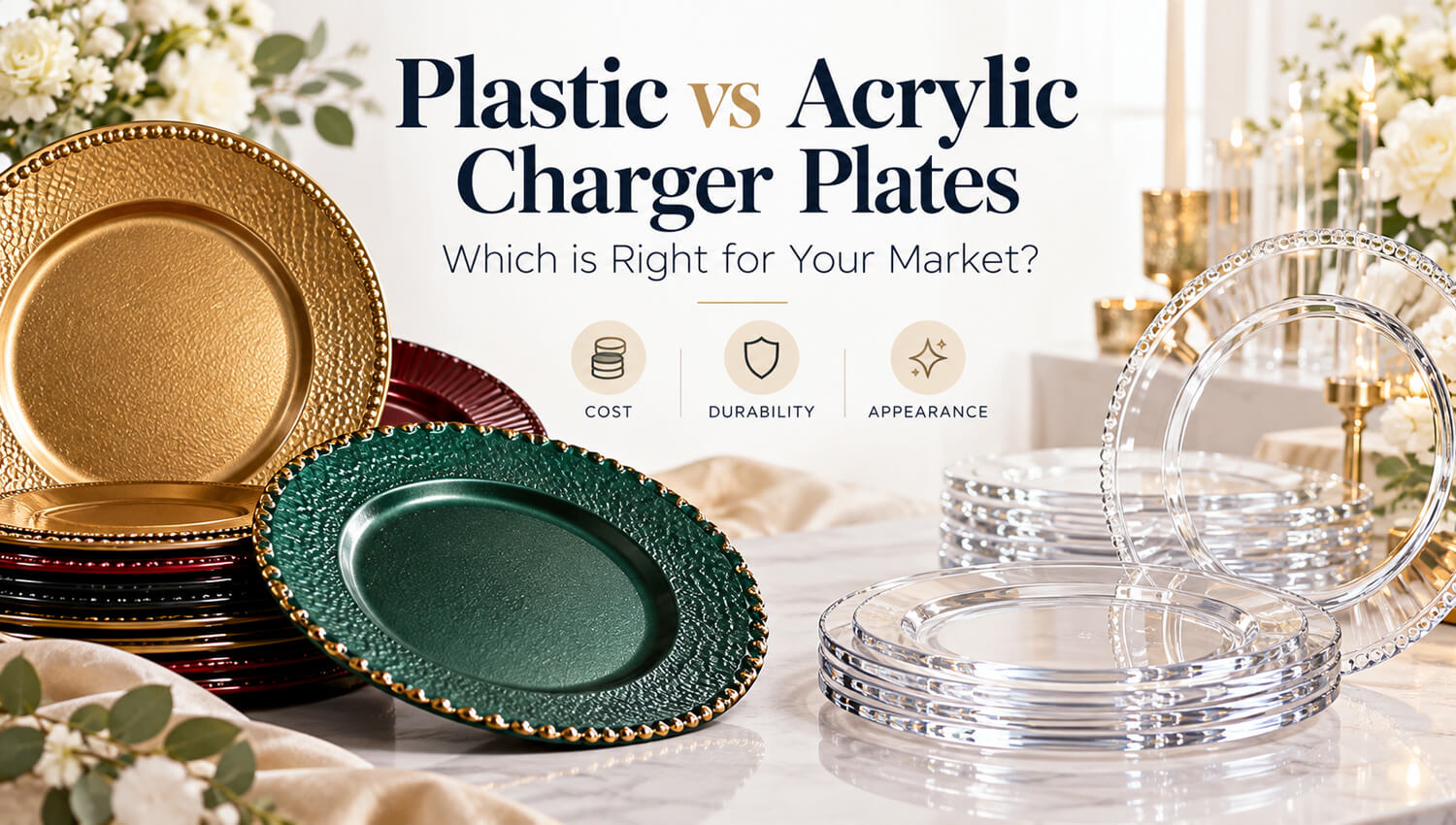
Charger plates are large decorative plates placed beneath dinnerware to improve table presentation, define each place setting, and protect the table surface. They are widely used at weddings, hotels, restaurants, banquets, and catering events.
For B2B buyers, choosing the right charger plate involves more than appearance. Size, material, weight, finish, durability, stackability, packaging, and customization all affect product performance and total purchasing cost.
A well-designed charger plate should look attractive, fit common dinnerware sizes, withstand repeated handling, and ship efficiently. Understanding how charger plates are actually used helps importers, wholesalers, rental companies, and hospitality buyers select products that better match their customers and markets.
What Are Charger Plates Used For?
The simplest answer is that charger plates are decorative base plates placed beneath regular dinnerware. They create a finished place setting while supporting the plates used throughout the meal.
In traditional formal dining, a charger is also called a service plate or underplate. Emily Post’s formal place-setting guidance explains that a service plate can remain underneath plates used for early courses and is normally exchanged when the entrée is served.
In modern hospitality and event decoration, charger plates serve several practical purposes:
- Creating a decorative foundation for dinnerware
- Defining each guest’s individual place setting
- Adding color, texture, and dimension to a tablescape
- Protecting tablecloths from minor spills and plate contact
- Supporting salad, soup, appetizer, or dinner plates
- Coordinating dinnerware with an event theme
- Making banquet tables appear more complete before food arrives
For B2B customers, the decorative function is often just as important as the traditional dining function.
Wedding planners may choose gold-rimmed chargers for luxury receptions. Hotels may use neutral designs that work with several tablecloth colors. Restaurants may select understated finishes that support their branding.
Rental companies often take another approach. They need styles that are attractive but broad enough to work across dozens of events.
This is why one charger plate design can serve very different commercial markets.
The key point is simple: a charger plate isn’t normally the plate from which the main meal is eaten. Its main purpose is to provide a decorative and functional foundation beneath the actual food-service plate.
How Charger Plates Improve Table Presentation and Guest Experience
One of the strongest reasons for using charger plates is visual presentation.
A dinner plate placed directly on a large table can sometimes appear isolated. Adding a wider charger underneath creates another visual layer. That additional layer gives the table setting more depth and creates a clear boundary around each guest’s place.
This matters greatly in hospitality.
Imagine a wedding table with white linen, clear glasses, silver flatware, and white dinner plates. Everything may be high quality, yet the overall setting can still feel flat.
Place a textured gold charger underneath the plate and the effect changes immediately.
Now the dinnerware has contrast.
The place setting looks more intentional.
The charger can also connect other decorative elements. Gold chargers may coordinate with candle holders. Black plates can complement modern flatware. Wood-look designs may suit rustic weddings. Transparent chargers work well with patterned tablecloths because they don’t hide the linen.
Professional table styling often relies on this type of layering. Architectural Digest’s table-setting guidance also includes chargers as part of a formal layered place setting.
From a buyer’s perspective, this means charger plates aren’t simply another piece of tableware.
They are part of the visual design system of the table.
That creates several merchandising opportunities.
A distributor can build collections around themes such as:
- Classic wedding
- Modern luxury
- Rustic dining
- Christmas banquet
- Mediterranean dining
- Minimalist hospitality
- Outdoor celebration

Matching colors and finishes helps your customers build complete tablescapes.
For manufacturers, this also creates opportunities to develop product series rather than individual SKUs.
A buyer may begin with one gold charger but later request matching silver, black, champagne, rose gold, or transparent versions.
That makes charger plates a surprisingly flexible category for B2B tableware programs.
Where Are Charger Plates Commonly Used?
Charger plates are most useful in environments where presentation matters and tables need to look finished before or during service.
Their commercial applications extend far beyond formal household dinners.
Weddings and Event Venues
Weddings are one of the largest application areas.
Chargers create an immediate visual effect because hundreds may appear in the same room. Wedding planners can coordinate them with flowers, linens, chairs, centerpieces, and cutlery.
Popular styles include gold, silver, clear, pearl, vintage, beaded, hammered, and metallic finishes.
Hotels and Banquet Halls
Hotels need versatile tableware that works for conferences, banquets, weddings, gala dinners, and private events.
Durability becomes especially important here.
Products may be placed, removed, washed, stacked, transported, and stored repeatedly.
Restaurants
Some restaurants use chargers to reinforce their visual identity.
Fine-dining venues may choose understated designs. Theme restaurants may prefer bold colors or unusual textures.
Catering Companies
Caterers often move tableware between venues. Lightweight products can therefore offer an operational advantage.
Plastic charger plates are popular in this market because they can provide an elegant appearance without the weight and breakage risk associated with some glass products.

Party Rental Businesses
Rental companies have different priorities.
They usually want:
- Broadly appealing designs
- Strong construction
- Good stacking
- Easy cleaning
- Low breakage
- Repeat-use potential
- Replaceable styles
Wholesale and Retail Programs
Importers may sell charger plates to home décor stores, wedding suppliers, hospitality distributors, online sellers, and event wholesalers.
The same product category can therefore support several sales channels.
| Buyer Type | Main Charger Plate Requirement | Buying Priority |
| Hotels | Repeated banquet use | Durability |
| Wedding planners | Strong visual impact | Design |
| Caterers | Easy transport | Lightweight construction |
| Rental companies | Repeated handling | Strength and stackability |
| Wholesalers | Broad customer appeal | Price/design balance |
| Private-label brands | Differentiation | Customization |
| Restaurants | Brand consistency | Style and reliability |
Charger Plate vs Dinner Plate vs Placemat
Charger plates, dinner plates, and placemats can appear in the same table setting, but they don’t perform the same job.
Understanding the difference is especially important when developing product descriptions or educating wholesale customers.
| Feature | Charger Plate | Dinner Plate | Placemat |
| Main purpose | Decorative underplate | Holds food | Protects/decorates table |
| Position | Under dinnerware | Above charger | Directly on table |
| Typical size | Larger than dinner plate | Medium | Larger surface area |
| Food placed directly on it | Usually no | Yes | No |
| Decorative importance | High | Medium to high | High |
| Common materials | Plastic, glass, metal, wood | Ceramic, porcelain, glass | Fabric, PVC, paper, woven material |
| Formal table setting | Common | Essential | Optional |
The biggest misunderstanding concerns food.
A regular dinner plate is designed specifically to hold a meal.
A decorative charger may not be.
Some charger products are manufactured only as decorative table accessories. Their paints, coatings, metallic finishes, or surface treatments may not have been designed or evaluated for direct food contact.
That is why suppliers should clearly communicate intended use.
Placemats are different again.
A placemat normally sits directly on the table. The charger can then sit on top of it, although many designers use either one or the other.
For B2B buyers, combining these categories can create cross-selling opportunities.
A wedding supply distributor might offer:
Tablecloth → placemat → charger → dinner plate → napkin ring
Each layer contributes to the complete presentation.
This is also useful for product photography. Buyers are often more interested when they can see how one charger design works within a complete table setting rather than viewing the product alone against a white background.
How Charger Plates Support Professional Food Service
Appearance gets most of the attention, but charger plates can also support table organization and service.
Before guests arrive, a charger immediately identifies where each person will sit.
That allows servers and event staff to build evenly spaced place settings.
Napkins, menus, name cards, favors, or starter dishes may then be arranged around or above the charger.
This can be especially helpful at large events.
Imagine a banquet hall preparing 500 seats.
Small inconsistencies become highly visible across that many tables. Chargers create a clear visual reference point for each place setting. This makes it easier to position glasses, cutlery, and chairs consistently.
They may also provide limited protection between dinnerware and table linens.
A broad charger can catch small crumbs, condensation, or light spills around a smaller plate. It can also reduce direct contact between warm serving plates and tablecloths.
However, chargers shouldn’t be treated as heavy-duty heat protection unless the manufacturer specifically confirms that application.
Traditional formal etiquette provides another useful guideline.
The charger can remain in place beneath plates for early courses. It is generally removed before or when the main entrée plate arrives, depending on the style of service. Emily Post describes this traditional service-plate arrangement clearly.
Modern events are often more flexible.
Some venues keep chargers throughout much of the meal because they are part of the decoration. Others remove them earlier to create more space.
For professional buyers, therefore, the best product isn’t determined only by etiquette.
It also depends on:
- Serving style
- Table size
- Dinnerware diameter
- Number of courses
- Venue workflow
- Storage space
- Event design
That practical perspective is important when selecting products for hospitality customers.
Popular Charger Plate Materials and Finishes
Material choice affects appearance, weight, cost, durability, shipping, and customer positioning.
There is no single material that fits every market.
Plastic Charger Plates
Plastic is widely chosen for event, wholesale, catering, and rental applications.
Its main advantages include:
- Lower weight
- Lower breakage risk
- Wide design flexibility
- Many color options
- Different surface textures
- Efficient mass production
- Easier international shipping compared with many heavy alternatives
Plastic molding can also reproduce decorative patterns such as beads, hammered textures, waves, geometric rims, flowers, or vintage-inspired borders.
Glass Charger Plates
Glass provides a heavier and often more premium feel.
Clear glass also allows the table linen underneath to remain visible.
Its disadvantages are predictable: increased shipping weight and greater breakage risk.
Metal Charger Plates
Metal products can offer strong durability and a distinctive appearance.
However, they are usually heavier and may sit at a different price point.
Wood and Wood-Look Chargers
Wood-style designs suit rustic events, outdoor weddings, country themes, and natural tablescapes.
Some products use actual wood. Others reproduce a wood appearance using molded or printed materials.
Common Decorative Finishes
Buyers may encounter:
- Glossy gold
- Matte gold
- Champagne gold
- Silver
- Rose gold
- Black
- White
- Transparent
- Pearl
- Mirror effect
- Metallic paint
- Antique finish
- Hammered texture
- Beaded rim
For wholesale programs, color consistency matters more than many first-time buyers expect.
A small shade difference may seem insignificant when examining one sample. Put 200 pieces together at a banquet, however, and inconsistent batches become much easier to notice.
That is why production samples and approved color standards can be useful when developing long-term OEM programs.
How to Use Charger Plates Correctly at the Table
Using charger plates is straightforward once you understand their role.
Start by positioning one charger in the center of every place setting.
The plate should align with the chair so that the complete table looks balanced.
A dinner plate, appetizer plate, soup bowl, or salad plate can then be placed above it depending on the menu.
Typical Table Arrangement
A basic sequence may look like this:
Table → Charger Plate → Dinnerware → Napkin or Menu
Cutlery sits beside the charger rather than on top of its rim.
Glassware is normally positioned above and to the right.
A name card can sit above the setting or directly on the top plate.
For formal dining, the traditional approach uses the charger as the service plate beneath earlier courses. The charger is then removed when the main dinner plate is served.
For weddings and modern banquet styling, rules can be more flexible.
Some venues place the dinner plate directly on the charger before guests arrive.
Others put only a napkin, menu, or decorative card on top.
Buffet events may leave the charger at each seat while guests collect their dinner plates elsewhere.
A Practical Event Setup
For a 10-seat round wedding table:
- Place ten chargers evenly around the table.
- Confirm adequate space between guests.
- Center each charger with the chair.
- Arrange flatware around the charger.
- Add glassware.
- Place napkins or menus on top.
- Check that the centerpiece doesn’t interfere with the settings.
Simple? Yes.
Yet consistent spacing has a big effect when the same arrangement appears across twenty or fifty tables.
This is one reason charger plates have become such useful tools for professional event styling.
What B2B Buyers Should Check Before Ordering Charger Plates
Wholesale sourcing requires more than choosing a good-looking design.
A charger may look excellent in a supplier’s photograph but still create problems during storage, transportation, or repeated use.
Professional buyers should therefore create a product specification before ordering.
Diameter
Charger plates are normally wider than standard dinner plates so the decorative rim remains visible.
Before confirming an order, compare the charger with the dinnerware commonly used by your target customers.
Weight
Weight affects several costs.
Heavier products may feel more substantial, but they also increase carton weight and transportation expenses.
For catering and rental businesses, staff must repeatedly carry large quantities. Product weight therefore affects handling as well.
Stackability
Ask your supplier to show how the plates stack.
Poor nesting can increase:
- Carton size
- Warehouse space
- Shipping volume
- Handling difficulty
A beautiful shape that wastes 30% more carton space can become less attractive commercially.
Surface Durability
Request samples and examine likely contact areas.
Pay attention to:
- Rim scratches
- Coating consistency
- Surface marks
- Paint adhesion
- Decorative edge damage
Packaging
Export packaging should be designed around the product rather than treated as an afterthought.
Common options include:
- Individual polybags
- Tissue protection
- Bubble protection
- Inner boxes
- Dividers
- Master cartons
- Custom retail boxes
- Barcode labels
B2B Buyer Checklist
Before placing a bulk order, confirm:
- Product diameter
- Unit weight
- Material
- Color reference
- Surface finish
- Packing quantity
- Carton dimensions
- Gross weight
- Logo requirements
- Barcode requirements
- Drop-test expectations
- Sample approval
- Production lead time
Soft CTA: If you’re building a wholesale charger plate collection, send your target size, finish, quantity, and packaging requirement to the manufacturer before requesting a final quotation. A detailed specification produces a far more accurate landed-cost comparison.
OEM and Custom Charger Plates for Wholesale Buyers
Customization is one of the main differences between buying existing charger plates and building a long-term private-label product line.
For many overseas buyers, color customization is the easiest starting point.
An existing mold may support several finishes without requiring new tooling.
A buyer might develop the same design in:
- Gold
- Silver
- Champagne
- Black
- White
- Clear
- Seasonal colors
That creates a coordinated product family while reducing development complexity.
More advanced projects may involve a custom rim texture, special mold, embossed logo, printed pattern, label, barcode, or retail package.
Common OEM Requirements
| Custom Item | Typical Buyer Purpose |
| Custom color | Match brand or market trend |
| Custom finish | Build product differentiation |
| New mold | Create exclusive design |
| Logo | Private-label branding |
| Barcode | Retail inventory |
| Color box | Store/e-commerce presentation |
| Carton mark | Warehouse identification |
| Mixed colors | Broader assortment |
From a factory perspective, one important issue is balancing customization with order quantity.
A new mold involves tooling cost.
A special coating may require a minimum production batch.
Printed packaging also has setup requirements.
Buyers can often reduce risk by developing the project in stages.
Start with an existing mold.
Test two or three marketable colors.
Measure customer response.
Then consider exclusive tooling after sales data becomes available.
This approach is particularly useful for importers entering the charger plate category for the first time.
It protects working capital while still allowing brand differentiation.
Once the design proves successful, OEM development can move into custom patterns, exclusive textures, branded packaging, or coordinated decorative tableware collections.
Are Charger Plates Food Safe?
This question requires a careful answer.
Not every charger plate should be treated as a direct-food-contact plate.
Many products are manufactured primarily as decorative underplates. Food is served on a separate dinner plate placed above them.
Decorative paint, metallic coatings, printed surfaces, or other finishes may not have been developed for direct food contact.
Therefore, buyers shouldn’t assume that a charger is food safe simply because it looks similar to ordinary dinnerware.
If your intended product will directly touch food, discuss that requirement with the manufacturer before production.
For the U.S. market, the FDA regulates substances used in materials that come into contact with food. The FDA defines food-contact substances broadly and provides regulatory pathways for relevant materials and applications.
The European Union also maintains specific rules for materials intended to contact food. These requirements are designed to prevent materials from transferring substances to food in ways that may affect safety, composition, taste, or odor.
The exact compliance route depends on the material, formulation, coating, intended use, target market, and contact conditions.
For this reason, B2B buyers should tell the supplier exactly how the product will be marketed.
Ask:
- Is this product decorative only?
- Is direct food contact intended?
- Which raw material is used?
- What coatings or paints are applied?
- What test reports are available?
- Which market were those tests prepared for?
- Does the tested sample match current production?
These questions are far more useful than simply asking, “Is it FDA approved?”
Regulatory requirements can be application-specific, and the documentation should match the intended product and market.
How to Choose a Reliable Charger Plate Manufacturer
A charger plate supplier shouldn’t be evaluated only by unit price.
For B2B buyers, consistency often matters more.
Suppose you order 5,000 gold plates today and another 8,000 six months later. Your customer expects the second shipment to match the first.
That requires process control.
When evaluating a manufacturer, examine several areas.
Product Development Capability
Can the factory support:
- Existing molds
- New mold development
- Color matching
- Surface decoration
- OEM packaging
- Private labels
Factories with several decoration options make it easier to build collections.
Sample Management
A good sampling process establishes an approval reference before mass production.
Confirm:
- Dimensions
- Weight
- Color
- Surface appearance
- Packaging
- Logo position
Keep an approved sample or documented specification whenever possible.
Quality Control
A practical QC process may inspect:
- Raw material
- Molded shape
- Dimensions
- Visible defects
- Color consistency
- Coating appearance
- Packing quantity
- Carton condition
Export Packaging Experience
This is especially important for charger plates with decorative surfaces.
Even plastic products can arrive with scratches when plates rub against each other during ocean freight.
Ask the supplier to explain the protection between individual pieces.
Communication
A professional supplier should ask questions before quoting a complex OEM project.
If you request a custom charger and receive a price without discussing size, weight, finish, packaging, quantity, logo, or destination requirements, the quotation may not be comparable with your real project.
The strongest supplier relationship is built around specifications rather than assumptions.
Frequently Asked Questions About Charger Plates
Can you eat directly from a charger plate?
Usually, you shouldn’t. Many charger plates are designed as decorative underplates rather than direct-food-contact dinnerware. Unless the supplier confirms the material and finish are suitable for food contact, place regular dinnerware above the charger.
Do charger plates stay on the table during dinner?
That depends on the service style. In traditional formal dining, chargers may remain beneath early-course plates and are generally removed when the entrée is served. Modern weddings and banquets may follow more flexible arrangements.
What size should a charger plate be?
A charger should be large enough for its decorative rim to remain visible beneath the dinner plate. B2B buyers should test actual samples with the dinnerware used by their target hotels, caterers, or event customers.
Why do wedding venues use charger plates?
They quickly create visual structure across large tables and help coordinate dinnerware with linens, flowers, flatware, and event colors. They also make every place setting look complete before meal service begins.
Are plastic charger plates suitable for hotels and catering?
They can be an effective option because they are lightweight, decorative, and less vulnerable to breakage than many glass alternatives. Buyers should still evaluate coating durability, stacking performance, cleaning instructions, and repeated-use requirements.
Are charger plates the same as placemats?
No. A placemat normally sits directly on the table and covers a wider area around the dinnerware. A charger is a plate-shaped decorative base positioned immediately beneath the plates used during meal service.
Can charger plates be customized for wholesale orders?
Yes. Depending on the manufacturing process and order quantity, customization may include colors, metallic finishes, patterns, new molds, embossed designs, logos, labels, barcodes, retail boxes, and master-carton markings.
How should importers compare charger plate quotations?
Compare more than the unit price. Check diameter, weight, material, surface treatment, packaging quantity, carton dimensions, customization, testing requirements, MOQ, tooling charges, and shipping volume to understand the true landed cost.
Conclusion: Turning Charger Plates Into a Better Tableware Offering
Charger plates are mainly used to create a decorative base beneath dinnerware, organize place settings, and improve the overall dining presentation. They are especially valuable for weddings, hotels, catering, restaurants, and event rental businesses.
For B2B buyers, the best option should balance design, durability, size, weight, stacking efficiency, packaging, and customization. If direct food contact is required, appropriate material and compliance requirements should also be confirmed.
Before placing a bulk order, define your target market and application clearly. This makes it easier to choose the right material, finish, packaging, and OEM solution.
Looking for wholesale or custom plastic charger plates? Send us your target size, design, color, quantity, and packaging requirements for an OEM/ODM quotation.