When sourcing decorative tableware for the hospitality or retail sectors, selecting the right plastic charger plate material is a critical decision. The chosen material directly dictates the product’s appearance, commercial durability, production costs, and shipping efficiency. Because different buyers prioritize different features—such as event planners seeking lightweight, luxurious finishes versus retailers focusing on high-volume cost-efficiency—understanding the specific strengths of each material is essential to avoid unnecessary expenses.
Fortunately, modern production technologies like electroplating, UV printing, and vacuum metallization allow high-quality plastics to convincingly replicate glass, ceramic, or metal while remaining lighter and easier to transport. This guide explores the most widely used plastic materials, comparing their performance and commercial benefits to help importers, distributors, and brands select products that perfectly align with their market demands and budget goals.
Plastic Charger Plate Material: A Complete Overview
Choosing the right Plastic Charger Plate Material begins with understanding how different plastics perform in real-world commercial environments. While charger plates serve primarily as decorative table accessories, they must also meet demanding requirements for durability, consistency, appearance, and manufacturing efficiency.
Unlike dinner plates, charger plates are designed to enhance table presentation rather than hold food directly during an entire meal. Because they are used repeatedly in restaurants, banquet halls, hotels, and event venues, manufacturers must carefully select materials that combine attractive finishes with reliable performance.
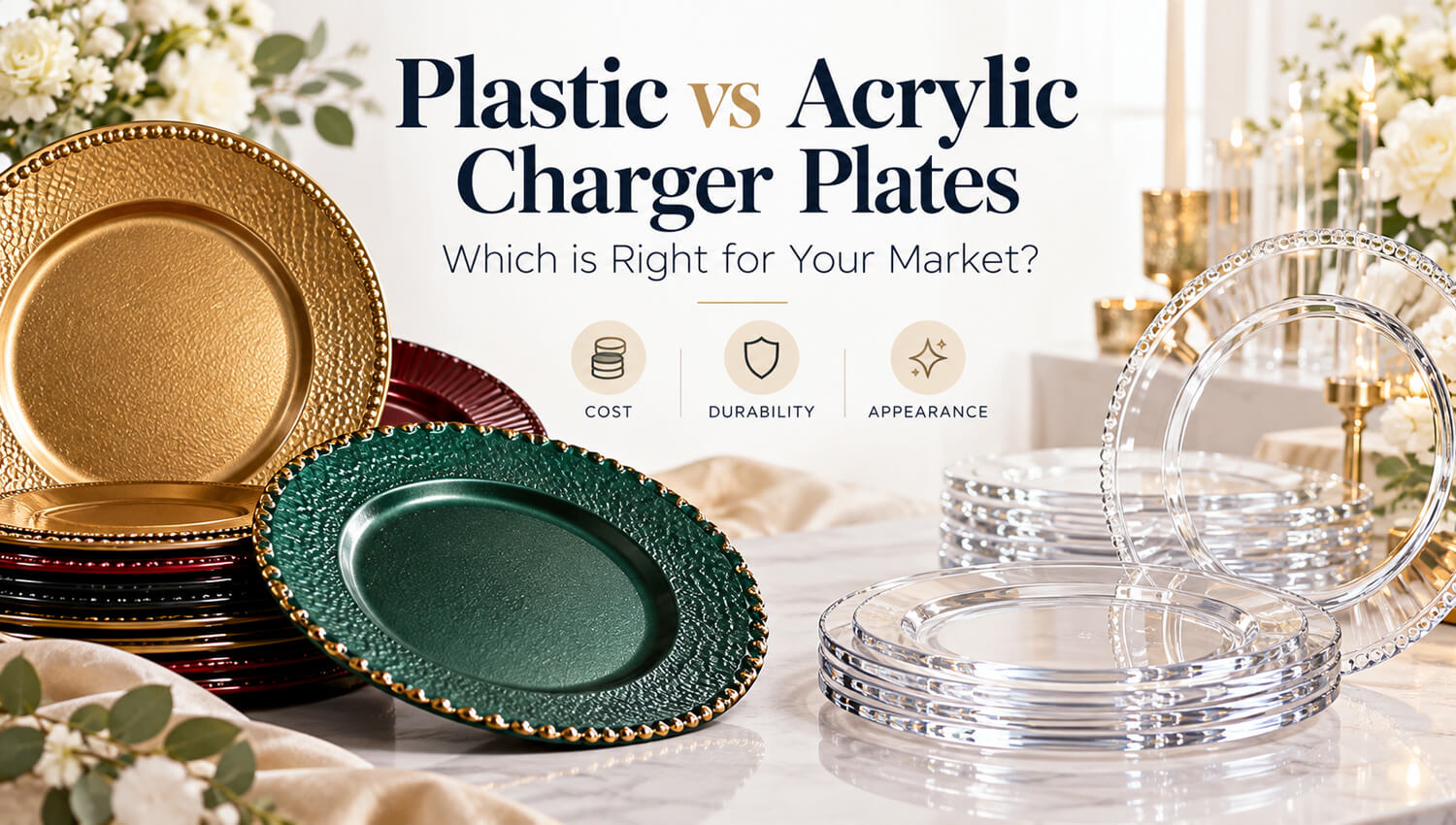
Several plastic materials dominate today’s charger plate industry. Polypropylene (PP), Polystyrene (PS), Acrylic (PMMA), PET, RPET, and ABS each offer distinct benefits depending on customer requirements.
The table below summarizes their primary characteristics.
| Material | Appearance | Durability | Cost Level | Typical Applications |
|---|---|---|---|---|
| PP | Smooth | High | Low | Restaurants, wholesale |
| PS | High gloss | Medium | Low | Wedding décor, retail |
| Acrylic | Crystal clear | High | Premium | Luxury hotels |
| PET | Transparent | Medium | Medium | Disposable premium collections |
| RPET | Similar to PET | Medium | Medium | Sustainable product lines |
| ABS | Premium finish | Very High | Higher | Commercial hospitality |
Material selection influences many aspects of production, including molding speed, decorative coating adhesion, scratch resistance, shipping weight, and manufacturing cost. Even two charger plates with the same design can perform very differently if they are made from different plastics.
For example, PP is known for excellent toughness and flexibility, making it less likely to crack during transportation. PS offers outstanding surface gloss and crisp decorative details but is slightly more brittle. Acrylic creates a luxurious glass-like appearance, while ABS provides excellent impact resistance for commercial applications.
Manufacturing processes also vary depending on material properties. Some plastics accept electroplating more easily, while others produce superior embossed patterns or metallic coatings. Experienced manufacturers select production methods that maximize the advantages of each material while maintaining consistent quality throughout large production runs.
From a B2B perspective, buyers should evaluate more than just appearance. Questions about production capacity, quality control, compliance certifications, recyclability, customization options, and packaging all play important roles when selecting a reliable supplier.
Ultimately, understanding plastic materials helps you purchase charger plates that not only look attractive but also reduce logistics costs, improve customer satisfaction, and strengthen your competitive position in the hospitality and tableware market.
Polypropylene (PP) Charger Plates
Polypropylene, commonly referred to as PP, is one of the most widely used materials in decorative tableware manufacturing. It has earned a strong reputation among manufacturers, wholesalers, and hospitality businesses because it offers an excellent balance of durability, affordability, and production efficiency.
PP is a thermoplastic polymer that performs exceptionally well during injection molding. It flows smoothly into precision molds, allowing manufacturers to produce charger plates with consistent dimensions, clean edges, and detailed decorative features. This manufacturing efficiency helps reduce production costs while maintaining stable product quality across large orders.
One of PP’s greatest advantages is its toughness. Unlike more brittle plastics, polypropylene resists cracking when dropped or subjected to normal commercial handling. This makes PP charger plates particularly suitable for banquet halls, hotels, catering companies, and rental businesses where products are frequently transported, stacked, cleaned, and reused.
Key advantages of PP charger plates include:
- Lightweight for lower shipping costs
- Excellent impact resistance
- Good flexibility
- Cost-effective mass production
- Recyclable material
- Consistent injection molding performance
- Wide color customization options
Manufacturers can decorate PP charger plates using a variety of finishing techniques, including:
- Vacuum metallization
- UV printing
- Metallic spray coating
- Marble-effect printing
- Hot stamping
- Embossed decorative textures
Because polypropylene accepts pigments well, factories can match nearly any Pantone color requested by OEM customers. This flexibility allows private-label brands to develop exclusive collections tailored to different market segments.
For international buyers, PP also provides logistics advantages. Its low density keeps product weight down, allowing more units to fit into each shipping container while reducing freight costs. Strong stacking performance further minimizes packaging damage during transportation.
Another important consideration is environmental responsibility. Polypropylene is recyclable in many regions, and many manufacturers now incorporate recycled content into selected product lines without significantly affecting performance. This supports sustainability initiatives that are increasingly important to retailers and hospitality brands worldwide.
Although PP may not achieve the crystal-clear appearance of acrylic, its combination of durability, affordability, manufacturing efficiency, and excellent decorative potential makes it one of the most practical and commercially successful materials available for modern charger plate production.
Polystyrene (PS) Charger Plates
Polystyrene (PS) is one of the most popular materials for decorative charger plates because it offers an excellent combination of elegant appearance, precise molding, and competitive pricing. Many wedding planners, event rental companies, party supply brands, and home décor retailers choose PS charger plates because they closely resemble glass or ceramic while remaining lightweight and affordable.
Unlike polypropylene, PS has a naturally glossy surface. This makes decorative finishes appear brighter and more refined. Manufacturers can create intricate beaded edges, embossed floral patterns, geometric designs, and vintage textures with remarkable detail. As a result, PS is widely used for fashionable charger plate collections that emphasize appearance over heavy-duty durability.
Advantages of PS Material
- High-gloss surface finish
- Excellent decorative detail
- Consistent dimensional accuracy
- Easy color customization
- Cost-effective for large production
- Ideal for metallic coatings
Because PS has a rigid structure, it provides excellent stability on banquet tables. However, it is more brittle than PP, meaning it requires careful handling during transportation and repeated commercial use.
Professional manufacturers reduce breakage by optimizing product thickness and using reinforced export packaging with protective foam separators and strong master cartons.
PS charger plates are available in numerous decorative styles, including:
- Gold rim collections
- Silver rim collections
- Antique bronze finishes
- Transparent colors
- Marble textures
- Pearl finishes
- Matte luxury collections
- Glitter decorative surfaces
From a B2B perspective, PS remains one of the best-selling materials because it combines attractive pricing with premium appearance. Retailers can offer elegant products without entering the premium price category associated with glass or porcelain.
Acrylic (PMMA) Charger Plates
Acrylic, also known as PMMA (Polymethyl Methacrylate), is considered one of the most luxurious plastic materials used in charger plate manufacturing. It offers exceptional transparency that closely resembles crystal glass while maintaining the lightweight benefits of plastic.
High-end hotels, luxury wedding planners, premium banquet venues, and designer home décor brands frequently select acrylic charger plates because of their sophisticated appearance.
One of acrylic’s greatest advantages is optical clarity. Premium acrylic allows light to pass through beautifully, creating elegant reflections that enhance luxury table settings.
Key Benefits
| Feature | Benefit |
|---|---|
| Crystal-clear appearance | Luxury presentation |
| High surface hardness | Better scratch resistance |
| Excellent transparency | Premium visual appeal |
| Weather resistance | Long-lasting finish |
| Color stability | Reduced fading |
Manufacturers can also produce colored acrylic charger plates in smoke gray, champagne, black, amber, blue, rose gold, and other decorative colors.
Popular acrylic designs include:
- Clear charger plates
- Frosted collections
- Colored transparent chargers
- Gold-lined acrylic
- Laser-engraved collections
- Mirror acrylic chargers
Although acrylic is more expensive than PP or PS, many buyers find the premium appearance justifies the additional investment.
Manufacturing requires careful temperature control during molding to prevent internal stress and maintain excellent transparency.
For premium hospitality brands, acrylic creates an upscale image while reducing the breakage risks associated with glass.
PET and RPET Charger Plates
PET (Polyethylene Terephthalate) has become increasingly popular as sustainability gains importance across the hospitality industry.
PET combines attractive transparency with good strength and recyclability, making it an excellent choice for environmentally conscious product lines.
RPET uses recycled PET materials collected from post-consumer plastic products. Advances in recycling technology now allow manufacturers to produce RPET charger plates with appearance and performance comparable to virgin PET.
Advantages
- Lightweight
- Good impact resistance
- Excellent transparency
- Recyclable
- Food-safe grades available
- Lower environmental impact
Many international retailers now request RPET collections to support corporate sustainability goals and reduce virgin plastic consumption.
Applications include:
- Eco-friendly weddings
- Sustainable hospitality programs
- Retail decorative collections
- Disposable luxury charger plates
- Seasonal promotional products
Manufacturers continue investing in recycled material technologies that improve clarity, consistency, and production efficiency.
As regulations surrounding plastic waste become stricter worldwide, PET and RPET products are expected to experience steady market growth.
ABS and Specialty Plastic Materials
ABS (Acrylonitrile Butadiene Styrene) is an engineering plastic known for exceptional impact resistance and dimensional stability.
Although less common than PP or PS, ABS is widely used for premium commercial charger plates where durability is especially important.
Advantages include:
- Excellent strength
- High rigidity
- Superior impact resistance
- Premium surface quality
- Long service life
ABS also performs well during secondary decoration processes such as electroplating and metallic coating.
Some manufacturers combine multiple plastic materials to optimize performance.
Examples include:
- PC blends
- Modified ABS
- High-impact PS
- Reinforced PP
- Specialty engineering plastics
These materials serve demanding commercial applications requiring improved durability and premium appearance.
Plastic Charger Plate Material Manufacturing Process
Manufacturing quality directly determines product consistency, appearance, and long-term durability.
Professional factories typically follow a standardized production workflow.
Raw Material Inspection
Each batch of resin undergoes testing for:
- Melt flow index
- Moisture content
- Color consistency
- Material purity
Mold Design
Precision molds determine:
- Plate diameter
- Rim profile
- Decorative patterns
- Thickness consistency
High-quality molds also reduce production defects and improve manufacturing efficiency.
Injection Molding
Plastic pellets are heated until molten before being injected into steel molds under high pressure.
After cooling, products are automatically removed and inspected.
Surface Decoration
Depending on customer requirements, manufacturers apply:
- Vacuum metallization
- Electroplating
- UV printing
- Spray painting
- Hot stamping
- Marble transfer printing
- Laser engraving
Quality Inspection
Each production batch undergoes inspections for:
| Inspection | Purpose |
|---|---|
| Dimensions | Size consistency |
| Appearance | Surface quality |
| Color | Batch matching |
| Coating adhesion | Finish durability |
| Scratch resistance | Commercial performance |
| Packaging | Export protection |
Packaging
Professional export packaging typically includes:
- Individual protective bags
- Foam separators
- Inner cartons
- Reinforced master cartons
- Wooden pallets if required
Factories with automated production lines generally achieve higher efficiency and more consistent quality.
Surface Finishes and Decorative Technologies
Decorative finishes transform ordinary plastic charger plates into luxury hospitality products.
Popular finishes include:
- Gold electroplating
- Silver electroplating
- Rose gold
- Matte metallic coating
- Mirror finish
- Pearl coating
- Marble printing
- Wood grain effect
- Glitter finish
- Embossed textures
- Beaded rims
- Antique vintage effects
Each finish targets different customer preferences.
Wedding planners often choose champagne gold or rose gold collections.
Hotels frequently select matte metallic or minimalist marble designs.
Retailers typically carry seasonal decorative collections.
Manufacturers continually develop new coating technologies that improve durability while reducing environmental impact.
Material Comparison Chart
| Material | Appearance | Durability | Weight | Cost | Best Application |
|---|---|---|---|---|---|
| PP | ★★★★☆ | ★★★★★ | Light | Low | Hotels, wholesale |
| PS | ★★★★★ | ★★★☆☆ | Light | Low | Weddings |
| Acrylic | ★★★★★ | ★★★★☆ | Medium | Premium | Luxury hospitality |
| PET | ★★★★☆ | ★★★★☆ | Light | Medium | Sustainable collections |
| RPET | ★★★★☆ | ★★★★☆ | Light | Medium | Eco-friendly brands |
| ABS | ★★★★☆ | ★★★★★ | Medium | Higher | Commercial rentals |
How to Choose the Right Charger Plate Material
Selecting the right material depends on your customers, budget, and business strategy.
Before placing an order, consider the following factors:
Target Market
- Hotels
- Restaurants
- Wedding planners
- Event rental companies
- Retail chains
- Online sellers
Budget
Lower-cost materials such as PP and PS work well for high-volume markets.
Luxury brands often choose acrylic or ABS.
Shipping Costs
Lightweight materials reduce freight expenses and increase container efficiency.
Customization Requirements
Consider:
- Logo printing
- Custom colors
- Decorative finishes
- Private packaging
- Exclusive molds
Product Life Cycle
Rental companies benefit from durable materials that withstand repeated handling.
Retail products may emphasize appearance over long-term commercial durability.
Request production samples before confirming large orders.
Evaluate coating quality, packaging, production consistency, and supplier communication.
Strong manufacturers should also provide production photos, inspection reports, and technical documentation.
Quality Standards and International Compliance
Reliable manufacturers comply with international quality requirements to ensure safe and consistent products.
Common certifications include:
Professional factories also implement:
- Incoming material inspection
- In-process quality control
- Final product inspection
- Packaging inspection
- Batch traceability
These systems help reduce quality issues and improve customer satisfaction.
OEM & ODM Manufacturing Services
Most professional manufacturers provide flexible OEM and ODM services.
Customization options include:
- Private labels
- Custom logos
- Pantone color matching
- New mold development
- Gift box packaging
- Retail packaging
- Barcode labeling
- Instruction inserts
OEM development generally follows this process:
- Product discussion
- Design confirmation
- Sample production
- Sample approval
- Mass production
- Quality inspection
- Export packaging
- Shipment
Working directly with an experienced manufacturer helps reduce costs while creating exclusive products for your market.
Future Trends in Plastic Charger Plate Materials
Several trends are shaping the future of decorative tableware manufacturing.
Growing demand includes:
- Recycled plastics
- Bio-based polymers
- Sustainable packaging
- Luxury matte finishes
- Minimalist designs
- AI-assisted manufacturing
- Automated quality inspection
Consumers increasingly prefer products that combine elegant appearance with environmental responsibility.
Manufacturers investing in automation and sustainable materials are likely to remain competitive in the years ahead.
For broader guidance on foodservice and hospitality trends, buyers can also explore resources from the National Restaurant Association: https://restaurant.org.
Frequently Asked Questions
Which plastic material offers the best balance between cost and durability?
Polypropylene (PP) is generally the best overall choice because it combines affordability, good impact resistance, lightweight construction, and excellent manufacturing efficiency. It performs well in hotels, restaurants, wholesalers, and large event businesses.
Why do many luxury brands choose acrylic charger plates?
Acrylic offers outstanding transparency and a crystal-like appearance that closely resembles glass. It creates an elegant table presentation while remaining lighter and less fragile than traditional glass charger plates.
Is recycled plastic suitable for premium charger plates?
Yes. Modern RPET technology allows manufacturers to produce attractive decorative charger plates with consistent quality while reducing environmental impact. Many retailers now include RPET collections in their sustainable product lines.
How important is surface coating quality?
Surface coating significantly affects scratch resistance, color retention, and long-term appearance. High-quality coatings help charger plates maintain their decorative finish after repeated transportation, storage, and commercial use.
Can manufacturers create exclusive designs for wholesalers?
Absolutely. Most manufacturers offer OEM and ODM services, including custom molds, exclusive decorative patterns, private labels, custom colors, branded packaging, and logo printing for wholesalers and distributors.
What should buyers evaluate before selecting a manufacturer?
Review production capacity, quality management systems, certifications, export experience, customization capabilities, communication, sample quality, packaging methods, and after-sales support. These factors help ensure reliable long-term cooperation.
Conclusion
Selecting the right Plastic Charger Plate Material is a strategic decision that influences product quality, customer satisfaction, transportation costs, and overall profitability. PP, PS, acrylic, PET, RPET, and ABS each provide unique strengths, making them suitable for different market segments and business models.
For wholesalers, distributors, retailers, hotels, and event suppliers, the best choice depends on the balance between appearance, durability, budget, and sustainability goals. Beyond the material itself, it is equally important to partner with a manufacturer that offers reliable quality control, advanced production technology, flexible OEM and ODM services, and strong export experience.
By understanding material characteristics, manufacturing processes, decorative technologies, and international compliance requirements, you can make informed purchasing decisions that strengthen your product portfolio and deliver greater value to your customers. A trusted manufacturing partner will not only supply high-quality charger plates but also support your long-term growth in the competitive hospitality and tableware industry.