A charger plate is a large decorative base plate placed underneath other dinnerware, while a dinner plate is the functional plate used to serve and eat the main course. Chargers are usually larger, often around 12–14 inches, and are mainly used for presentation. Dinner plates are usually smaller and designed for direct food contact. This is the simplest way to understand Charger Plate vs Dinner Plate.
For consumers, the distinction may seem small. For a hotel buyer, wedding supplier, distributor, caterer, or tableware importer, however, it matters quite a lot.
The two products have different jobs. They may also need different materials, surface treatments, packaging methods, testing requirements, and price targets. A beautiful charger may perform very poorly as a dinner plate. In the same way, an excellent ceramic dinner plate may not provide the visual impact needed for an upscale wedding table.
From a manufacturer’s perspective, the intended use should therefore be one of the first questions discussed with a buyer. Is the product mainly decorative? Will food directly touch its surface? Will it be handled hundreds of times by catering staff? Does it need to survive commercial dishwashing? Will it be packed as an individual retail product or shipped in bulk for event rental?
Those answers shape the product specification.
This guide explains the differences clearly and then moves beyond basic table etiquette. It also looks at dimensions, materials, commercial applications, food-contact considerations, OEM manufacturing, packaging, and sourcing. That makes it useful not only to diners, but also to professional tableware buyers.
Charger Plate vs Dinner Plate
The easiest way to separate these two products is to look at what happens during a meal.
A charger plate, also called a service plate or underplate, creates the visual foundation of a place setting. Other dishes may be placed on top of it. In traditional formal dining, the charger can remain beneath early-course dishes and is generally removed when the entrée plate is served. Emily Post describes the service plate as a large plate that acts as an underplate for dishes served before the entrée.
A dinner plate has another role. It holds the food you actually eat during the main course.
Here is the difference at a glance:
| Feature | Charger Plate | Dinner Plate |
|---|---|---|
| Main purpose | Decoration and presentation | Serving the main course |
| Typical diameter | About 12–14 in. | About 9–11 in. |
| Direct food contact | Often not intended | Yes |
| Position | Under another plate | On top of charger or directly on table |
| Common materials | Plastic, acrylic, glass, metal, melamine | Ceramic, porcelain, stoneware, melamine, glass |
| Decorative finish | Often highly decorative | Usually more practical |
| Common users | Weddings, hotels, events, banquets | Homes, restaurants, hotels, catering |
| Commercial priority | Appearance, durability, stackability | Food safety, durability, usability |
The difference matters because product design follows product function.
For example, a metallic gold charger may use a decorative coating selected primarily for visual impact. A dinner plate must focus more heavily on the behavior of the food-contact surface.
For B2B buyers, it helps to avoid using the general word “plate” when requesting quotations. Instead, specify whether you need a decorative charger, service plate, dinner plate, or food-contact plate.
That small detail can prevent major misunderstandings during sampling and production.
What Is a Charger Plate and What Is It Used For?
A charger plate is best understood as part of the table presentation rather than simply another piece of dinnerware.
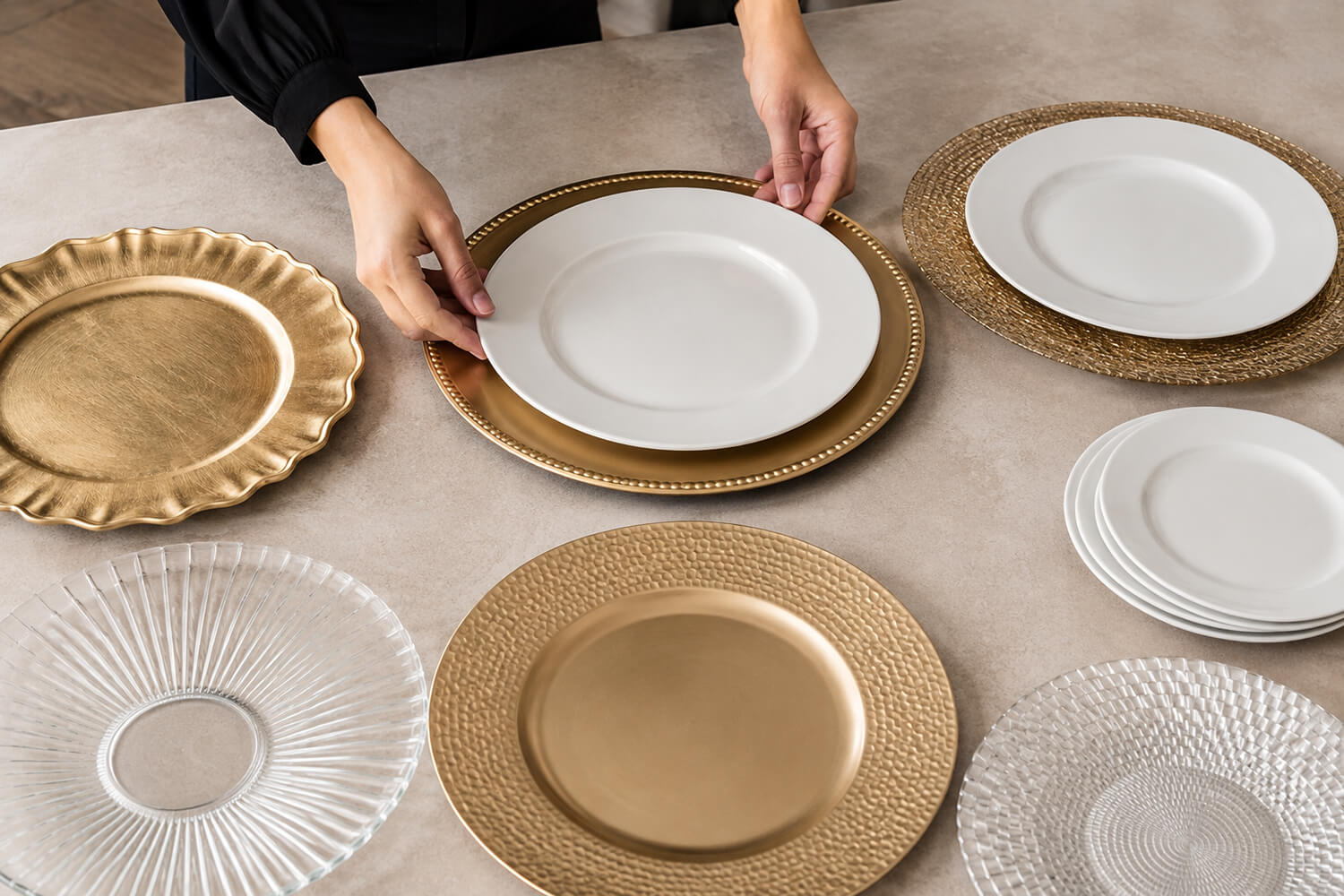
It sits underneath the dishes used for different courses. Because the charger is wider than the plate above it, its decorative rim remains visible. That visible border helps frame the food presentation and creates a more complete table design.
This is why charger plates are especially common at:
- Weddings
- Hotel banquets
- Gala dinners
- Corporate events
- Luxury restaurants
- Holiday dinners
- Award ceremonies
- Event rental businesses
- Catering functions
- High-end residential dining
The product solves several visual problems at once.
First, it fills empty space between the dinnerware, flatware, glassware, and centerpiece. Second, it creates a consistent color theme. Third, it gives a relatively inexpensive place setting a more premium appearance.
Consider a common wedding setup. A buyer may use white porcelain dinnerware across many events because white plates are versatile. Rather than stocking dinner plates in ten different colors, the rental company can change the charger.
Gold chargers can support a luxury theme. Clear acrylic designs can fit modern weddings. Wood-look finishes work well for rustic events. Black or metallic designs can support corporate dinners.
One dinnerware collection can therefore work with many event themes.
That flexibility explains why plastic charger plates are attractive to many commercial buyers.
They can be lightweight, stackable, decorative, and easier to transport than heavy glass or metal products. For large events, a small difference in weight can matter. Moving 1,000 pieces between a warehouse, truck, venue, washing area, and storage room creates considerable handling.
A professional buyer should therefore look beyond appearance. Rim strength, stacking behavior, scratches, color consistency, warping, coating adhesion, and packaging efficiency all affect the true commercial value of a charger.
What Is a Dinner Plate and How Is It Different?
A dinner plate is primarily a functional eating surface.
In a typical place setting, it holds the entrée or main course. Emily Post describes the dinner plate as the central element of an informal table setting. It is normally positioned in front of the diner, with other utensils arranged around it.
That functional role creates different product requirements.
A dinner plate may need to handle hot food, sauces, oil, acids, cutlery contact, repeated cleaning, and regular handling. Depending on the target market and material, buyers may also ask about microwave use, dishwasher resistance, temperature limits, scratch resistance, or food-contact documentation.
That is very different from selecting an event charger mainly for visual presentation.
Typical dinner plate materials include:
- Porcelain
- Ceramic
- Stoneware
- Bone china
- Tempered glass
- Melamine
- Food-grade plastics
- Stainless steel in some markets
Commercial buyers also evaluate dinner plates differently.
A restaurant purchasing manager may care about chip resistance because replacing broken plates every month adds cost. A hotel may want a stackable shape because storage space is limited. A catering company may prioritize low weight because tableware is transported frequently.
A distributor may care more about carton quantity, barcode labels, retail packaging, and repeat availability.
So, despite their similar round shape, dinner plates and chargers belong to different purchasing conversations.
This distinction is particularly important when sourcing plastic products. A buyer shouldn’t assume that every decorative plastic charger is suitable for direct food service.
Before ordering, ask the supplier to confirm the product’s intended use.
If direct food contact is required, make that requirement clear during development rather than after production. Materials, additives, coatings, pigments, printing, and testing may need to be evaluated according to the destination market.
In short, a dinner plate is designed around food service. A charger is designed mainly around table presentation.
Charger Plate Size vs Dinner Plate Size
Size is one of the most visible differences between the two plates.
A charger must normally extend beyond the dinnerware placed above it. Otherwise, the decorative rim disappears and the product loses much of its visual purpose.
Common charger sizes include:
| Charger Diameter | Typical Application |
|---|---|
| 12 inch | Compact tables, smaller dinnerware |
| 13 inch | Weddings, banquets, general event use |
| 14 inch | Large tables, luxury presentations |
| 15+ inch | Specialty decorative settings |
Dinner plates commonly fall around 9–11 inches, although exact dimensions vary by region, brand, cuisine, and tableware collection.
A 13-inch charger is therefore a popular commercial format because it can create a visible border around many standard dinner plates without becoming excessively large.
However, bigger isn’t automatically better.
Imagine a banquet table with limited space. Each guest may need a charger, forks, knives, spoons, wine glasses, water glasses, napkin, bread plate, and sufficient elbow room. Increasing each charger from 13 to 14 inches may seem minor on a drawing. Across a tightly arranged table, though, that extra diameter can create problems.
B2B buyers should test the complete setting rather than evaluating the charger alone.
A simple sample check can include:
Dinnerware fit → Flatware clearance → Glass position → Guest spacing → Table centerpiece clearance
The same approach helps manufacturers.
When developing an OEM mold or custom plate, the customer should ideally provide the diameter of the dinner plate that will sit on top. The visible decorative border can then be planned more accurately.
Other important dimensions include:
- Overall diameter
- Inner usable diameter
- Rim width
- Total height
- Base diameter
- Wall angle
- Thickness
- Stack height
Stack height is easy to overlook.
For an event-rental company ordering thousands of pieces, a few millimeters added to each stacked plate can significantly change carton dimensions and warehouse capacity. Good sourcing decisions therefore consider both the dinner table and the storage room.
Materials and Finishes for Charger Plates and Dinner Plates
Material selection is another major difference.
Because chargers are strongly connected with decoration, they are produced in a much wider variety of dramatic finishes.
Plastic chargers, for example, can imitate materials that would otherwise be heavier or more expensive. Manufacturers can create metallic looks, hammered patterns, beaded rims, wood effects, marble styles, translucent colors, matte finishes, and textured surfaces.
Common charger materials include:
- PP and other suitable plastics
- Acrylic-type materials
- Melamine
- Glass
- Stainless steel or other metals
- Wood or wood-look materials
Dinner plates are more commonly associated with porcelain, stoneware, ceramic, glass, or food-service-grade melamine.
The correct choice depends heavily on the customer’s market.
Practical B2B material comparison
| Material | Appearance | Weight | Breakage Risk | Customization | Typical Buyer |
|---|---|---|---|---|---|
| Plastic | Very flexible | Low | Low | High | Events, wholesalers, rentals |
| Glass | Premium | High | Higher | Medium | Hotels, weddings |
| Metal | Premium/formal | Medium–High | Low | Medium | Luxury hospitality |
| Ceramic | Classic | Medium–High | Higher | High | Restaurants, homes |
| Melamine | Practical | Medium | Low | High | Food service |
For plastic charger plate buyers, surface finishing deserves particular attention.
Metallic colors may look similar in photographs while behaving very differently during regular use. Buyers should inspect production samples for scratching, fingerprints, coating uniformity, edge coverage, and color difference under several lighting conditions.
Factories should also control color consistency across production batches.
This becomes important for repeat orders. A hotel or rental company may order 5,000 gold chargers this year and another 2,000 next year. Noticeably different gold tones can make the combined inventory difficult to use at one event.
For that reason, professional OEM discussions should record approved color samples, finishing requirements, and any acceptable variation rather than relying only on descriptions such as “champagne gold.”
Formal Table Setting and Correct Plate Placement
Correct placement helps explain why the two products cannot simply replace each other.
In a formal table setting, the charger is positioned in the center of each place before guests are seated. It creates a visual anchor for the entire arrangement.
Depending on the service style, a smaller plate or bowl may then be placed on top.
Emily Post notes that the service plate can remain underneath courses that precede the entrée. When the entrée is served, the charger and earlier plate are exchanged.
For a deeper reference, buyers and hospitality professionals can review the Emily Post formal place-setting guide.
A simplified service flow looks like this:
Table prepared
↓
Charger placed at each seat
↓
Appetizer / soup dish may be placed above charger
↓
Earlier course removed
↓
Charger remains according to service style
↓
Charger removed before or when main-course plate arrives
↓
Dinner plate becomes the main food-service surface
Modern events don’t always follow traditional etiquette perfectly.
Wedding planners and restaurants often use chargers primarily as decorative elements. Some leave them in place longer because the charger is part of the table design.
That is acceptable as a styling choice, provided the product is being used as intended.
Commercial buyers should therefore think about their own service workflow.
An event rental company may prioritize attractive chargers that survive repeated transport. A fine-dining restaurant may care more about formal etiquette and coordinated tableware. A wedding organizer may want highly photographic finishes because table images influence the overall event experience.
For a supplier, understanding that final application improves recommendations.
Instead of asking only, “Which color do you need?” a more useful B2B conversation asks about event type, dinner plate dimensions, expected reuse, washing method, storage, quantity, and table style.
Those questions often reveal which charger specification will actually work.
Food Contact Safety and Product Compliance
Food contact is one of the most important technical differences buyers should understand.
A dinner plate is expected to touch food directly.
A decorative charger may not be.
That distinction can affect the materials, coatings, decorative processes, documentation, and testing needed for a particular market.
The European Commission defines tableware that comes into contact with food as food-contact material. EU rules require applicable food-contact materials to meet safety requirements and be manufactured according to relevant good manufacturing practices.
The U.S. FDA likewise regulates substances that come into contact with food under its food-contact framework.
For B2B buyers, the practical lesson is straightforward:
Never assume decorative tableware is automatically suitable for direct food contact.
Before placing an order, tell the manufacturer how the product will be used.
Useful sourcing questions include:
- Will uncovered food touch the product?
- Will hot food be placed directly on it?
- Is the decorative coating on the food-contact surface?
- Which country will receive the goods?
- Does the importer require food-contact testing?
- Will the item be labeled “for decorative use only”?
- Does it need dishwasher resistance?
- Are there customer-specific restricted substances?
Compliance also depends on material and market. There is no single document that automatically makes every tableware product compliant everywhere.
For decorative chargers, manufacturers and buyers should agree clearly on intended use before production.
This prevents a common sourcing problem: the buyer originally requests a decorative charger but later decides to market it as a food-serving plate.
That change may be more than a packaging decision.
If a product is intended for food contact, the complete construction matters. That can include substrate, colorant, coating, printing, adhesive, decoration, and other components.
For professional importers, compliance should therefore be part of product development—not something discussed only after the container has shipped.
Which Plate Should Hotels, Caterers, and Event Companies Buy?
The right choice depends on the buyer’s business model.
A restaurant needs dinner plates because guests must eat from them. It may add chargers when the dining concept calls for a more formal or decorative presentation.
A wedding rental company works differently.
It may already stock several white dinnerware sets. Adding dozens of colored dinner plate collections would require more capital, warehouse space, and handling. Decorative chargers can provide a faster way to change the style of the table while using the same core dinnerware.
Here is a practical buyer chart:
| Business Type | Charger Priority | Dinner Plate Priority |
|---|---|---|
| Wedding rental | Very high | High |
| Event decorator | Very high | Low–Medium |
| Fine-dining restaurant | Medium–High | Very high |
| Casual restaurant | Low | Very high |
| Hotel banquet department | High | Very high |
| Catering company | Medium–High | Very high |
| Tableware wholesaler | High | High |
| Party-supply distributor | Very high | Medium |
| Home décor retailer | High | Medium |
For rental companies, durability can matter more than a small difference in purchase price.
Suppose one charger costs slightly less but becomes badly scratched after several rentals. Another costs more but remains presentable for many additional events. The second product may create a lower cost per use.
Hotels have another concern: consistency.
They may need hundreds of identical table settings in one ballroom. Differences in rim shape, color, gloss, or diameter become visible when 500 chargers are placed side by side.
Distributors look at the issue differently again.
They need products that are attractive to several customer groups, easy to package, economical to ship, and available for repeat ordering.
So there’s no universal “better” plate.
Choose dinner plates for food service. Choose chargers for presentation. Use both when your customers need formal appearance and functional dining at the same table.
B2B Charger Plate Manufacturing and Quality Control
For wholesale buyers, appearance in a catalog is only the beginning.
Two chargers may look almost identical in a staged photograph but perform very differently after transportation and repeated event use.
Plastic charger manufacturing therefore requires attention to details that retail consumers rarely see.
One important factor is dimensional stability.
A charger should sit flat on the table. Excessive warping can make it rock or leave one side visibly raised. When many chargers are used together, even a modest shape difference becomes easy to notice.
The rim also deserves attention.
Decorative beaded, scalloped, hammered, embossed, or geometric rims must reproduce consistently. Irregular edges can create a cheap appearance even when the base material is acceptable.
Common QC checkpoints can include:
- Overall diameter
- Product weight
- Flatness
- Rim symmetry
- Surface scratches
- Flow marks
- Flash or sharp edges
- Color consistency
- Coating coverage
- Decoration alignment
- Stackability
- Carton protection
For metallic or painted effects, surface performance is especially important.
Buyers should define how the charger will be handled and cleaned. Some decorative surfaces are designed for gentle event use rather than aggressive commercial washing.
Packaging tests also matter.
A charger may be difficult to break, yet its decorative surface can still become scratched when pieces rub against each other during a long ocean shipment.
Separators, protective bags, tissue, foam, inner boxes, or other packing structures may therefore be appropriate depending on finish and price level.
A useful sample approval process is:
Design sample → Color approval → Functional check → Packaging check → Pre-production confirmation → Mass-production QC → Shipment inspection
For serious importers, a golden sample should be retained when possible.
It gives the buyer and manufacturer the same physical reference for color, finish, dimensions, and workmanship during future production.
Soft CTA
If you’re sourcing chargers for wholesale, hospitality, weddings, or event rental, send your target diameter, finish, color, annual volume, and dinner plate size to the manufacturer. A specification-based quotation is far more useful than comparing unit prices alone.
OEM Charger Plate Sourcing: MOQ, Packaging, Colors, and Branding
Once a buyer moves from product research to purchasing, the conversation becomes more commercial.
The first question is usually price. Yet charger plate pricing depends on several variables, so asking only for “the price of a 13-inch charger” rarely produces a meaningful comparison.
A professional RFQ should include:
- Diameter
- Material
- Product weight or thickness target
- Rim design
- Surface pattern
- Color
- Metallic or matte finish
- Quantity
- Logo requirements
- Packaging style
- Destination country
- Expected use
- Testing requirements
Customization can range from simple color changes to completely new tooling.
For an existing mold, OEM work may involve custom colors, labels, cartons, barcodes, stickers, or packaging.
More advanced projects can involve a new rim pattern, embossed branding, custom dimensions, proprietary shapes, or private molds.
Naturally, tooling changes the economics.
A custom mold makes more sense when expected order volume can support the development cost. Buyers with smaller initial volumes may achieve a better commercial result by selecting an existing shape and customizing the color or packaging.
Packaging is another major cost variable.
Bulk cartons may work well for event distributors. Retailers may need color boxes, barcode labels, sets of four or six, Amazon-ready packaging, or other shelf presentation.
Importers should also consider container efficiency.
The product itself is relatively wide. Even when chargers nest together efficiently, carton dimensions influence freight cost. For high-volume orders, optimizing pieces per carton and carton size can meaningfully affect landed cost.
This is why experienced B2B purchasing teams compare landed commercial value, not simply FOB unit price.
A slightly more expensive charger that stacks efficiently, arrives with fewer scratches, has consistent repeat-order colors, and produces fewer customer complaints may be the stronger purchasing decision.
Frequently Asked Questions About Charger and Dinner Plates
Below are answers to common questions from tableware buyers, event companies, distributors, and hospitality customers.
Can you use a charger plate as a dinner plate?
Usually, you shouldn’t unless the manufacturer specifically confirms that the product is intended and suitable for direct food contact. Many chargers are decorative products, and their coatings or finishes may have different intended-use requirements from dinnerware.
Does a dinner plate sit on top of a charger plate?
Yes. In many formal or decorative table settings, the dinnerware is centered above the charger. The charger is larger, so part of its rim remains visible and creates a decorative frame around the plate.
What size charger works with a 10-inch dinner plate?
A 12- to 14-inch charger can work, depending on the desired visible rim and available table space. A 13-inch format is common because it provides noticeable framing without taking up as much room as larger designs.
Do charger plates stay on the table during the whole meal?
Not necessarily. Traditional formal service normally removes the charger when the entrée is served. Modern weddings and events may use different service styles, so venues sometimes keep chargers longer for decorative reasons.
Are plastic charger plates better than glass chargers?
Neither material is universally better. Plastic is lighter and less prone to breakage, which benefits rentals and large events. Glass offers a different premium feel but adds weight and breakage risk during handling and transportation.
Can charger plates be customized for wholesale orders?
Yes. Depending on the manufacturer and order quantity, common OEM options can include custom colors, metallic finishes, surface patterns, packaging, labels, logos, dimensions, and new molds for proprietary designs.
What should an importer check before buying charger plates?
Check dimensions, flatness, material, surface finish, scratches, edge quality, stackability, color consistency, intended use, packaging protection, testing requirements, carton quantity, and repeat-order capability before confirming mass production.
Are charger plates food safe?
Some may be suitable for food contact, while others are intended only as decorative underplates. Buyers should never decide based only on appearance or material name. Ask the supplier to confirm intended use and applicable compliance documentation.
Conclusion: Choosing the Right Plate for Your Business
The fundamental difference is simple.
A dinner plate serves food.
A charger plate supports presentation.
Yet for B2B buyers, Charger Plate vs Dinner Plate involves much more than table etiquette. The distinction influences size, material selection, surface finish, food-contact requirements, durability, packing, shipping, customization, and quality control.
If you’re purchasing for a hotel or restaurant, start with service requirements. Determine which dinnerware must contact food and how often it will be washed and handled.
If you’re buying for weddings or event rentals, look closely at visual impact, scratches, stacking, storage, weight, and cost per use.
If you’re a distributor, think about both sides. Your products need to attract customers while remaining practical to inventory, ship, replenish, and sell across several markets.
For charger sourcing in particular, don’t judge a supplier only by photographs.
Request representative samples. Place your actual dinner plate on them. Build a complete table setting. Check the finish in daylight and indoor lighting. Stack several dozen pieces. Inspect the edges. Review packaging. Confirm intended use and destination-market requirements.
Then compare the full commercial offer.
A good B2B specification might look like this:
| Requirement | Example Information to Send |
|---|---|
| Product | Decorative charger plate |
| Diameter | 13 inches |
| Material | Plastic |
| Color | Champagne gold |
| Surface | Metallic / textured |
| Dinner plate size | 10.5 inches |
| Application | Wedding rental |
| Quantity | 5,000 pcs |
| Branding | Custom carton label |
| Packaging | Scratch-resistant bulk packing |
| Market | United States |
| Key concern | Repeated use and color consistency |
Providing this information lets a manufacturer recommend a much more suitable solution.
Ultimately, the right product isn’t simply the plate with the lowest quotation. It is the plate that performs correctly throughout its commercial life—from factory production and international shipping to storage, table presentation, reuse, and repeat ordering.
NOTE: Need custom charger plates for your wholesale, hospitality, wedding, event-rental, retail, or private-label collection? Send us your required size, material, color, finish, quantity, logo, packaging, destination market, and target application. Our manufacturing team can evaluate OEM options and prepare a suitable quotation and sample plan for your project.