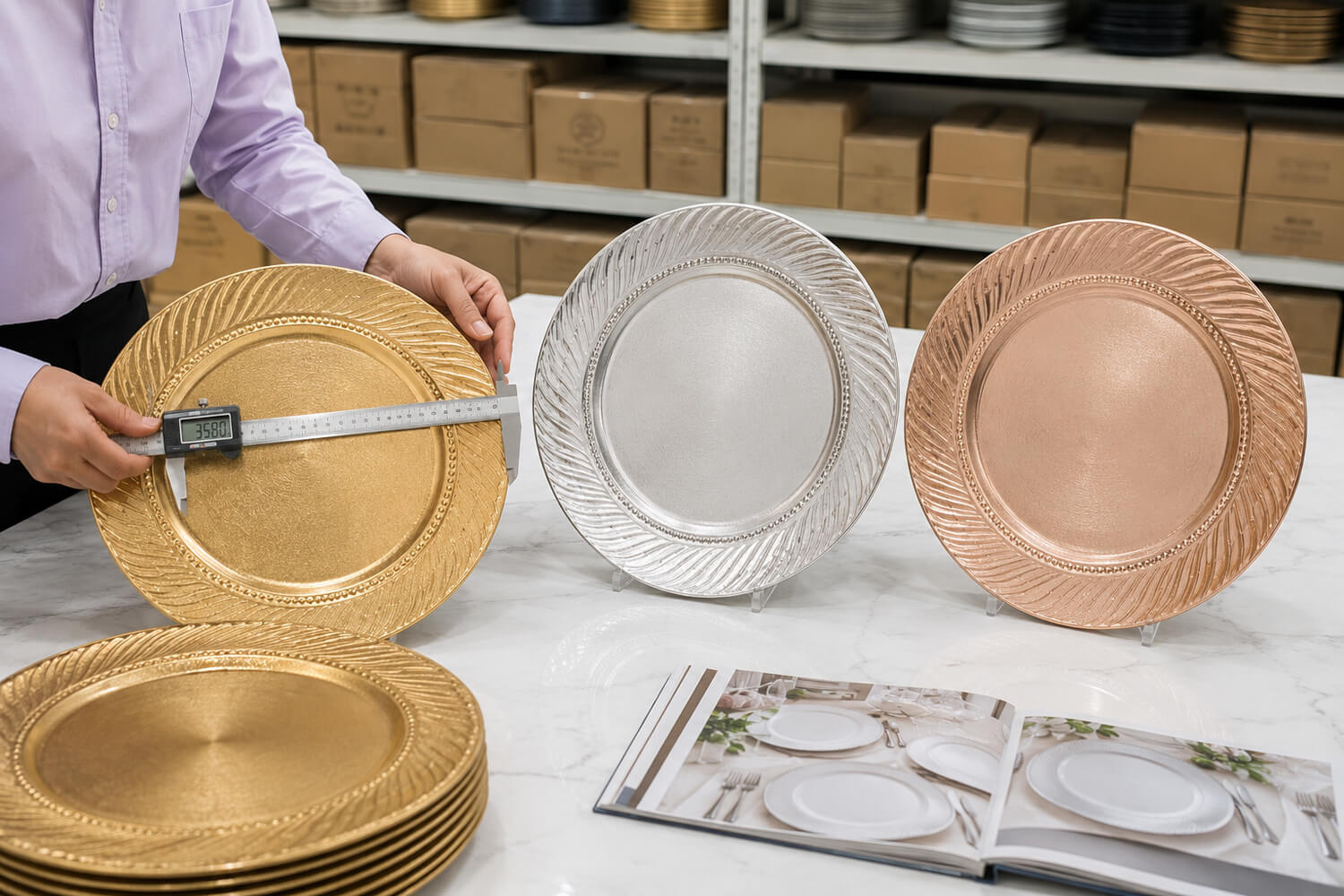
For most B2B tableware programs, 13-inch charger plates are the safest all-around choice. A 12-inch charger suits compact tables and smaller dinnerware, while a 14-inch charger creates a broader decorative frame for larger tables and premium events. Your final choice should consider dinner plate diameter, available table space, rim design, packaging efficiency, and the look your customers expect. Industry references also identify 13 inches as the most common standard diameter.
That sounds simple enough. In practice, though, purchasing managers rarely buy charger plates one table at a time.
You may be developing a new catalog for an event-supply company. You might be supplying several hundred wedding venues. Perhaps you’re an importer building a private-label tableware line. In each case, one inch can affect much more than appearance.
It can change:
- Compatibility with existing dinnerware
- Available flatware space
- Carton dimensions
- Pieces loaded per warehouse shelf
- Container utilization
- Retail positioning
- Event-table capacity
- Product photography
- Perceived value
That’s why choosing between 12, 13 and 14 inches should be treated as a product specification decision rather than simply a styling preference.
This guide looks at the issue from a manufacturer and sourcing perspective.
Charger Plate Size: The Quick Answer for B2B Buyers
Charger plates are decorative base plates placed beneath dinner plates, bowls, or other tableware. They are also called service plates, underplates, or presentation plates. A charger normally remains visible around the edge of the dinner plate, creating a layered table setting.
Most commercial models fall between approximately 12 and 14 inches, while 13 inches is widely considered the mainstream diameter. WebstaurantStore identifies 13 inches as the standard size, and other event-tableware references likewise describe 12, 13 and 14 inches as common options.
For purchasing purposes, the basic decision looks like this:
| Diameter | Metric Equivalent | General Positioning | Typical Advantage |
|---|---|---|---|
| 12 inch | 30.48 cm | Compact | Saves table space |
| 13 inch | 33.02 cm | Mainstream | Broad compatibility |
| 14 inch | 35.56 cm | Large / premium | Strong visual impact |
A buyer shouldn’t choose only by diameter, however.
Consider the usable center area as well. A charger with a very wide embossed border may offer less space for the dinner plate than another charger with the same outside diameter.
Likewise, a sharply scalloped 13-inch model doesn’t occupy a table in exactly the same way as a smooth round plate.
From a sourcing standpoint, therefore, ask for at least:
- Overall outside diameter
- Flat center diameter
- Rim width
- Total height
- Maximum thickness
- Unit weight
- Material
- Surface finish
- Stack height
- Recommended dinner plate diameter
These numbers provide a far more useful specification than simply writing “13-inch charger” on a purchase order.
Charger Plate Size Guide: 12 vs 13 vs 14 Inch
The difference between these three formats looks small on paper. Put several hundred chargers into an event venue or shipping carton, though, and those inches start to matter.
A 12-inch charger provides a restrained border and occupies less table space. It works especially well when the primary dinner plate is around 9 to 10 inches or when the venue uses narrower tables.
A 13-inch charger sits in the middle. That’s one reason it has become the most broadly used commercial specification. It works with many common dinner plates while still leaving a clearly visible decorative rim.
A 14-inch charger makes a stronger statement. It gives designers more visible decorative surface and can support larger plate stacks. However, buyers need to check table spacing more carefully.
Here’s the physical difference:
| Specification | 12 Inch | 13 Inch | 14 Inch |
|---|---|---|---|
| Diameter | 30.48 cm | 33.02 cm | 35.56 cm |
| Nominal face area | 113.1 sq. in. | 132.7 sq. in. | 153.9 sq. in. |
| Relative area vs. 12″ | Base | +17.4% | +36.1% |
| Visual effect | Subtle | Balanced | Dramatic |
| Table-space demand | Low | Medium | High |
| SKU versatility | Good | Excellent | Application-specific |
Notice something interesting: moving from 12 to 14 inches increases the nominal circular face area by roughly 36%.
So, although the diameter changes by only two inches, the physical footprint grows much faster.
For importers, rental companies and distributors, that’s worth remembering.
The best-selling diameter isn’t automatically the best diameter for every program. Your target buyer, dinnerware collection, carton limits and retail positioning should drive the final specification.
How Dinner Plate Diameter Changes the Right Charger Size
One of the easiest ways to compare charger plates is to calculate the visible border around the dinner plate.
The basic formula is:
Visible rim on each side = (charger diameter − dinner plate diameter) ÷ 2
Suppose your customer’s dinnerware uses a 10.5-inch dinner plate.
The result would look like this:
| Charger Diameter | Dinner Plate | Visible Charger Border |
|---|---|---|
| 12″ | 10.5″ | 0.75″ per side |
| 13″ | 10.5″ | 1.25″ per side |
| 14″ | 10.5″ | 1.75″ per side |
Visual Rim Comparison
12″ Charger: ███ 0.75″
13″ Charger: █████ 1.25″
14″ Charger: ███████ 1.75″
That’s why judging the charger alone can be misleading.
A beautiful 12-inch sample may appear excellent in a showroom. Put an 11-inch dinner plate on it, however, and only about half an inch remains visible on each side.
The decorative effect becomes much weaker.
By contrast, the same 11-inch dinner plate on a 13-inch charger leaves about one inch visible around the perimeter.
This relationship is particularly important for:
- Event rental companies
- Wedding suppliers
- Hospitality distributors
- Restaurant groups
- Private-label dinnerware brands
- Tabletop wholesalers
Dinner plates themselves aren’t all identical. Commercial references commonly place dinnerware around 10.5 inches, although larger 11- and 12-inch plates are also used in hospitality.
When developing a charger program, send your supplier either a physical dinner plate sample or its exact dimensions.
Better yet, ask for a charger sample and test the actual stack.
A few minutes of physical testing can prevent thousands of units from arriving with the wrong visual proportion.
When a 12-Inch Charger Plate Is the Better Choice
Twelve inches shouldn’t be viewed as a “small” or inferior option.
For the right market, it can be the smarter specification.
Its strongest advantage is space efficiency. When venues use narrow banquet tables or place settings containing multiple glasses, forks, knives and side plates, every inch of tabletop counts.
A 12-inch model can also create a cleaner appearance for modern or minimalist table settings.
It’s particularly suitable when you are selling to:
- Cafés and smaller restaurants
- Compact wedding venues
- Home-entertaining retailers
- Event companies using narrow banquet tables
- Buyers pairing chargers with smaller dinnerware
- Markets favoring minimalist table design
Imagine an event company serving 200 guests.
The buyer isn’t looking at one beautiful table. They must think about 200 placements, storage racks, transportation crates, setup speed and the number of chargers that can fit into each service area.
Here, a slightly smaller footprint can become useful.
There is a limitation, though.
If your customer’s primary dinner plate is already 11 inches wide, a 12-inch underplate leaves only around 0.5 inch of visible border on each side. Decorative patterns close to the center can become partly hidden.
For that reason, rim artwork matters.
If you manufacture or source a 12-inch design, place the important decoration toward the outside edge. Avoid putting the primary visual feature where the dinner plate will cover it.
From a product-development perspective, 12 inches often performs best when space efficiency and subtle presentation matter more than dramatic styling.
It’s not simply about going smaller. It’s about matching the product to the customer’s operating environment.
Why 13-Inch Charger Plates Dominate the Commercial Market
If a distributor wants to launch only one charger diameter, 13 inches is usually the logical starting point.
Several tableware and hospitality references identify 13 inches as the common or standard charger diameter.
Why has it become so popular?
Because it sits in a useful middle ground.
It is large enough to create a visible frame around common dinner plates, yet it’s not so large that it automatically overwhelms commercial tables.
For example, an 11-inch dinner plate positioned over a 13-inch charger leaves approximately one inch of visible rim on each side.
That’s enough room to show:
- Metallic finishes
- Beaded borders
- Antique effects
- Embossed patterns
- Seasonal prints
- Transparent rims
- Decorative textures
That makes 13-inch models especially attractive to buyers serving several market segments.
A wholesaler can offer the same diameter in gold, silver, black, white, transparent, vintage or seasonal designs without forcing customers to change their table-setting geometry.
This matters for inventory planning.
Rather than stocking three diameters across ten colors, a distributor might concentrate most volume on one mainstream size while creating variety through surface treatment.
From a manufacturing viewpoint, that can simplify purchasing and catalog management as well.
For example, SPD-HD currently lists 13-inch PP charger products while offering multiple surface-treatment options including plating, spray paint, paper decal, UV printing and antique finishes. The company also supports customization of dimensions, colors, logos and packaging.
For many B2B programs, therefore, 13 inches is more than a conventional measurement.
It’s a practical core SKU around which a broader collection can be built.
When 14-Inch Charger Plates Create More Value
Fourteen-inch chargers have a different job.
They aren’t mainly about fitting “more food.” Their value comes from presentation.
A larger decorative surface allows more of the charger to remain visible beneath the dinner plate. That creates stronger contrast in banquet photography and more space for elaborate rims.
Industry styling references generally position 14-inch models toward larger or more dramatic table settings.
They can work particularly well for:
- Luxury weddings
- Gala dinners
- Premium hospitality
- Large banquet tables
- Editorial event styling
- High-end rental collections
- Oversized dinnerware
- Statement table décor
The visual difference can be significant.
With a 10.5-inch dinner plate, a 14-inch charger leaves approximately 1.75 inches of exposed border on each side.
That’s more than twice the visible border created by a 12-inch charger with the same dinner plate.
For ornate products, that extra area matters.
However, buyers should consider operational trade-offs.
A larger diameter means more tabletop occupancy. Cartons may also require larger dimensions, and storage shelves need additional clearance.
That’s why we don’t recommend selecting an oversized charger from a product photograph alone.
Before ordering, create a real place setting containing:
- Charger
- Dinner plate
- Flatware
- Water glass
- Wine glasses
- Bread plate
- Napkin
- Menu card
Then test the complete setting on the actual table.
A 14-inch charger may look spectacular on a 72-inch round banquet table yet feel crowded on a narrow rectangular table.
In B2B procurement, context beats catalog photography every time.
Table Size, Guest Spacing and Place-Setting Geometry
Selecting an underplate should never happen separately from table planning.
A charger sits inside a wider place-setting system. Flatware must fit beside it, glassware sits above it, and guests still need enough elbow space to eat comfortably.
One foodservice guide recommends positioning charger place settings about two feet apart, illustrating how important guest spacing becomes in formal table layouts.
This isn’t a universal engineering standard. Actual spacing varies according to chair width, table shape, venue style and service level.
Still, it is a useful planning reference.
Suppose a rectangular banquet table provides roughly 24 inches of width for each guest.
A 12-inch charger occupies half that width.
A 14-inch plate occupies nearly 58%.
The remaining area must accommodate cutlery, shared décor and neighboring settings.
This becomes even more important when buyers use:
- Wide-handled flatware
- Multiple wine glasses
- Large napkin folds
- Menu cards
- Bread plates
- Floral decorations
- Table numbers
- Candles
For weddings, table designers often become excited about centerpiece styling while overlooking physical dining space.
That’s where B2B suppliers can add value.
Instead of selling a plate based only on color, provide dimensions and recommended table applications.
A distributor could even create a simple specification sheet showing:
Recommended Dinner Plate → Recommended Charger → Suggested Table Width
That information helps event planners choose faster and reduces product returns caused by unrealistic expectations.
For traditional formal service, a charger acts as the service plate beneath early courses.
12 vs 13 vs 14 Inch Charger Plate Comparison for Wholesale Buyers
For a wholesale buyer, visual appearance is only one column on the decision sheet.
Commercial success also depends on compatibility, inventory turnover, packaging and target customer type.
Here’s a practical comparison:
| Buyer Factor | 12 Inch | 13 Inch | 14 Inch |
|---|---|---|---|
| Dinnerware compatibility | Good with smaller plates | Broadest | Strong with larger plates |
| Table space | Excellent | Balanced | Requires more room |
| Decorative rim visibility | Moderate | Strong | Very strong |
| General wholesale demand | Market-dependent | Broad | More specialized |
| Wedding market | Good | Excellent | Excellent for premium setups |
| Restaurant use | Strong for compact tables | Strong | Selective |
| Event rental use | Good | Excellent | Strong premium option |
| Storage efficiency | Better | Moderate | Lower |
| Private-label flexibility | High | Very high | High |
| Visual impact | Subtle | Balanced | Dramatic |
For a new importer, a common mistake is launching too many specifications at once.
Imagine creating:
3 sizes × 8 colors × 4 finishes.
That’s already 96 SKUs before you change shape, packaging or artwork.
Unless demand is proven, inventory can become difficult to manage.
A more practical strategy may be:
- Make 13 inches your core line
- Add selected 12-inch models for compact applications
- Use 14-inch models as premium or statement products
- Test colors through samples or smaller initial orders
- Expand only after sales data becomes available
This approach gives buyers variety without letting SKU complexity get out of hand.
Soft CTA: If you’re building a wholesale charger plate collection, request physical samples of your shortlisted 12-, 13- and 14-inch models and test them with your target dinnerware before confirming bulk production.
That small sourcing step can answer more questions than dozens of product images.
Material, Rim Design and Shape Can Change the Effective Size
Diameter is important, but it isn’t the whole specification.
Two products labeled “13 inch” can behave very differently on the table.
Consider a flat round charger with a narrow edge.
Now compare it with a deeply embossed model featuring a thick floral border.
The outside dimensions may match. The available center area may not.
That’s why buyers should distinguish between:
Overall diameter
and
usable center diameter.
Shape matters too.
Round models distribute their footprint evenly. Square chargers extend farther toward neighboring flatware at their corners. Scalloped, irregular and geometric products introduce additional spacing considerations.
Material also changes the user experience.
Plastic PP chargers are attractive for commercial programs because manufacturers can create varied molded shapes and apply different decorative effects. SPD-HD, for example, lists PP charger plates with plating, spray-paint, paper-decal, UV-printing, transparent and antique-finish options.
For buyers, key physical specifications should include:
- Resin/material type
- Product weight
- Rim width
- Overall height
- Flatness
- Stackability
- Surface treatment
- Abrasion expectations
- Packing method
- Intended usage
Another important point: don’t automatically assume a decorative charger is intended for direct food contact.
Foodservice guidance notes that charger plates are commonly decorative underplates and may not be designed for food to be placed directly on them.
If direct food contact is part of your intended application, tell the manufacturer before ordering and request appropriate compliance documentation for your destination market.
That distinction is especially important for importers creating retail packaging or product claims.
How Charger Diameter Affects Packaging, Freight and Storage
Here’s the part that often gets missed in styling guides.
Charger dimensions affect logistics.
A 14-inch plate is only two inches wider than a 12-inch plate. Yet its nominal face area is around 36% greater.
That doesn’t mean shipping cost automatically rises by 36%. Charger plates can nest, and actual carton efficiency depends on product depth, rim profile, protection requirements and carton configuration.
Still, the calculation shows why size matters.
Larger products may require:
- Wider master cartons
- Larger inner cartons
- More warehouse shelf space
- Different pallet patterns
- Greater protective clearance
- Lower carton quantities
- Different container-loading plans
For a retailer buying 100 pieces, that may not seem important.
For an importer purchasing tens of thousands, it certainly does.
Suppose your supplier offers 24 pieces per carton for one design.
Don’t assume the same quantity will fit safely after increasing the diameter or changing from a flat rim to a high embossed rim.
Ask the manufacturer for:
| Packing Data | Why You Need It |
|---|---|
| PCS per inner box | Retail/repacking planning |
| PCS per master carton | Order calculation |
| Carton dimensions | CBM calculation |
| Gross weight | Freight planning |
| Net weight | Product costing |
| Stack height | Warehouse planning |
| Packing method | Damage prevention |
| Loading quantity | Container forecast |
From a manufacturer’s perspective, stackability can sometimes matter almost as much as diameter.
A decorative design that nests tightly may use carton space more efficiently than a smaller design with a high or irregular profile.
So when comparing quotations, don’t compare FOB unit price alone.
Compare estimated landed cost per sellable piece.
That’s the number that ultimately affects your margin.
OEM Charger Plate Sizing for Brands and Distributors
Private-label buyers don’t always have to accept an existing catalog diameter.
Custom sizing can make sense when there is a clear commercial reason.
You might need a charger specifically designed for:
- An existing dinnerware collection
- A hotel group’s proprietary table setting
- A restaurant chain
- A premium wedding-rental collection
- Retail shelf dimensions
- Branded gift packaging
- A particular export-market preference
Before requesting a new size, however, decide whether the difference genuinely creates value.
Changing a 13-inch product to 12.8 inches simply because it feels unique may add tooling complexity without delivering a meaningful customer benefit.
A custom program becomes more worthwhile when size is connected to functionality or positioning.
For example:
Existing plate compatibility:
Your brand sells 11-inch dinner plates and wants exactly 1.25 inches of visible charger rim.
Space-saving hospitality design:
A hotel wants a smaller footprint because its restaurant uses narrow tables.
Premium collection:
An event-rental customer wants a larger border to showcase an embossed design.
Retail packaging:
The diameter must fit a predetermined box or shelf system.
A capable charger manufacturer should be able to discuss more than mold diameter.
The conversation should cover:
- Shape
- Size
- Material
- Color
- Logo
- Surface finish
- Artwork
- Packaging
- Quantity
- Target market
SPD-HD states that its OEM/ODM program can customize charger plate sizes, shapes, surface treatments, logos, colors and packaging.
That type of integrated development is useful because the final product is a system—not merely a molded plate.
How to Specify Charger Plates to a Manufacturer
A strong inquiry produces a stronger quotation.
Instead of writing:
“Please quote 13-inch gold charger plate.”
Give the supplier a commercial specification.
For example:
| Item | Example Requirement |
|---|---|
| Product | PP round charger plate |
| Diameter | 13 inch |
| Dinner plate used | 10.5 inch |
| Color | Gold |
| Surface | Plating / antique / spray finish |
| Logo | Private label if required |
| Packing | Buyer-defined or supplier standard |
| Quantity | 5,000 pcs |
| Destination | Los Angeles, USA |
| Application | Wedding and event rental |
| Sample | Required before order |
Also request several photos showing:
- Front
- Back
- Rim detail
- Surface finish
- Side profile
- Plate stack
- Charger with dinner plate
- Packaging
Physical samples are even better.
SPD-HD currently states that samples are available and that regular and customized charger programs can be discussed with its sales team. Its website also identifies the company as a PP charger plate manufacturer with 15+ years of industry experience and OEM/ODM capabilities.
For bulk sourcing, approve the physical standard before production whenever possible.
Your approval sample can become the benchmark for:
- Color
- Finish
- Pattern
- Dimension
- Workmanship
- Packing
That reduces ambiguity later.
The cheapest purchasing mistake is the one caught before mass production.
Frequently Asked Questions About Charger Plate Sizes
What is the most common charger plate diameter?
A 13-inch diameter is widely treated as the most common commercial specification. It provides enough room for many standard dinner plates while leaving a decorative border visible, which makes it particularly versatile for weddings, restaurants, banquets and event rental businesses.
Is a 12-inch charger plate too small?
No. A 12-inch charger can work very well with smaller dinner plates and compact table settings. The key is checking the visible rim. With a 10-inch dinner plate, for example, a 12-inch charger leaves about one inch visible on each side.
Should I choose a 13-inch or 14-inch charger plate?
Choose 13 inches when you need versatility and easier table integration. Choose 14 inches when stronger visual impact matters and the venue has sufficient space. Always test the full setting with dinnerware, cutlery and glasses before placing a large wholesale order.
What size dinner plate fits a 13-inch charger?
Many common dinner plates can work with a 13-inch charger. A 10.5-inch plate leaves approximately 1.25 inches of decorative rim on each side, while an 11-inch dinner plate leaves about one inch. The exact fit also depends on rim design.
Can food be served directly on a charger plate?
Don’t assume so. Chargers are primarily decorative service plates placed beneath dinnerware, and some products are not designed for direct food contact. Buyers planning food-contact use should communicate that requirement and request appropriate compliance documentation before ordering.
Does charger plate shape affect the size I should buy?
Yes. A square or irregular charger may occupy more usable tabletop space than a round model with a similar nominal measurement. Buyers should check maximum width, corner-to-corner dimensions, center area, rim profile and spacing beside flatware.
Which size is best for a wholesale charger plate collection?
For many distributors, 13 inches makes the strongest core SKU because it covers a broad range of applications. Twelve-inch products can address compact tables, while selected 14-inch designs can create a premium collection for weddings, hotels and event rentals.
Can a manufacturer make a custom charger plate diameter?
Yes, depending on tooling, order volume and design requirements. Custom sizes are especially useful when matching proprietary dinnerware or developing a private-label range. Provide the target diameter, center area, material, shape, finish, packaging and expected order quantity before development begins.
Conclusion: Choosing the Best Diameter for Your Market
There isn’t one perfect diameter for every buyer.
There is, however, a clear way to make the decision.
Choose 12 inches when space efficiency, smaller dinnerware and restrained styling matter most.
Choose 13 inches when you need a broadly compatible commercial format that can support different colors, patterns, finishes and customer segments.
Choose 14 inches when your customers have larger tables and want a stronger decorative statement.
For most wholesalers, importers and event-supply businesses, 13 inches remains the logical starting point. From there, 12- and 14-inch products can extend the range according to actual market demand.
More importantly, don’t evaluate the diameter alone.
Check:
- Dinner plate compatibility
- Usable center size
- Rim width
- Table spacing
- Shape
- Material
- Finish
- Stackability
- Carton dimensions
- Unit weight
- Packaging
- Target application
That’s how a simple size decision becomes a better B2B purchasing decision.
If you’re developing a new charger plate range, send your manufacturer your preferred dinner plate dimensions, target diameter, shape, finish, color, logo requirements, packaging plan and expected order quantity.
A physical sample should then be tested on the actual table before mass production.
Hard CTA: Send us your target charger diameter, reference design, color, surface finish, quantity and packaging requirements. Our team can recommend suitable existing PP charger plate styles or evaluate an OEM/ODM solution and prepare samples for your sourcing project.