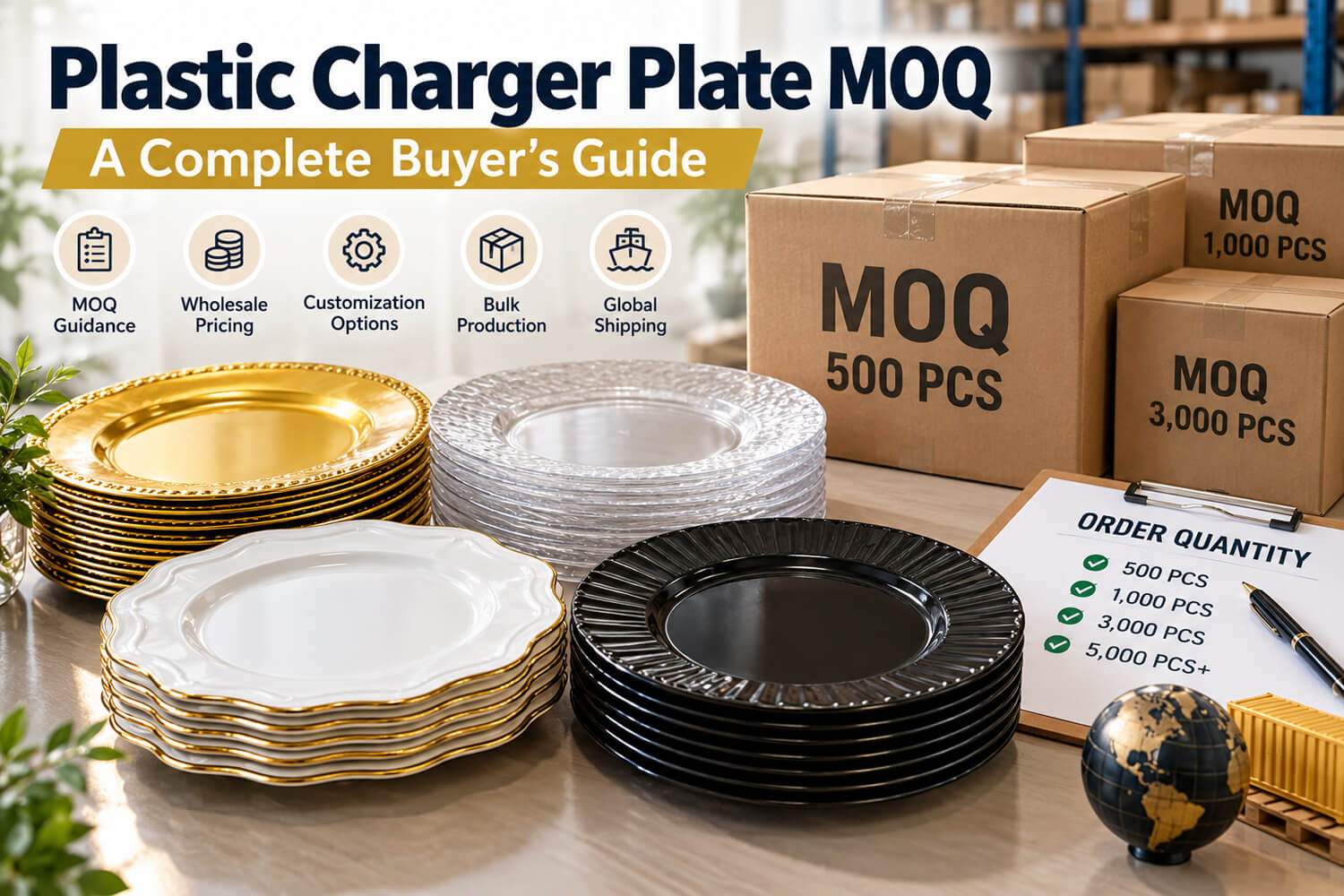
To import plastic charger plates successfully, you need to define the product first, verify a suitable Chinese manufacturer, approve samples, confirm compliance, control production quality, choose clear shipping terms, and prepare customs documents before the goods leave China. For B2B buyers, the safest process is not simply finding the lowest quotation. It is building a supply chain where product quality, cost, delivery, and responsibility are clear before money and goods start moving.
China is an important sourcing market for plastic tableware because buyers can access injection molding, decoration, packaging, OEM development, and export services within one manufacturing ecosystem. Yet that convenience can create a trap. Two suppliers may send you products that look almost identical in photos while using different resin, wall thickness, color masterbatch, surface treatment, packaging, and QC standards.
That’s why the buying process should start with specifications rather than price.
A professional sourcing sequence normally looks like this:
Requirement → Supplier Verification → Quotation → Sample → Compliance Review → Purchase Order → Production → Inspection → Shipment → Customs Clearance
For distributors, wholesalers, event-supply companies, restaurant-supply businesses, and private-label brands, each stage affects your final margin.
A $0.05 saving on the plate means little if 8% of your shipment arrives scratched. A cheap carton isn’t cheap if plates crack during transportation. Likewise, an attractive FOB quotation doesn’t tell you what your real warehouse cost will be.
The goal, then, isn’t merely to buy charger plates from China.
It is to receive the right product, at the expected quality, at a predictable landed cost, and at the time your business needs it.
Find a Reliable Plastic Charger Plate Manufacturer in China
Supplier selection is one of the most important parts of importing plastic tableware. A polished website, attractive catalog, or fast quotation doesn’t automatically mean you’ve found the right manufacturing partner.
Start by determining whether the company is actually suitable for your product.
Ask whether the supplier operates injection molding equipment in-house, outsources production, or mainly works as a trading company. A trading company isn’t automatically a bad choice. However, you should understand who controls the production line and who will solve problems when specifications change.
For a long-term B2B program, request basic supplier information such as:
- Registered company name
- Business license
- Factory location
- Main product categories
- Production processes
- Number and type of molding machines
- Main export markets
- Quality-control procedures
- Available test reports
- OEM and private-label capability
- Typical production capacity
- Standard lead time
- Existing mold availability
You should also compare what suppliers say with what they can demonstrate.
A genuine charger plate factory should be able to discuss material choices, molding limitations, color variation, plate weight, packaging protection, mold costs, production scheduling, and defect control in practical detail.
For important projects, a factory audit or third-party verification can add another layer of protection. U.S. government trade guidance also emphasizes due diligence when selecting overseas business partners because poor partner selection can cause financial, legal, and reputation risks.
From a manufacturer’s perspective, serious buyers usually get better results when they share clear purchasing plans. Tell the supplier your target market, expected annual quantity, required sizes, packaging type, and whether the product is decorative or intended for direct food contact.
That information allows the factory to recommend a more suitable production solution instead of sending you a generic price list.
Define Your Charger Plate Specifications Before Requesting Quotes
One common sourcing mistake is sending ten factories a message such as, “Please quote 13-inch plastic charger plates.”
That’s simply not enough information.
The supplier may quote the thinnest standard model. Another may calculate a heavier plate. A third might include individual polybags. Someone else might assume bulk packing.
The quotations look comparable, but they aren’t.
Create a product specification sheet before requesting a serious price.
| Specification | What You Should Confirm |
|---|---|
| Material | PP, PS, or another specified resin |
| Diameter | Exact finished diameter and tolerance |
| Weight | Target weight per plate |
| Shape | Round, square, irregular or custom |
| Surface | Glossy, matte, metallic, textured, embossed |
| Color | Standard color, Pantone reference or custom match |
| Edge Design | Plain, beaded, scalloped, embossed or decorative |
| Logo | Printed, molded, labeled or no logo |
| Intended Use | Decorative underplate or direct food contact |
| Packing | Bulk, polybag, set pack, retail box, master carton |
| Carton Requirement | Size, strength, shipping marks |
| Quantity | Trial order and forecast annual volume |
Material matters more than many buyers expect.
PP generally offers good toughness and flexibility. PS can provide a rigid feel and attractive surface appearance, but the exact performance depends on grade, design, thickness, and manufacturing conditions. Don’t select resin based on one-word descriptions such as “strong” or “premium.”
Ask for measurable specifications.
Weight is particularly useful when comparing similar plates. Two products with the same diameter and appearance may have noticeably different material usage.
You should also tell the manufacturer how the plate will be sold. A product for an event rental company faces different handling conditions from a decorative plate sold in four-piece retail packs.
Better input usually creates a better quotation—and fewer surprises later.
Order Samples and Create a Golden Sample
Never treat a digital photo as final product approval.
Before placing a meaningful bulk order, request physical samples. Ideally, you should evaluate both an existing factory sample and, when customization is involved, a pre-production sample made according to your approved specifications.
The goal is to establish a golden sample.
A golden sample is the physical reference against which production quality can be judged. Both buyer and manufacturer should understand that the approved sample represents the expected appearance, dimensions, finish, construction, and workmanship.
Check the sample carefully.
What Should You Inspect?
- Plate diameter
- Product weight
- Overall flatness
- Rim shape
- Stacking consistency
- Color consistency
- Surface gloss
- Scratches
- Flow marks
- Sink marks
- Burrs or sharp edges
- Printing or logo position
- Metallic coating consistency
- Odor
- Packaging protection
Place the plate on a flat table. Does it wobble?
Stack 20 or 30 pieces. Do they sit evenly?
Hold several samples under the same light. Can you see unacceptable color differences?
Run your fingers around decorative edges. Are there uncomfortable molding seams or sharp areas?
These simple checks can reveal problems that photos won’t show.
For custom colors, provide a physical reference or an agreed color standard whenever possible. Screen colors vary between monitors, cameras, and lighting environments.
For decorative metallic coatings, don’t approve appearance alone. Discuss rub resistance, scratch resistance, and packaging because a beautiful surface leaving the factory can still arrive damaged after thousands of plates rub against one another during ocean transport.
Once the sample is approved, record important dimensions, weight, color reference, photos, packaging requirements, and tolerances in your purchase agreement.
A good sample shouldn’t merely convince you to buy.
It should become part of your quality standard.
Check Safety and Compliance Before Mass Production
Compliance needs to be decided according to how the charger plate is intended to be used and where it will be sold.
This distinction is especially important with charger plates.
Traditionally, a charger is an underplate placed beneath dinnerware. Food may never directly touch its surface. However, some retailers and consumers may use plastic charger plates in ways the original buyer didn’t expect.
Therefore, your product claims and intended-use instructions matter.
If you market a plastic plate for direct food contact in the United States, applicable food-contact requirements need to be reviewed. The U.S. FDA explains that materials used in food-contact applications must have appropriate regulatory authorization for their intended conditions of use. Those conditions can vary according to food type and temperature.
For buyers selling in the European Union, Regulation (EC) No 1935/2004 establishes the general framework for food-contact materials, while Commission Regulation (EU) No 10/2011 provides specific requirements for plastic materials and articles intended to contact food.
That doesn’t mean every decorative charger automatically requires the same food-contact testing.
It means you must define the intended use before determining the compliance route.
Ask your supplier for available reports, but don’t stop there. Check:
- Product name on the report
- Material tested
- Test standard
- Tested color
- Report date
- Sample description
- Laboratory identity
- Whether the tested product matches yours
A report for another plate, another resin, or another color isn’t automatically proof for your product.
When necessary, arrange third-party testing using your actual production sample.
For B2B buyers, regulatory verification before mass production is far cheaper than discovering a problem after a container reaches customs.
Compare Supplier Quotations by Total Landed Cost
The lowest unit price rarely tells the whole story.
Suppose Factory A quotes $0.78 per plate and Factory B quotes $0.84.
At first glance, Factory A wins.
Then you discover that Factory A uses a larger carton, loads fewer units per cubic meter, charges separately for export packing, requires expensive inland transportation, and produces a lighter plate that doesn’t meet your quality target.
Factory B may actually generate the lower landed cost.
Build your comparison around the entire supply chain.
Basic Landed Cost Formula
**Product Cost
- Mold or Tooling Cost
- Custom Packaging
- China Inland Transportation
- Export Charges
- International Freight
- Insurance
- Import Duty / Tariffs
- Customs Brokerage
- Port / Terminal Charges
- Testing and Inspection
- Destination Delivery
= Approximate Landed Cost**
You can then calculate:
Landed Cost per Plate = Total Landed Cost ÷ Saleable Units Received
“Saleable” matters.
If you receive 10,000 plates but 500 have serious scratches, your effective cost isn’t based on 10,000 pieces. It’s based on approximately 9,500 sellable units.
Compare quotations using one specification sheet and one quantity.
A useful RFQ should request:
- EXW price if needed
- FOB price
- MOQ
- Units per carton
- Carton dimensions
- Gross weight
- Estimated CBM
- Production lead time
- Sample cost
- Mold cost
- Packaging cost
- Payment terms
- Quotation validity
Packaging data is especially important for bulky products such as charger plates. Freight is driven by more than product weight. Carton volume and container utilization can materially change your cost.
For large-volume programs, ask your supplier how many pieces fit into a 20-foot or 40-foot container based on the proposed packing method.
That’s a much more useful question than simply asking, “What’s your cheapest price?”
Build a Practical Quality Inspection Standard
Quality control shouldn’t begin when production is finished.
By then, many problems are expensive to correct.
Create inspection requirements before issuing the purchase order. Your supplier should know what you will inspect and which defects are unacceptable.
A charger plate inspection can be divided into several areas.
Appearance
Inspect for:
- Scratches
- Black spots
- Contamination
- Color variation
- Uneven metallic coating
- Flow marks
- Sink marks
- Deformation
- Printing defects
- Visible gate marks
Dimensions and Construction
Check:
- Diameter
- Height
- Product weight
- Flatness
- Rim dimensions
- Stacking
- Mold consistency
Function
Depending on the product, evaluate:
- Stability on a table
- Flex resistance
- Crack resistance
- Edge safety
- Coating adhesion
- Logo adhesion
- Stacking performance
Packaging
Inspect:
- Quantity per inner pack
- Quantity per carton
- Barcode accuracy
- Shipping marks
- Carton quality
- Product protection
- Carton dimensions
For larger orders, buyers often use sampling inspection rather than checking every single piece. You can agree an AQL-based inspection plan with your supplier or third-party inspection company.
The exact acceptance limits should be based on your product and market. Don’t copy an arbitrary AQL number from another product category.
For example, a tiny cosmetic mark might be considered a minor defect. A cracked plate, wrong color, sharp edge, incorrect barcode, or severe deformation can have much greater commercial consequences.
Factory-side experience shows that defining defects with photographs is extremely useful.
“Surface must be good” is subjective.
“No scratch longer than the agreed limit on the visible front surface” is measurable.
The clearer your standard is, the less room there is for arguments after production.
Understand OEM, Custom Molds and Private-Label Packaging
China sourcing becomes much more valuable when you move beyond simply purchasing a standard plate already offered by dozens of competitors.
OEM customization can help distributors and brands build a more differentiated product.
You may customize:
- Plate color
- Diameter
- Surface texture
- Edge pattern
- Embossed design
- Logo
- Metallic finish
- Printed design
- Sticker
- Barcode
- Gift box
- Retail sleeve
- Carton artwork
Some changes require little additional investment. Others require new tooling.
Changing a Pantone color may only require a customized production run and material preparation. Creating a completely new plate shape or decorative rim usually requires a custom mold.
Before paying for tooling, clarify several points in writing:
| Mold Question | Why It Matters |
|---|---|
| Who owns the mold? | Prevents later ownership disputes |
| Where will it be stored? | Important for repeat production |
| What is the mold life? | Affects long-term sourcing |
| Is maintenance included? | Prevents unexpected charges |
| Can another customer use it? | Protects exclusive designs |
| What happens if cooperation ends? | Clarifies transfer or disposal rights |
Packaging deserves similar attention.
Retail buyers often focus heavily on the plate and leave packaging until the final week. That’s risky.
Custom boxes can require artwork approval, barcode verification, color proofing, printing, cutting, assembly, and carton testing. These activities can extend your lead time.
Send final artwork early and insist on a packaging proof.
If you’re selling through Amazon, large retailers, distributors, or warehouse networks, provide labeling requirements before production starts.
Good packaging doesn’t merely make the product attractive.
It protects your inventory, reduces handling problems, supports efficient warehousing, and lowers the risk of returns.
Choose the Right Shipping Method and Incoterm
Most commercial charger plate orders from China move by sea because plates occupy considerable volume compared with their value and weight.
However, the right shipping method depends on order size and urgency.
Typical Options
| Shipping Method | Best For | Main Consideration |
|---|---|---|
| Courier | Samples | Fast but expensive per unit |
| Air Freight | Small urgent commercial orders | Higher freight cost |
| LCL Sea Freight | Smaller bulk orders | More handling and consolidation |
| FCL Sea Freight | Larger orders | Better control and often lower unit freight |
| Rail | Certain China-Europe routes | Depends on destination and service |
| Express Air | Emergency samples/replacements | Highest cost |
You also need to choose an Incoterm.
Common terms include EXW, FOB, CIF, and sometimes DDP.
The International Chamber of Commerce publishes the official Incoterms® 2020 rules, which define important buyer and seller responsibilities in international transactions. ICC Incoterms® 2020 official guidance
For experienced importers, FOB is commonly useful because the Chinese supplier handles the goods through export delivery at the agreed port while the buyer controls the main international freight arrangement under the relevant FOB obligations.
Don’t choose an Incoterm merely because it sounds convenient.
DDP, for example, may appear easy because the supplier quotes delivery to your destination. Yet you still need to understand who is acting as importer of record, how duties are handled, and whether the arrangement complies with local rules.
Before confirming an order, write the Incoterm together with the named location.
For example:
FOB Ningbo, Incoterms® 2020
is much clearer than simply writing:
FOB China
Shipping responsibility should never be vague.
Prepare Customs Classification and Import Documents
Customs preparation should happen before shipment, not after the vessel reaches your country.
Start by identifying the likely customs classification.
For the United States, the current Harmonized Tariff Schedule lists plastic tableware and kitchenware under heading 3924.10, with more detailed subheadings beneath it. However, classification depends on the actual merchandise, and applicable duty or additional tariff treatment must be checked for the specific product and current import conditions.
Never assume that an HS code given by one Chinese supplier is automatically correct for every country.
The first six digits of the Harmonized System provide international structure, but national tariff schedules add further classification detail.
Your customs broker can help verify the correct classification.
Common shipping and import documents may include:
- Commercial invoice
- Packing list
- Bill of lading or air waybill
- Purchase contract
- Certificate of origin when required
- Test or compliance documentation when applicable
- Customs entry information
- Insurance documents when applicable
For U.S. buyers, CBP publishes an official guide covering the import process, importer responsibilities, valuation, classification, entry procedures, and related customs topics. U.S. Customs and Border Protection – Importing into the United States
Pay close attention to the commercial invoice.
Descriptions such as “plastic products” are unnecessarily vague.
A more informative commercial description would identify the goods accurately, such as plastic decorative charger plates, together with quantity, value, country of origin, and other required invoice information.
Your broker may request additional information depending on the destination country.
Most importantly, don’t copy duty rates from old blog posts.
Tariffs, trade measures, and customs policies can change. Check the current official tariff database or ask your licensed customs professional before calculating your final landed cost.
Protect Your Payment and Supply Chain Before Shipping
Payment terms aren’t just financial details. They’re part of your quality-control strategy.
A common arrangement for custom manufacturing is a deposit followed by a balance payment at an agreed production stage. The exact percentage varies according to the supplier relationship, tooling, product, order size, and negotiation.
Whatever arrangement you use, connect payments to clear milestones.
For example:
Specification confirmed → Purchase order → Deposit → Production → Inspection → Shipping approval → Balance according to contract
Avoid paying the final amount simply because someone sends you a message saying, “Production finished.”
Ask for production photos and packing information. For larger or higher-risk orders, arrange a pre-shipment inspection.
Also make sure the purchase order specifies:
- Product specifications
- Approved sample reference
- Quantity
- Unit price
- Packaging
- Incoterm
- Lead time
- Inspection requirement
- Labeling
- Defect standard
- Required documentation
- Payment terms
- Handling of defective products
Lead time should also be defined carefully.
“30 days” can mean 30 days after deposit, after artwork approval, after sample approval, or after material confirmation.
Write the starting point.
It is also sensible to avoid depending entirely on one production path when your business becomes large enough. Keep approved specifications, molds, packaging files, inspection records, and supplier correspondence organized.
That makes repeat orders much easier.
A successful importer doesn’t manage each purchase as an isolated transaction.
You gradually build a controlled system.
After two or three successful orders, compare actual defect rates, actual production lead time, freight cost, and delivery performance with the original estimates.
That data gives you far more negotiating power than simply asking for a lower price.
Calculate the Real Cost Before You Place the Order
A buyer can negotiate an excellent factory price and still end up with poor margins.
That’s why you should calculate your expected landed cost before approving the purchase order.
Consider this simplified example.
Illustrative B2B Cost Model
| Cost Item | Example |
|---|---|
| Product Purchase | $8,000 |
| Packaging Upgrade | $500 |
| Inspection | $300 |
| China Inland / Export Charges | $450 |
| Ocean Freight | $1,600 |
| Insurance | $80 |
| Duty / Tariffs | Variable |
| Customs Broker / Entry | $250 |
| Destination Handling | $500 |
| Warehouse Delivery | $700 |
| Total Before Variable Duty | $12,380 |
These figures are only an example, not a current freight quotation.
The important lesson is the structure.
If the order contains 10,000 saleable plates, every $1,000 of unexpected logistics expense adds $0.10 to your effective unit cost.
Container utilization can therefore become a product-development issue.
A carton that’s two centimeters smaller may appear insignificant. Across hundreds of cartons, however, better packing density can materially improve freight economics.
Ask your supplier to provide:
PCS/CTN × Carton Length × Width × Height × Gross Weight
Then calculate total cartons and CBM.
You can also compare multiple packing configurations. Perhaps 24 plates per carton gives better protection, while 36 reduces freight. The right choice depends on damage risk and logistics savings.
Don’t forget destination-side costs.
Importers sometimes calculate:
FOB Price + Ocean Freight = Landed Cost
That’s incomplete.
Port handling, customs entry, duties, tariffs, examinations, drayage, warehouse delivery, storage, and other charges can materially affect the result.
You should know your approximate landed cost before you know your selling margin.
Otherwise, you’re pricing your product backwards.
A B2B Buyer’s Import Risk-Control Chart
The following chart summarizes where the biggest sourcing risks usually appear.
| Import Stage | Main Risk | Practical Control |
|---|---|---|
| Supplier Search | Fake or unsuitable supplier | Business verification + factory assessment |
| RFQ | Incomparable quotations | Standard specification sheet |
| Sampling | Sample differs from production | Signed golden sample |
| Compliance | Wrong material/testing assumptions | Confirm intended use + market requirements |
| Production | Color or dimensional variation | Written QC standard |
| Packaging | Scratches or breakage | Packing test + approved pack method |
| Final QC | Defects discovered too late | Pre-shipment inspection |
| Freight | Unexpected logistics cost | Compare CBM and Incoterms |
| Customs | Wrong classification/documentation | Broker review before shipping |
| Repeat Orders | Quality drift | Retain approved specifications and QC records |
The pattern is simple.
Most importing problems become expensive because someone waited too long to check something.
Supplier verification should happen before the deposit.
Compliance should be checked before mass production.
Packaging should be tested before thousands of products are packed.
Customs classification should be reviewed before shipping.
Inspection should happen before the goods leave China.
That sequence gives the buyer leverage.
Once the shipment is in your warehouse, your options become much more limited.
For manufacturers, distributors, wholesalers, and private-label brands, supplier relationships become increasingly valuable when the process is documented. The manufacturer learns your tolerance levels, color requirements, packaging standards, sales seasons, and order patterns.
At the same time, you learn the supplier’s real capacity and strengths.
This is how China sourcing moves from a one-time purchase to a stable B2B supply chain.
Frequently Asked Questions
What is the normal MOQ for plastic charger plates from China?
MOQ depends on whether you’re buying an existing design or requesting custom production. Standard models may support lower quantities, while custom colors, printing, packaging, or new molds usually require larger production runs to make manufacturing economically practical.
How long does production usually take?
Lead time depends on order volume, material availability, customization, packaging, mold requirements, and factory capacity. Rather than relying on a general estimate, ask the manufacturer to state exactly when production time starts and what approvals are required first.
Should I choose PP or PS plastic charger plates?
Neither material is automatically better for every application. PP is generally valued for toughness and flexibility, while PS can offer rigidity and strong surface appearance. Compare actual samples, product thickness, weight, finish, intended use, and compliance requirements.
Are plastic charger plates from China food safe?
It depends on the material formulation, intended use, manufacturing process, and applicable market regulations. If the plate will directly contact food, request appropriate documentation and arrange testing when required rather than assuming all plastic charger plates are food-contact compliant.
What HS code is used for plastic charger plates?
Classification varies by country and specific product characteristics. In the United States, plastic tableware and kitchenware appears within HTS heading 3924.10, but importers should confirm the exact current subheading, duty treatment, and additional tariffs with official customs resources or a broker.
Is FOB or DDP better when importing from China?
FOB gives experienced buyers greater control over international freight, while DDP may appear simpler. The best choice depends on your logistics capability. With DDP, always clarify customs responsibility, importer-of-record arrangements, duties, documentation, and legal compliance.
Can I put my own logo on charger plates?
Yes, many manufacturers support private-label options such as printed logos, labels, molded branding, packaging artwork, and custom cartons. The suitable method depends on plate material, surface finish, order quantity, durability requirements, and your target price.
Do I need a custom mold for my own charger plate design?
If you’re only changing color, logo, or packaging, an existing mold may be enough. A new diameter, profile, edge shape, embossed pattern, or structural design will usually require tooling. Confirm mold ownership and exclusivity before payment.
Should I inspect the order before paying the balance?
For significant B2B orders, pre-shipment inspection is a useful risk-control step. The inspection can verify quantity, dimensions, workmanship, color, packaging, labels, and agreed quality criteria while the goods are still at the factory.
Conclusion: Build a Reliable China Charger Plate Supply Chain
Learning how to import plastic charger plates from China isn’t really about finding one supplier and arranging one shipment.
The stronger approach is to create a repeatable sourcing system.
Start with an exact product specification. Find manufacturers whose production capabilities match your requirements. Compare samples instead of photographs. Establish a golden sample. Determine compliance requirements according to your target market and intended product use. Write measurable QC standards into your order.
Then calculate the complete landed cost.
Don’t judge suppliers only by cents per piece.
For B2B buyers, consistency often matters more.
A factory that understands your required color, weight, finish, packaging, inspection standard, seasonal demand, and delivery schedule can eventually reduce management costs throughout your supply chain.
Before each bulk shipment, follow five final checks:
- Product: Does production match the approved specification?
- Quality: Has the order passed your agreed inspection?
- Compliance: Are the required documents and tests available?
- Logistics: Are carton data, freight terms, and shipment details confirmed?
- Customs: Has your broker reviewed classification and import requirements?
If those five areas are controlled before the cargo leaves China, you’ve removed many of the most expensive risks in international sourcing.
For distributors, wholesalers, event-supply businesses, restaurant-supply companies, and private-label brands, that’s the real advantage of working directly with a capable manufacturer: not merely a lower purchasing price, but better control over product development, quality, packaging, lead time, and repeat supply.
Ready to Source Custom Plastic Charger Plates?
If you’re preparing a wholesale or private-label charger plate project, send the manufacturer your product size, material preference, color, surface finish, logo requirements, packaging concept, destination market, and estimated order quantity.
A professional manufacturer can then evaluate the suitable production method, existing mold options, customization requirements, packaging solution, MOQ, lead time, and quotation based on real specifications instead of guesswork.