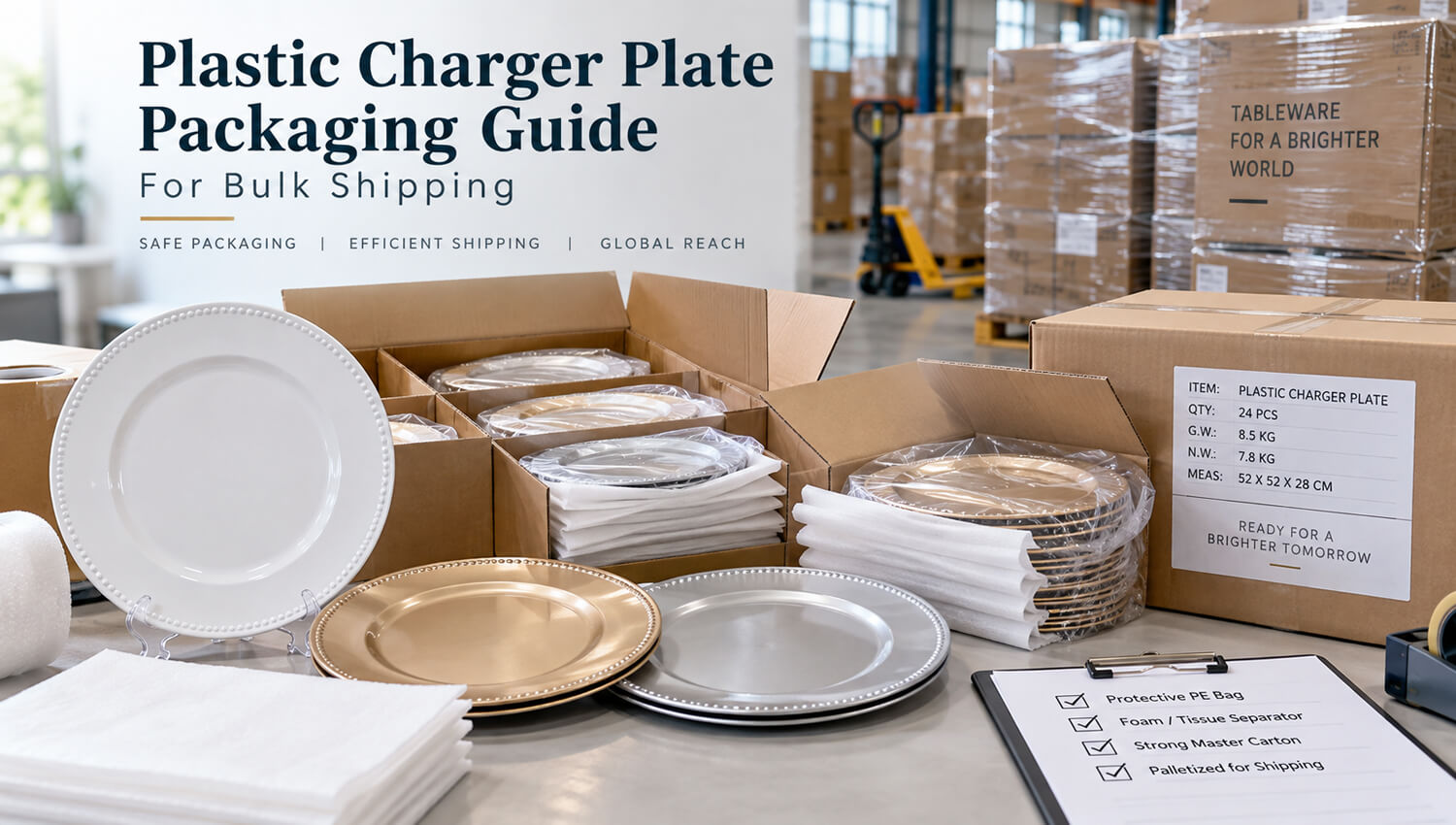
Good Plastic Charger Plate Packaging protects plates from scratches, pressure, moisture, deformation, and carton damage during international shipping. For bulk orders, the best system normally combines individual surface protection, controlled nesting, strong export cartons, pallet or container securing, and clear shipping marks. The exact packing method should match the plate material, finish, order quantity, shipping route, and buyer’s warehouse requirements.
That sounds simple. In practice, packaging can have a surprisingly large effect on your landed cost.
A charger plate may look strong when held in your hand. However, hundreds or thousands of plates behave differently inside a carton or shipping container. Repeated vibration can rub decorative surfaces together. Heavy stacking can place pressure on plate rims. Weak cartons can collapse after weeks in a humid container. Poorly secured cartons can also shift during road or sea transport.
For a B2B buyer, the problem isn’t only a damaged plate. You may also face sorting costs, delayed deliveries, customer complaints, replacement shipments, and lost selling time.
As a manufacturer, we therefore look at packaging as part of the product specification. It shouldn’t be decided only after production finishes.
Your purchase order should define:
- Inner protection
- Pieces per inner pack
- Pieces per master carton
- Carton dimensions and gross weight
- Pallet requirements
- Shipping marks
- Barcode or SKU labels
- Special retail packaging
- Required packaging tests
A clear packing specification makes quotations easier to compare. More importantly, it gives you a measurable standard before mass production begins.
Plastic Charger Plate Packaging
A reliable packaging system starts with one question: what can realistically damage the plates between the factory and your warehouse?
For bulk charger plates, four risks normally deserve the most attention.
The first is surface damage. Glossy, metallic, mirror, painted, printed, or textured surfaces can show rubbing marks. A plate may remain structurally perfect but still become commercially unacceptable.
The second risk is pressure. Charger plates are usually nested because nesting saves space. Yet excessive pressure can affect rims or decorative details. The risk increases when too many pieces are placed in one carton.
The third issue is carton failure. Export cartons pass through factories, trucks, warehouses, ports, containers, customs facilities, and distribution centers. Each stage adds handling.
Finally, there is load movement. Even strong cartons can be damaged if the container load isn’t properly secured.
From a manufacturer’s perspective, good packaging uses several layers of defense rather than one oversized carton.
A common structure looks like this:
| Packaging Level | Main Purpose |
|---|---|
| Individual protection | Prevent rubbing, dust and surface scratches |
| Bundle protection | Keep nested plates stable |
| Master carton | Resist handling and stacking pressure |
| Pallet or unit load | Improve forklift handling and load stability |
| Container securing | Reduce movement during international transport |
This layered approach is important because packaging failures usually have more than one cause.
For example, adding a stronger carton won’t solve scratching between two metallic plates. Likewise, adding foam around each plate won’t help if cartons move freely inside a container.
Before ordering, ask your supplier for a packing photo, carton specification, packing quantity, gross weight, and carton dimensions. For a new design, requesting a packed pre-production sample can be even more useful.
That small step gives your purchasing team much better visibility before the goods leave the factory.
Plastic Charger Plate Packaging Guide for Bulk Shipping?
Bulk export packaging should protect the product while keeping freight volume practical. That’s the key balance.
Too little packaging increases damage risk. Too much packaging raises material cost, carton volume, labor, and freight expenses. The ideal solution sits between those two extremes.
For most plastic charger plates, a manufacturer first studies the product itself.
Important factors include:
- PP, PS, ABS, PET or other material
- Plate diameter
- Rim height and shape
- Product thickness
- Stackability
- Metallic or painted finish
- Embossed decoration
- Scratch sensitivity
- Quantity per shipment
- Ocean, air, rail or truck transportation
A simple matte PP plate can require less surface protection than a high-gloss gold charger plate. The second product may reveal tiny rubbing marks under strong retail lighting.
Shipping method also matters.
A full-container shipment usually receives fewer individual handling events than cartons moving through mixed logistics networks. LCL shipments may be handled and consolidated several times. Parcel shipments face another type of risk altogether.
This is why serious packaging development considers the distribution environment, not just carton appearance. ASTM D4169, for example, provides a framework for evaluating shipping units against transportation hazards such as handling and vibration.
ASTM D4169 shipping-container testing information
For B2B orders, we recommend treating packaging specifications like product specifications.
Instead of writing only:
“Standard export packing.”
your purchase documents can define measurable requirements such as carton quantity, label format, pallet type, approved packing sample, and maximum carton weight.
That gives both sides a clearer target.
It also makes inspections easier. A QC inspector can check an actual requirement rather than deciding whether the packaging simply “looks strong.”
Inner Protection for Charger Plates: PE Bags, Tissue, Foam and Dividers
The inner packaging is your first defense against cosmetic damage.
Plastic charger plates are often nested. This saves significant space, but it also places finished surfaces close together. During transportation, vibration creates small repeated movements. Over a long journey, those movements can leave visible rubbing marks.
The right separator depends on the surface.
PE Bags
Individual PE bags are widely used because they’re simple and economical. They help protect products from dust and direct surface contact.
They’re particularly useful for:
- Matte surfaces
- Standard molded colors
- Basic decorative plates
- Products requiring individual cleanliness
The bag thickness and size should allow easy packing without excessive loose material.
Tissue Paper and Thin Protective Sheets
Soft tissue or thin sheets can separate nested surfaces. They add little volume, which helps maintain carton efficiency.
For highly decorative finishes, however, the actual material should be tested. A separator that feels soft may still leave marks after prolonged vibration.
EPE Foam
Thin expanded polyethylene foam offers more cushioning.
It can be useful around:
- Metallic finishes
- Mirror-like surfaces
- Raised rims
- Decorative edges
- Premium private-label products
Foam costs more and takes additional space. Therefore, it isn’t automatically the right answer for every order.
Dividers and Protective Pads
Top and bottom pads help distribute pressure through the carton. Side protection can also reduce direct contact between plate edges and carton walls.
A practical inner-packing sequence may look like:
Plate → protective bag or sheet → controlled nesting → bundle protection → top/bottom pads → export carton
Before approving mass production, perform a rubbing test with the actual surface finish.
This matters because two charger plates of the same material can behave differently after painting, metallization, printing, or other finishing processes.
Your packaging decision should therefore follow the finished product, not only the base resin.
Master Carton Strength and Corrugated Box Specifications
The master carton carries more responsibility than many buyers realize.
A carton may contain perfectly protected plates, yet the shipment can still fail if the box loses strength.
Corrugated cartons are affected by compression, humidity, handling, dimensions, flute structure, paper quality, and load distribution. Long ocean shipments can make these factors more important.
For bulk business, avoid evaluating a carton only by touching the board.
Instead, consider the complete packed carton.
Ask your supplier to confirm:
| Item | Why It Matters |
|---|---|
| Carton dimensions | Determines fit and freight volume |
| Net weight | Shows actual product weight |
| Gross weight | Affects handling and stacking |
| Pieces per carton | Controls pressure and efficiency |
| Corrugated structure | Influences strength |
| Closure method | Prevents cartons opening |
| Inner pads | Spreads pressure |
| Carton marks | Supports warehouse handling |
Large cartons aren’t always better.
Putting more plates in one carton can reduce the number of cartons. Yet carton weight and stacking pressure also rise.
For manually handled shipments, very heavy cartons can create another problem. Warehouse workers may drag, drop, or mishandle them simply because they’re difficult to lift.
A good carton therefore needs a practical relationship between product weight, carton dimensions, stacking strength, and handling method.
The corners and seams deserve attention too.
Tape should remain secure under normal shipping conditions. If straps are used, they shouldn’t crush carton edges. Corner protectors can help spread strapping pressure.
For premium orders, a supplier can also test the finished carton under compression rather than judging the board alone.
This approach gives you better evidence because you’re testing the packaging system as shipped.
For your purchase order, consider approving a golden packing sample. Keep photos and specifications with the order documents.
Then production packaging can be checked against the same approved reference.
Bulk Packing Quantity, Nesting Pressure and Plate Deformation Control
Nesting is one of the biggest advantages of plastic charger plates during shipping.
Unlike products with large empty spaces, many charger plate designs fit inside one another. This can create excellent carton efficiency.
But there’s a catch.
Maximum nesting isn’t always optimal nesting.
Imagine increasing the carton quantity from 12 plates to 24 plates. You may save some cardboard. However, you’re also increasing weight and vertical pressure. If the product has a raised rim or delicate decorative feature, that pressure may concentrate in a small area.
That’s why pieces per carton should be validated rather than guessed.
Several variables matter:
- Plate diameter
- Plate depth
- Rim geometry
- Material stiffness
- Product thickness
- Temperature sensitivity
- Surface coating
- Total carton weight
- Stacking height
Plastic behavior can also change with temperature. A tightly packed load exposed to elevated container temperatures may behave differently from one stored in an air-conditioned showroom.
One useful factory check is to pack the proposed quantity and leave the carton under expected stacking pressure. The plates can then be inspected for deformation, surface transfer, rim damage, or sticking.
Bulk Shipping Damage Risk Chart
| Risk Factor | Low Exposure | Medium Exposure | High Exposure |
|---|---|---|---|
| Surface rubbing | ▮ | ▮▮▮ | ▮▮▮▮▮ |
| Excessive nesting pressure | ▮ | ▮▮▮ | ▮▮▮▮▮ |
| Loose carton space | ▮ | ▮▮ | ▮▮▮▮ |
| Weak carton stacking | ▮ | ▮▮▮ | ▮▮▮▮▮ |
| Unsecured container load | ▮ | ▮▮▮ | ▮▮▮▮▮ |
A buyer shouldn’t simply request “as many pieces per carton as possible.”
A better instruction is:
Optimize packing quantity for safe stacking and freight efficiency without causing deformation or cosmetic damage.
That gives your supplier room to engineer the pack while keeping the commercial objective clear.
Before shipment, carton quantity should also match your warehouse process. Standard pack sizes make receiving, counting, picking, and redistribution much easier.
Palletization, Stretch Wrapping and Container Loading for Export Orders
Pallets make handling easier, but they also consume space and add cost.
Whether you need them depends on your shipment.
For some full-container orders, floor-loaded cartons offer better container utilization. For other supply chains, palletized cargo is worth the additional volume because forklifts can move the goods quickly.
If pallets are used, carton placement matters.
Cartons shouldn’t overhang the pallet edge. Overhang exposes the carton to impact and reduces stacking support.
A stable pallet load may include:
- Consistent carton pattern
- Anti-slip sheets where needed
- Corner boards
- Stretch wrapping
- Suitable strapping
- Top protection
- Clear pallet labels
The final load should act as one stable unit.
International shipments using raw-wood pallets, crates, or dunnage may also need to meet ISPM 15 requirements. The International Plant Protection Convention states that the standard covers wood packaging material made from raw wood and describes phytosanitary measures designed to reduce pest risks in international trade.
Official IPPC information on ISPM 15
Container loading deserves equal attention.
You shouldn’t assume tightly packed cartons will automatically stay in position. Empty spaces may allow movement as a truck accelerates or a vessel moves at sea.
The IMO/ILO/UNECE CTU Code provides international guidance covering the loading and securing of cargo inside transport units.
IMO CTU Code guidance for cargo packing and securing
For buyers, container-loading photos provide useful evidence.
Ask for pictures showing:
- Empty container condition
- First rows of cartons
- Load arrangement
- Securing materials
- Final loaded container
- Closed container and seal number
These records are especially useful for large overseas orders.
Moisture, Heat and Surface-Finish Protection During Long-Distance Shipping
An export container isn’t a controlled showroom environment.
Cargo may travel through hot ports, cool nights, rain, humid coastal areas, and changing temperatures. Inside a closed container, those conditions can create moisture and heat challenges.
Plastic itself may tolerate moisture well, but the complete product can include more sensitive elements.
Examples include:
- Printed decoration
- Metallic finishes
- Labels
- Adhesives
- Paper inserts
- Retail boxes
- Corrugated cartons
Humidity can also reduce carton strength.
For that reason, packaging design must consider more than water touching the plate.
A premium decorative finish requires special care. Before production, we recommend checking whether the finished surfaces can remain nested for an extended period without sticking, transferring color, or developing pressure marks.
For highly scratch-sensitive finishes, individual bags or interleaving materials can create a useful barrier.
The shipping container should also be inspected before loading.
Look for:
- Holes
- Water damage
- Strong odors
- Excess dirt
- Wet flooring
- Structural damage
Desiccants may be considered for some routes and cargo combinations. Their quantity shouldn’t be guessed, however. Container size, voyage length, humidity, product packaging, and moisture sources all affect performance.
The same principle applies to sealed plastic bags.
A bag protects against dust and direct contact. It doesn’t automatically solve every humidity problem.
For B2B buyers, the safest approach is to tell the supplier where the shipment is going and how it will travel.
For example, an ocean shipment to a humid tropical destination may justify different controls from a short domestic truck shipment.
Packaging is therefore part of logistics engineering.
When manufacturers understand the destination, transport mode, warehouse conditions, and finish requirements early, they can propose more suitable protection without adding unnecessary packaging everywhere.
Drop, Vibration and Compression Testing for Export Packaging
A carton that looks strong in the factory can still fail in distribution.
Transportation produces repeated shocks and vibration that are difficult to judge by sight. That’s where packaging tests become useful.
Different tests answer different questions.
Drop Testing
Drop testing evaluates how a packed carton reacts to impact.
Corners, edges, and faces can behave differently. A carton that survives a flat-face drop may fail when the load lands on one corner.
Vibration Testing
Vibration is especially relevant for nested charger plates.
Small movements can gradually create rubbing damage, even without a major impact.
ISTA describes its 3-Series as general simulation tests designed to reproduce transportation hazards such as vibration, drops, and atmospheric conditions. ISTA 3B specifically covers packaged products moving through less-than-truckload distribution, including palletized or skidded shipments.
ISTA transport testing procedures
Compression Testing
Compression checks how cartons perform under stacking loads.
This becomes important when cartons sit near the bottom of a high stack.
Practical Test Matrix
| Test | Main Risk Evaluated | Typical Buyer Benefit |
|---|---|---|
| Drop | Handling impact | Reduces breakage and rim damage |
| Vibration | Road and transport movement | Detects rubbing and loosening |
| Compression | Warehouse/container stacking | Identifies carton collapse risk |
| Conditioning | Heat/humidity exposure | Shows environmental weakness |
| Packing inspection | Incorrect quantities/materials | Confirms production consistency |
Not every order requires laboratory certification.
For standard repeat products, a proven packaging specification may already have shipping history behind it.
However, testing becomes more valuable when you introduce a new plate, unusual finish, larger carton, new shipping method, or demanding retail customer.
The cost of a test is often small compared with replacing a damaged commercial shipment.
Shipping Marks, Barcodes and Retail-Ready Carton Labeling
Packaging has another job after protection: it must communicate information.
A warehouse may receive hundreds of similar cartons. If markings are unclear, receiving becomes slow and mistakes become more likely.
Basic master-carton information often includes:
- Product name
- Item number
- Color
- Quantity
- Net weight
- Gross weight
- Carton dimensions
- Carton sequence
- Country of origin
- Handling marks where appropriate
The exact requirements depend on your company and destination market.
Distributors often need additional information.
For example, you may request:
SKU barcode → inner-pack label → master-carton label → pallet label
Using the same SKU structure across these levels makes inventory control easier.
Private-label customers may also need custom artwork, retailer carton labels, or warehouse-specific routing marks.
Don’t leave these details until loading day.
Barcode dimensions, label placement, artwork, and variable data should be approved before production packaging starts.
For complicated orders, create a simple packaging artwork approval sheet containing:
| Requirement | Buyer Approval |
|---|---|
| Master carton artwork | Approved / Revised |
| Barcode type | Confirmed |
| SKU | Confirmed |
| Quantity marking | Confirmed |
| Country-of-origin mark | Confirmed |
| Pallet label | Confirmed |
| Retail insert | Approved / Revised |
This prevents small administrative errors from delaying otherwise good products.
For example, a charger plate can be manufactured perfectly but still create warehouse trouble if the wrong SKU appears on 200 cartons.
B2B packaging therefore connects production with logistics, sales, warehousing, and retail distribution.
If you’re buying several colors or styles in one container, accurate carton identification becomes even more important.
Ask the manufacturer for photographs of finished labels before shipment. That gives your team one final chance to detect obvious errors while the goods remain at the factory.
Packaging Cost, Carton CBM and Freight Efficiency
The cheapest packaging isn’t always the lowest-cost packaging.
For an importer, the more useful figure is total landed cost.
Imagine one packaging option saves a few cents per plate but increases carton volume by 15%. The material saving may disappear once ocean freight and warehouse costs are included.
The opposite problem also occurs.
Aggressive nesting can reduce CBM, but damage rates may rise.
You therefore need to optimize several costs together:
Product cost + packaging cost + freight + handling + storage + damage risk
CBM is especially important for bulky products.
A basic calculation is:
Carton Length × Width × Height in meters = Carton CBM
Then:
Carton CBM × Total Cartons = Approximate Shipment Volume
Suppose two packing proposals contain the same number of plates:
| Packing Option | Cartons | CBM | Protection Level | Commercial Result |
|---|---|---|---|---|
| Very loose packing | More | Higher | High | Freight may become expensive |
| Over-tight packing | Fewer | Lower | Low | Damage risk may rise |
| Optimized packing | Balanced | Controlled | High | Better landed-cost balance |
This is why purchasing teams should request carton data during quotation.
For container orders, ask the factory for an estimated loading quantity based on the final carton size.
Palletization can change this calculation considerably.
Pallets improve handling but may create unused container space. A warehouse with strict pallet receiving rules may still prefer them.
There isn’t one universal correct choice.
Your ideal solution depends on:
- Shipping mode
- Container type
- Destination
- Warehouse equipment
- Order value
- Labor cost
- Damage sensitivity
- Retail requirements
For repeat orders, collect actual shipment results.
Track damaged units, carton condition, receiving time, and customer feedback. That data can help the manufacturer improve the next production run.
Good export packaging should become more efficient as the supplier and buyer learn from real shipments.
OEM/ODM Charger Plate Packaging Requirements for B2B Buyers
Private-label buyers often need much more than a brown export carton.
Your packaging may be part of the product you sell.
For example, distributors and event-supply brands may request:
- Custom printed boxes
- Private-label stickers
- UPC or EAN barcodes
- Color labels
- Product inserts
- Care instructions
- Inner packs
- Retail-ready sets
- Custom master cartons
- Pallet identification
These requirements should be discussed during quotation.
Why?
Because changing packaging after the product is complete can affect price, lead time, MOQ, and carton dimensions.
A good RFQ should separate product requirements from packaging requirements.
B2B Packaging Checklist
Before approving an order, confirm:
- Plate material and dimensions
- Surface finish
- Individual protection method
- Pieces per bundle
- Pieces per carton
- Master-carton construction
- Net and gross weight
- Carton dimensions
- Pallet requirement
- Shipping marks
- Barcode format
- Private-label artwork
- Packing sample approval
- Required transit testing
- Container-loading requirement
For customized packaging, artwork control is equally important.
Ask your supplier to send digital proofs before printing. For major projects, an actual printed packaging sample gives you even greater confidence.
A manufacturer should also verify the first packed units during production. This prevents an artwork or packing mistake from being repeated across thousands of pieces.
For repeat business, don’t rebuild the specification every time.
Create an approved packaging file linked to the SKU.
That file can include product photos, carton drawings, labels, quantities, materials, and packing instructions.
When your purchasing team reorders six months later, both sides have a clear reference.
This turns Plastic Charger Plate Packaging from an informal factory decision into a controlled B2B specification.
Common Bulk Shipping Damage Risks and How to Prevent Them
Most packaging problems leave clues about their cause.
Learning to recognize those clues can help you improve future orders.
Fine Scratches Across Decorative Surfaces
Likely causes include direct plate-to-plate contact or vibration.
Possible improvements:
- Add individual protective bags
- Use interleaving sheets
- Test softer separator materials
- Reduce movement inside bundles
Bent or Distorted Rims
This can result from excessive nesting pressure, poor carton support, heat, or unsuitable stacking.
Consider reducing carton quantity or changing pressure distribution.
Crushed Bottom Cartons
This often suggests inadequate carton compression strength or excessive stacking load.
The solution may involve stronger board, better pallet patterns, or adjusted stack height.
Damaged Carton Corners
Corners often experience impacts during handling.
Corner boards and stronger unitization can help, especially for palletized shipments.
Cartons Moving Inside the Container
This indicates a cargo-securing issue rather than a plate-design problem.
Void spaces and load stability should be reviewed.
Wet or Soft Cartons
Check the container condition, humidity exposure, carton materials, loading conditions, and moisture-control strategy.
One important rule applies to all these cases:
Don’t fix the symptom before identifying the cause.
Adding thicker foam everywhere may increase cost without solving weak pallet loading. Buying stronger cartons won’t prevent two plated surfaces from rubbing together.
When damage occurs, document it.
Take photographs before unloading whenever possible. Record carton positions, pallet condition, damaged quantities, and the type of defect.
That information gives your supplier something concrete to investigate.
A cooperative manufacturer can then adjust materials, nesting quantity, carton construction, unitization, or loading procedures.
This feedback loop is one of the best ways to improve repeat shipments.
Plastic Charger Plate Packaging FAQs
How many plastic charger plates should be packed in one carton?
The ideal quantity depends on plate diameter, material, thickness, nesting depth, surface finish, carton strength, and target gross weight. Your manufacturer should validate the proposed quantity with actual packed samples instead of choosing the maximum possible stack.
Should charger plates be individually packed?
Individual protection is recommended when plates have glossy, metallic, printed, painted, or scratch-sensitive finishes. Standard matte products may use simpler protection, but the packing method should still be tested for rubbing during transport.
Do bulk charger plate shipments need pallets?
Not always. Pallets improve forklift handling and warehouse efficiency, but they use container space. Some full-container orders are floor loaded. The better choice depends on shipping mode, warehouse requirements, carton strength, and handling conditions.
How can I prevent gold or silver charger plates from getting scratched?
Use suitable protective bags, tissue, foam, or interleaving sheets between finished surfaces. More importantly, test the actual finished plates under vibration and nesting pressure because decorative coatings can react differently from standard molded surfaces.
Should packaging be tested before a large shipment?
Testing is especially useful for new products, new finishes, unfamiliar cartons, heavy packs, or new distribution routes. Drop, vibration, compression, and conditioning tests can identify weaknesses before thousands of pieces enter the supply chain.
Can a manufacturer provide customized charger plate packaging?
Yes. Depending on MOQ and production requirements, manufacturers can often provide custom labels, printed cartons, inner boxes, inserts, barcodes, private branding, and pallet marks. Confirm artwork, materials, quantities, and costs before mass production.
What information should I request in a packing specification?
Request pieces per carton, inner protection, carton construction, carton dimensions, net weight, gross weight, pallet details, shipping marks, barcode requirements, and packing photographs. These details make quotation comparison and pre-shipment inspection much easier.
Does wooden pallet packaging require special treatment for export?
Raw-wood packaging used in international trade may fall under ISPM 15 requirements. Requirements depend on the material and destination, so confirm them before shipment. Processed wood products such as plywood are treated differently under the standard.
Conclusion: Building a Reliable Bulk Packaging Specification
Good packaging isn’t about putting more material around a product.
It’s about controlling the right risks with the right materials.
For plastic charger plates, that usually means protecting finished surfaces, controlling nesting pressure, selecting suitable cartons, stabilizing the shipping load, and clearly identifying every carton.
B2B buyers should also think beyond the factory gate.
Your goods may move through several trucks, ports, warehouses, forklifts, and distribution centers before reaching the final customer. Packaging needs to survive that complete journey.
The most useful approach is to agree on a measurable specification before mass production.
Start with the product. Consider its material, diameter, rim shape, finish, weight, and stackability.
Then confirm:
- Inner protection
- Carton quantity
- Carton construction
- Gross weight
- CBM
- Pallet requirements
- Labels
- Transit testing
- Container loading
For a new product or private-label project, ask for packing photos or an approved packaging sample before shipment.
This gives you greater control over quality and landed cost.
It also improves communication with the manufacturer because both sides are working from the same standard.
For repeat orders, keep the approved packing specification attached to the SKU. Review actual shipping performance and improve the specification when necessary.
That’s how effective Plastic Charger Plate Packaging becomes more than a protective box. It becomes part of your quality system, logistics strategy, and customer experience.
Planning a bulk charger plate order? Send us your required plate size, finish, order quantity, destination country, packaging needs, and private-label requirements. Our manufacturing team can evaluate the packing structure and prepare a suitable OEM/ODM quotation for your project.