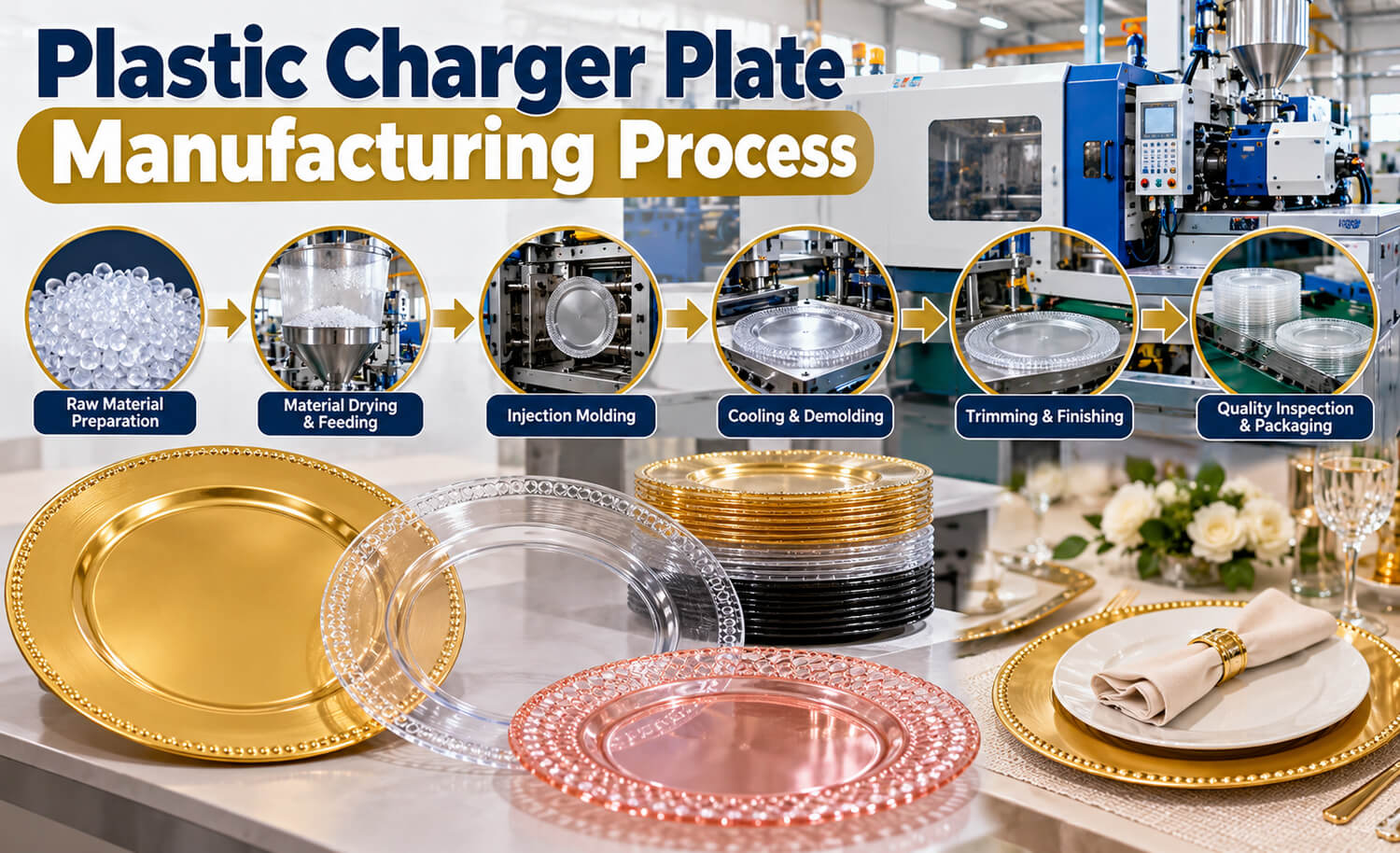
En Plato de plástico para raciones Manufacturing Process involves product design, material selection, mold development, plastic injection molding, surface decoration, quality inspection, and packaging. Manufacturers use controlled production methods to make charger plates with consistent shapes, colors, and finishes. For wholesale buyers, understanding these steps helps them compare suppliers, avoid quality problems, and choose products that meet their market needs.
Plastic charger plates are popular in wedding venues, hotels, restaurants, catering businesses, and event rental companies. They add color and style to table settings without the weight of many traditional decorative plates.
However, producing a good charger plate involves more than shaping plastic.
The plate needs a balanced structure, a clean surface, and an attractive finish. It should also be easy to stack, pack, and handle.
For wholesale buyers, small production differences can create major problems. Uneven edges may affect the product’s appearance. Poor paint adhesion can lead to peeling. Inconsistent colors can make a complete table setting look mismatched.
That’s why manufacturing control matters.
How Are Plastic Charger Plates Made?
The typical production route follows these stages:
Typical manufacturing workflow
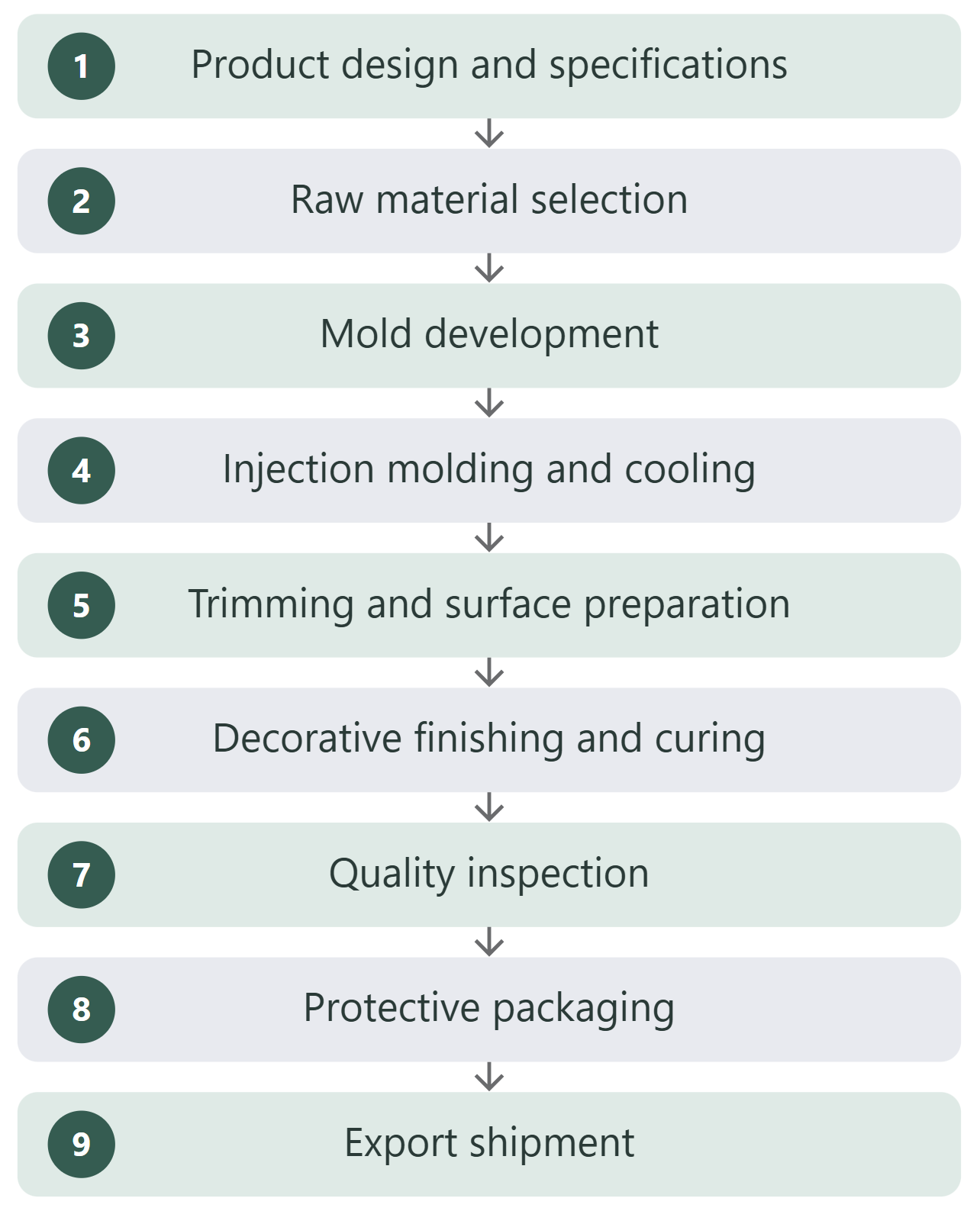
Illustrative workflow. Some finishes use different steps or equipment.
Each stage affects the final result. A well-designed mold supports accurate dimensions. Proper molding conditions reduce warping. Controlled finishing creates more consistent colors.
For importers and distributors, the main goal is simple: purchase decorative plates that look good across the entire order, not just in a showroom sample.
Choosing the Right Plastic Materials for Charger Plates
Material selection is one of the first important decisions in charger plate production.
Manufacturers commonly consider polystyrene (PS), polypropylene (PP), and acrylonitrile butadiene styrene (ABS). Each plastic has different properties, processing needs, and costs.
There is no single material that suits every product.
The correct choice depends on the plate’s design, target price, required toughness, surface finish, and intended use.
Comparing Common Plastic Materials
| Material | Main advantages | Important limitations | Suitable applications |
|---|---|---|---|
| Poliestireno (PS) | Rigid, economical, good detail reproduction | Can be brittle under impact | Decorative charger plates and high-volume ranges |
| Polipropileno (PP) | Lightweight, good toughness, chemical resistance | Surface coating may need pretreatment | Reusable plates needing greater flexibility |
| ABS Plastic | Good impact resistance and surface appearance | Often higher material cost | Decorative collections with more demanding durability requirements |
Why Is Polystyrene Commonly Used?
Polystyrene is a practical choice for many decorative charger plates.
It offers good dimensional stability and can reproduce molded details. This makes it suitable for textured rims, raised borders, and decorative designs.
Its relatively rigid structure also helps manufacturers produce thin, lightweight plates.
However, PS is not equally suitable for every application. Certain grades can crack when dropped or struck.
Therefore, the grade and finished design should match expected handling conditions.
When Should Buyers Consider PP or ABS?
PP may be considered where toughness, reduced brittleness, or chemical resistance is important. Its coating and bonding properties require special attention.
ABS can offer improved impact performance and attractive molded surfaces. Yet its cost and finishing requirements may differ.
Material choice can also affect finishing quality. A coating system that works well on PS might need adjustments for PP.
For large wholesale orders, buyers should request samples made from the actual production material.
They should also confirm whether the product is decorative only or designed for direct food contact.
A plastic resin’s general characteristics do not automatically prove that a finished, painted charger plate is food-contact safe.
Product Design and Injection Mold Development
A charger plate begins as a design, not a finished product.
Before production, manufacturers need to define the plate’s diameter, profile, rim pattern, thickness distribution, weight, and decoration requirements.
Many traditional charger plates are around 13 inches (33 cm) in diameter. However, sizes vary by collection and customer requirements.
From Product Concept to Technical Drawing
The design team may begin with a physical sample, a sketch, or a digital reference.
This concept is then developed into a technical drawing or three-dimensional CAD model.
The design should consider several practical details:
- Outer diameter and overall height
- Center recess and usable inner area
- Rim width and decorative pattern
- Wall thickness and structural support
- Stacking clearance and nesting behavior
- Gate locations and visible surface quality
A plate that looks attractive in a drawing may be difficult to manufacture reliably.
For example, an uneven wall structure can increase the risk of distortion during cooling.
Deep decorative patterns may also need special mold design to release cleanly.
Building the Injection Mold
After design approval, the manufacturer prepares the mold.
A mold normally contains the shaped cavity and core, along with feeding, cooling, venting, and ejection systems.
Steel molds are often used for repeat production because they can support long manufacturing runs when properly designed and maintained.
The tooling team must account for plastic shrinkage.
For example, published engineering guidance identifies typical PS molding shrinkage near 0.4–0.7%. Actual behavior depends on the resin, mold, geometry, and processing conditions.
Mold accuracy is particularly important for charger plates because their broad, shallow shape makes distortion easy to notice.
Sample Approval Before Mass Production
The first molded samples are checked for size, weight, shape, surface defects, and stacking fit.
The manufacturer may then adjust the mold or production conditions.
For OEM buyers, this is the ideal time to approve the physical design.
Changes after the mold has been finalized can be expensive.
A carefully approved pre-production sample helps prevent avoidable disputes during bulk production.
Plastic Injection Molding: From Resin to Plate
Injection molding is a widely used method for producing plastic charger plates in repeatable quantities.
The basic principle is straightforward. Plastic pellets are heated until they soften and flow. The molten material is then pushed into a shaped mold cavity.
After cooling, the finished plate is removed from the mold.
Although this sounds simple, several machine settings must work together to produce consistent results.
Raw Material Preparation
The production team first checks the selected resin and color requirements.
Plastic pellets may be mixed with approved color masterbatch or other additives, depending on the design.
The material must also be protected from moisture, dust, and contamination.
Drying requirements vary by resin. Some plastics need careful drying before molding. Others may require little drying when stored correctly.
Heating, Injection, and Cooling
The prepared material enters the injection molding machine.
Inside the heated barrel, a rotating screw moves and melts the resin. The machine then injects the molten plastic into the closed mold.
Packing pressure helps compensate for shrinkage while the plastic cools.
Once the plate becomes sufficiently rigid, the mold opens and ejector mechanisms release it.
The finished part is then inspected before moving to the next stage.
Typical Injection Molding Parameters
The following figures are published reference ranges for general-purpose polystyrene. They are not fixed production settings for every charger plate.
| Processing parameter | Reference range for PS | Manufacturing importance |
|---|---|---|
| Temperatura de fusión | 180–280°C | Influences melt flow and filling |
| Temperatura del molde | 20–70°C | Affects cooling and surface quality |
| Material injection pressure | 20–60 MPa | Helps fill the mold |
| Typical molding shrinkage | 0.4–0.7% | Influences finished dimensions |
| Tiempo de enfriamiento | Depends on the part and tool | Affects cycle time and distortion |
Preventing Common Injection Molding Defects
A manufacturer should monitor problems such as short shots, flow marks, sink marks, flash, and warping.
Large decorative plates need particular attention because uneven cooling can make the plate bend.
Regular machine checks and approved production settings help reduce variation.
For wholesale buyers, consistent molding means plates that stack properly, have cleaner edges, and present a more uniform appearance.
Surface Finishing and Decorative Coating Techniques
Surface finishing is often what makes a plastic charger plate attractive to the final customer.
A plain molded plate can become a gold, silver, black, pearl, or textured decorative product through additional finishing.
However, not every charger plate uses the same decoration process.
Manufacturers may use spray painting, vacuum metallization, molded colors, or combinations of several methods.
Surface Cleaning and Preparation
Before coating, the molded plates are checked for dust, grease, and surface defects.
Contamination may prevent paint or metal films from bonding properly.
Depending on the plastic, manufacturers may also use surface treatment or a special primer.
Good preparation can reduce peeling, uneven coating, and visible marks.
Vacuum Metallization for Metallic Finishes
Vacuum metallization is one method used to create a reflective metal appearance.
A typical process includes applying and curing a base coat, depositing a thin metal layer inside a vacuum chamber, and applying a protective topcoat.
Aluminum is commonly used for the metallic layer.
The topcoat may also be tinted to create different colors. A gold appearance, for example, does not necessarily mean that actual gold is deposited.
This process is described in technical guidance from Covestro’s vacuum metallization technical guide.
Spray Painting and Special Decorative Finishes
Spray painting allows manufacturers to achieve many colors and surface effects.
Popular choices include matte black, antique gold, champagne, rose gold, and solid custom colors.
Depending on the design, manufacturers may also use textured or layered effects.
For professional buyers, color consistency is essential.
A wedding rental company may place hundreds of identical chargers in one event space. Even small differences become noticeable when the plates sit side by side.
Buyers should therefore approve both the color standard and the finishing method before mass production.
Quality Control and Product Inspection Standards
Quality control should take place throughout production rather than only when products are ready for shipment.
For plastic charger plates, inspection normally focuses on appearance, dimensional accuracy, stability, material consistency, and finishing performance.
A beautiful sample is useful, but repeatability is what matters for wholesale purchasing.
Inspección de material entrante
Production quality begins with checking incoming raw materials.
The manufacturer should confirm the resin grade, material identification, color requirements, and supplier documentation.
When a product is made for a regulated application, relevant material certificates and test records may also be necessary.
In-Process Quality Inspection
During molding and finishing, operators should check products at agreed intervals.
The following table shows useful checkpoints for a wholesale charger plate order.
| Inspection item | What to check | Why it matters to buyers |
|---|---|---|
| Outer diameter | Match the approved drawing | Ensures consistent table settings |
| Plate weight | Stay within agreed limits | Supports product consistency |
| Planicidad | No excessive rocking or distortion | Improves presentation |
| Aspecto de la superficie | No obvious scratches, stains, or bubbles | Protects retail appearance |
| Rim and edges | No sharp flash or damaged details | Improves handling |
| Uniformidad del color | Match the approved sample | Prevents mismatched collections |
| Adhesión del recubrimiento | Pass the agreed test | Reduces peeling complaints |
| Apilamiento | Plates nest without excessive pressure | Supports safe storage |
| Embalaje | Correct quantity and protective materials | Reduces shipping damage |
Coating Durability and Adhesion Testing
Decorative coatings may require specific tests.
Tape adhesion testing, for example, can help evaluate coating attachment under a defined procedure.
ASTM D3359 provides recognized methods for assessing coating adhesion by tape testing. Test selection and acceptance limits should match the actual coating system.
Scratch resistance, rubbing resistance, and cleaning durability may also be evaluated.
However, buyers should not assume every metallic charger plate is dishwasher-safe.
Food-Contact Safety and Product Claims
Many decorative charger plates are designed to sit beneath dinner plates, not hold food directly.
When a product is intended for food contact, compliance must be assessed for the finished article and its intended conditions of use.
In the United States, the FDA regulates materials used in food-contact applications. Relevant requirements may include 21 CFR §177.1640 for polystyrene, along with rules applying to additives, coatings, and finished products.
Buyers should obtain appropriate supporting documents rather than relying on unsupported safety claims.
Custom Charger Plate Manufacturing and OEM/ODM Services
Customization helps importers and wholesalers create products for their own customers instead of selling identical collections.
A manufacturer may support customization through existing molds, modified decorative finishes, new product designs, or private-label packaging.
The right approach depends on the buyer’s budget, order quantity, and product goals.
Custom Colors and Finishes
Color is one of the most accessible forms of customization.
A buyer may need champagne gold for wedding suppliers, matte black for modern event venues, or seasonal colors for retail promotions.
When the same mold can be used, changing the surface finish may reduce the need for new tooling.
However, each new coating can require sampling, color approval, and durability testing.
The buyer should provide an approved color reference or physical sample.
Custom Patterns, Shapes, and Sizes
More extensive customization may involve creating a new design.
For example, a buyer may request a charger plate with a wider decorative rim, a unique geometric pattern, or a smaller diameter.
These changes can affect the mold and manufacturing process.
A new mold usually involves additional development costs.
The manufacturer should review the technical drawing before confirming feasibility or pricing.
Private-Label Packaging and Branding
Private-label services may include printed cartons, barcode labels, SKU information, carton markings, and branded packaging inserts.
These details are especially useful for retailers and distributors.
They allow imported products to move more smoothly into existing sales systems.
OEM/ODM Development Workflow
A practical custom-order workflow includes:
- Share product references, dimensions, and target market requirements.
- Confirm material, finish, order quantity, and packaging needs.
- Review the quotation and any mold development charges.
- Approve physical samples and packaging artwork.
- Confirm a written production specification.
- Start mass production after approval.
- Inspect the finished order before shipment.
For buyers, the strongest OEM programs are based on clear specifications.
A manufacturer should explain which changes are easy, which need tooling, and which require additional testing.
This approach helps both sides avoid delays and unexpected costs.
Manufacturing Costs, Production Capacity, and Lead Times
The cost of plastic charger plates depends on more than the amount of resin used.
Mold investment, part weight, production efficiency, decorative finishing, inspection, and packaging all influence the final price.
Understanding these cost drivers helps wholesale buyers evaluate quotations more accurately.
Major Cost Factors
| Cost factor | Effect on manufacturing cost |
|---|---|
| Plastic resin | Higher resin prices or heavier parts increase material costs |
| Mold development | New designs may require a separate tooling investment |
| Production cycle | Longer molding cycles reduce output per machine-hour |
| Decoración de superficies | Additional coating and curing steps increase processing costs |
| Order quantity | Larger runs may spread setup costs over more units |
| Quality requirements | Additional testing and inspection increase control costs |
| Embalaje | Individual protection and retail boxes add materials and labor |
| Transportation | Carton volume and shipment weight affect freight costs |
How Order Quantity Influences Unit Cost
Injection molding has both fixed and variable costs.
Fixed costs may include mold development and machine setup. Variable costs include materials, labor, energy, decoration, and packaging.
When the same mold supports a larger production run, some setup costs can be spread across more plates.
Consider a simple example.
Suppose a production setup costs $300.
Illustrative setup cost per plate
Based on a fixed $300 setup cost, excluding other manufacturing expenses.
$0$0.085$0.17$0.255$0.341,0003,0005,00010,00020,000
This chart illustrates why larger orders can reduce the setup cost per unit.
It does not represent actual factory pricing.
Production Lead Time Considerations
Lead time depends on mold availability, production capacity, surface finishing, order quantity, and packaging requirements.
A repeat order using an existing mold may move faster than a completely new OEM project.
Vacuum coating and complex packaging can also add production steps.
For buyers, it is important to distinguish between sample lead time, mold development time, mass production time, and shipping time.
A supplier’s quoted lead time should clearly state when the production clock begins.
That might be after deposit payment, sample approval, or final artwork confirmation.
Clear scheduling is particularly valuable for seasonal purchasing and event supply orders.
Packaging, Storage, and International Shipping
Even well-manufactured plastic charger plates can arrive damaged if they are not packed correctly.
This is especially important for metallic and painted products.
A highly polished surface may look excellent when it leaves production, yet become scratched during transportation.
For international buyers, packaging should protect the product while keeping freight and handling costs reasonable.
Protecting Decorative Surfaces
Plastic charger plates are often stacked to reduce carton volume.
However, direct contact between decorated surfaces can cause rubbing marks, especially during long-distance transportation.
Manufacturers may use thin protective sheets, tissue paper, PE bags, foam separators, or other suitable packaging materials.
The best method depends on the coating, plate shape, and shipment conditions.
For delicate metallic finishes, buyers should test whether the proposed separators offer enough protection.
Packaging materials should also be clean and compatible with the finished coating.
Carton Design and Packing Quantity
Carton design affects both product safety and shipping efficiency.
A larger carton may reduce packaging material per plate. However, it can also become heavy or difficult to handle.
A smaller carton may provide better protection but increase the number of shipping units.
Buyers should review the following details before approving export packaging:
- Number of plates per inner pack and master carton
- Carton dimensions and gross weight
- Protective separators and cushioning materials
- Carton strength and stacking performance
- Pallet requirements and shipping marks
- Barcode and retail packaging specifications
Export Packaging Inspection
Before shipment, a manufacturer should check carton quantities, labels, closures, and overall condition.
For products sold through retail channels, packaging artwork should match approved files.
Drop testing or simulated transportation testing may be appropriate for certain orders.
The purpose is to identify potential damage before the goods begin their international journey.
For wholesalers, effective packaging can reduce breakage claims, customer complaints, and replacement costs.
It also makes warehouse handling easier and helps products arrive in a condition suitable for resale.
Sustainable Manufacturing and Waste Reduction
Sustainability is becoming an important purchasing factor for many distributors, retailers, and hospitality suppliers.
Plastic charger plate manufacturing involves raw materials, electricity, coatings, packaging, and transportation.
Each stage creates opportunities to reduce waste and improve production efficiency.
However, sustainability claims should be supported by actual practices and evidence.
Reducing Material Waste During Molding
Injection molding can produce waste through runners, start-up parts, rejected plates, and production adjustments.
Manufacturers can reduce unnecessary waste through stable machine settings and preventive mold maintenance.
Accurate mold design also helps avoid excessive material usage.
In some cases, clean production scrap may be processed for reuse.
However, recycled material content must be controlled. Excessive reprocessing can affect appearance and mechanical properties.
Not every product specification allows recycled resin.
Improving Production Efficiency
Efficient production can reduce energy use and material losses.
Useful practices include monitoring molding cycles, maintaining cooling systems, preventing unnecessary machine downtime, and reducing rejected parts.
Good process control often supports both lower waste and more consistent quality.
Considering Surface Coatings and Recycling
Decorative finishing creates additional environmental considerations.
Paints, primers, and vacuum-applied coatings may affect recycling options and waste handling.
A plastic plate with several decorative layers is not automatically recyclable through ordinary local collection systems.
Actual recyclability depends on the resin, coating, local infrastructure, and waste-processing capabilities.
Manufacturers should avoid broad claims without supporting evidence.
Supporting Responsible Purchasing
Buyers can improve purchasing decisions by requesting information about resin identification, recycled content, packaging materials, and applicable environmental requirements.
They may also consider reusable product designs where appropriate.
Reusable charger plates can provide practical value in rental and hospitality settings, but their environmental impact depends on service life, washing, transport, and disposal.
The most useful approach is to match the product’s design with how customers will actually use it.
For manufacturers and buyers, reducing avoidable defects and shipping damage is also a practical sustainability measure.
How to Choose a Reliable Plastic Charger Plate Manufacturer
Selecting a manufacturer involves more than comparing prices.
For importers, event supply wholesalers, and retail brands, the supplier must deliver consistent quality across repeated orders.
A well-made sample is only the starting point.
You also need to understand how the factory manages production, inspection, customization, and shipping.
Evaluate Manufacturing Capabilities
Begin by confirming which production processes the supplier performs.
Some companies manufacture molded products and manage finishing internally. Others rely on specialized subcontractors for certain processes.
Either arrangement can work when responsibilities and quality controls are clearly defined.
Ask how the supplier manages mold development, resin selection, coating processes, and production inspection.
If you need a custom design, confirm whether the supplier can support technical drawings and sample development.
Request Representative Product Samples
Samples should match the proposed bulk order.
Check the size, weight, rim design, surface quality, color, and stacking behavior.
Handle the plates as your customers would.
For example, stack and separate several plates to evaluate surface rubbing.
Check whether the product remains stable on a flat table.
If coating durability matters, agree on a practical testing method before placing the order.
Review Factory Quality Management
A reliable supplier should be able to explain how quality is controlled.
Important questions include how incoming materials are identified, how production settings are maintained, and how defective goods are handled.
A written inspection specification can help avoid disagreements.
For large or high-value orders, buyers may also arrange an independent pre-shipment inspection.
Use a Supplier Evaluation Checklist
| Evaluation area | Questions for the supplier | Buyer priority |
|---|---|---|
| Manufacturing capability | Which processes are performed in-house? | Alto |
| Material control | Can the resin grade be identified? | Alto |
| Sample consistency | Will production match the approved sample? | Alto |
| Acabado decorativo | How is coating quality tested? | Alto |
| OEM development | Can the supplier provide tooling and custom designs? | Medio-alto |
| Embalaje | Can cartons be tested for transport damage? | Alto |
| Planificación de la producción | Is the quoted lead time realistic? | Alto |
| Documentation | Are required compliance documents available? | Alto |
| Servicio posventa | How are verified defects and claims resolved? | Alto |
Look Beyond the Lowest Quotation
A low unit price may look attractive, but it does not show the full purchasing cost.
Poor coatings can lead to returns. Weak packaging can cause transport damage. Inconsistent colors can make stock difficult to sell.
For professional buyers, reliable quality may be worth more than a small initial price difference.
When requesting a quotation, provide your target product, quantity, finish, packaging requirements, and destination market.
Clear purchasing details help manufacturers evaluate your project accurately.
Preguntas frecuentes
How Are Plastic Charger Plates Manufactured?
Plastic charger plates are commonly made through injection molding. Resin is heated and injected into a shaped mold, then cooled and removed. The plates may receive painting or metallic finishing before inspection and packaging. Exact steps depend on the product design.
What Is the Best Plastic Material for Charger Plates?
Polystyrene is a common option for rigid decorative charger plates. Polypropylene may suit products requiring greater toughness, while ABS offers other impact and appearance benefits. The best choice depends on price, intended use, finishing needs, and approved product specifications.
Are Plastic Charger Plates Made by Injection Molding or Thermoforming?
Injection molding is widely used for charger plates with detailed rims and decorative features. Thermoforming is another possible method for certain simpler, thin-wall designs. The appropriate process depends on geometry, material, order volume, tooling cost, and surface requirements.
How Are Gold and Silver Charger Plates Finished?
Gold and silver appearances may be created through decorative painting or vacuum metallization. Some metallized finishes use aluminum and a tinted protective coating. The method affects brightness, appearance, production costs, and durability, so buyers should approve finished samples.
Can a Manufacturer Produce Custom Charger Plate Designs?
Yes. Depending on its capabilities, a manufacturer may offer custom diameters, rim patterns, colors, surface finishes, and packaging. New shapes often require new tooling, while color changes may use existing molds. Buyers should confirm costs and minimum order quantities.
How Long Does Plastic Charger Plate Production Take?
Production time varies with the order size, mold availability, surface decoration, and factory schedule. New designs require additional development and sample approval. Repeat orders can often move faster. Always request separate estimates for tooling, sampling, production, and delivery.
Are Plastic Charger Plates Safe for Direct Food Contact?
Not necessarily. Many decorative charger plates are intended to sit below dinner plates. Direct food-contact suitability depends on the complete material and coating system, intended use, and applicable regulations. Buyers should request appropriate testing and documentation before making food-contact claims.
What Causes Scratches or Peeling on Metallic Charger Plates?
Scratches can result from handling, plate-to-plate contact, and inadequate packaging. Peeling may result from contamination, poor surface preparation, unsuitable coatings, or incomplete curing. Manufacturers can reduce these problems through process control, coating tests, and protective packaging.
What Should Wholesale Buyers Check Before Placing an Order?
Buyers should confirm material type, plate dimensions, weight, approved finish, order quantity, packaging, inspection criteria, and delivery requirements. Representative samples are essential. For custom products, also confirm mold ownership, development charges, and the procedure for approving changes.
Can Plastic Charger Plates Be Reused?
Many plastic charger plates are designed for repeated decorative use. However, durability depends on the resin, coating, cleaning method, and handling. Buyers should confirm care instructions and avoid assuming a finished charger plate is microwave-safe or dishwasher-safe without verification.
Conclusión
Understanding how plastic charger plates are manufactured helps buyers make better sourcing decisions.
Material selection, mold development, injection molding, decorative finishing, and quality inspection all influence the final product.
A plate may appear simple, but consistent production requires careful control.
For importers and wholesalers, three factors deserve special attention: product consistency, finish durability, and reliable delivery.
The lowest quotation is not always the best purchasing decision. A supplier that maintains stable quality and clear specifications can help reduce complaints, shipping losses, and repeat-order problems.
Before committing to mass production, approve representative samples, confirm the material and finish, and agree on measurable inspection requirements.