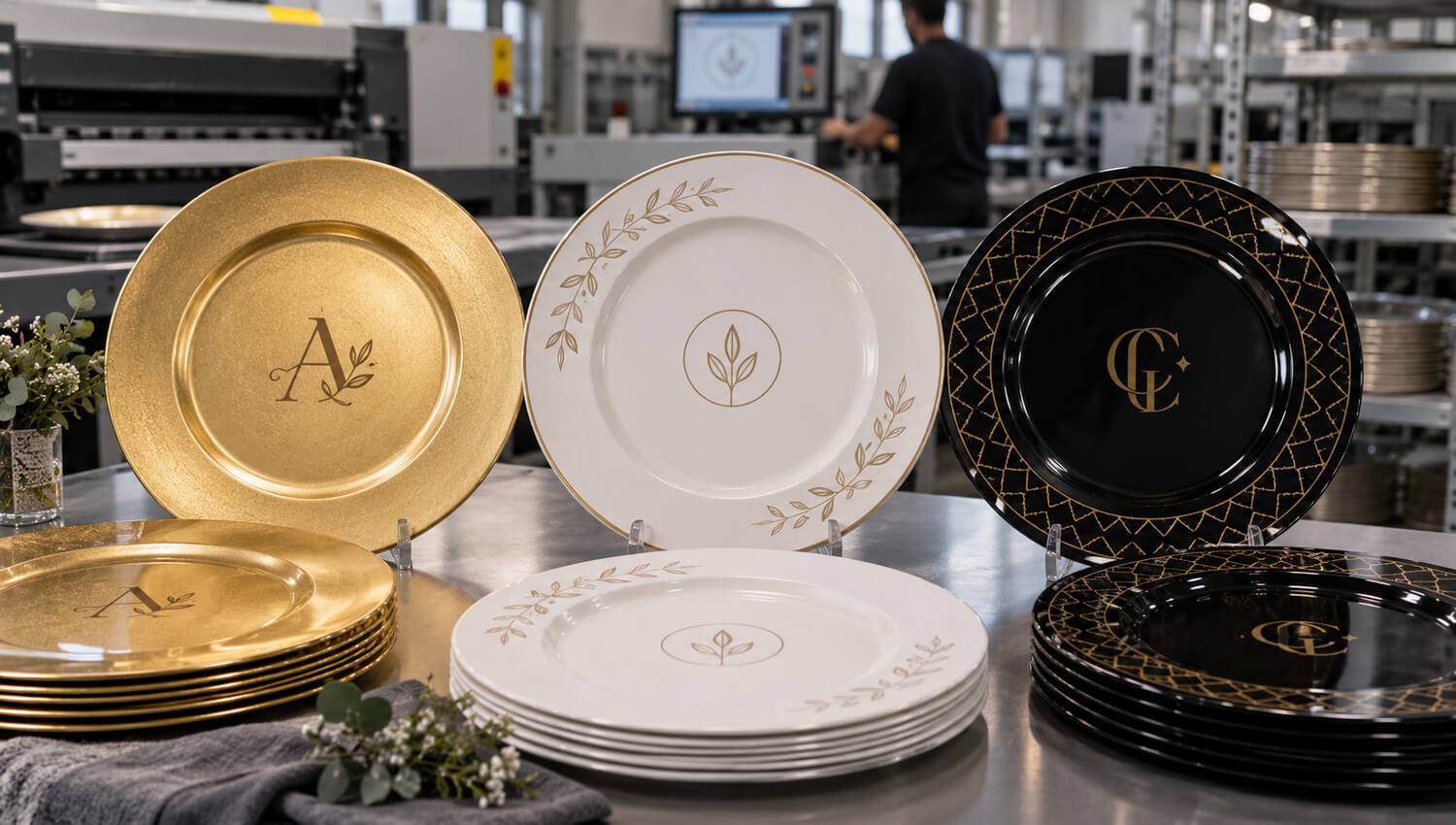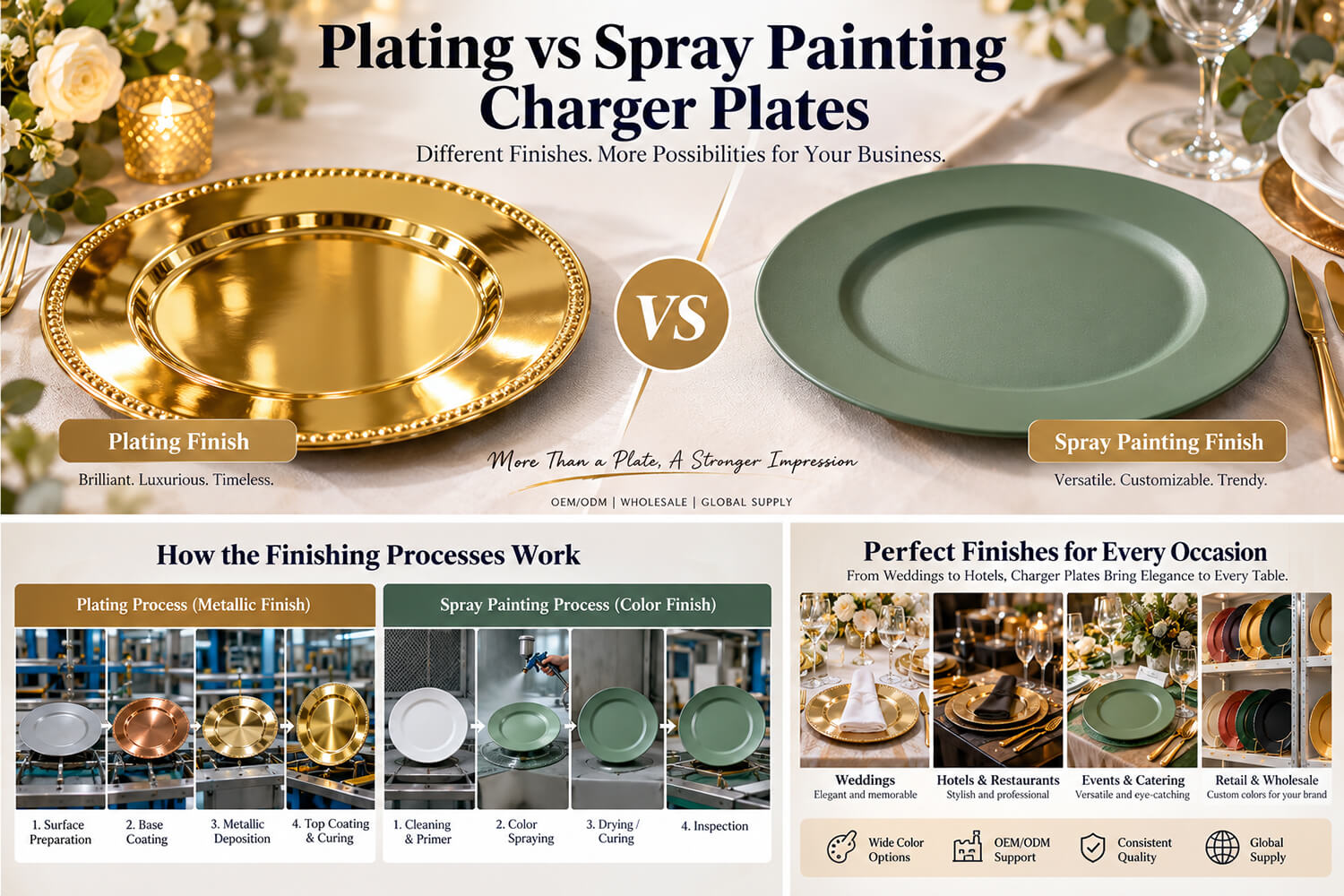
Choosing a Pantone color for a charger plate is not simply a matter of sending a color code to a factory. For reliable production, you should define the Pantone reference, plastic material, surface finish, manufacturing process, physical sample, and acceptable color tolerance before mass production begins.
That sounds like a lot, but the process is quite manageable when the specifications are clear.
For B2B buyers, color is often part of the product identity. A wedding supplier may need a soft ivory shade across several tableware items. A party brand may need its signature green. A distributor may need repeat orders to match stock purchased six months earlier.
This is why How to Choose Pantone Colors for Custom Charger Plates is really a question about color control, not just color selection.
A Pantone number gives the buyer and manufacturer a common starting point. It doesn’t automatically guarantee that a finished plastic plate will look identical to a printed Pantone card. Plastic resin, pigment, gloss level, molding temperature, coating, metallic effects, and lighting can all change how you see the final shade.
Pantone itself provides dedicated Plastic Chips for communicating and controlling colors on plastic products and hard goods. These physical chips are available across thousands of Pantone colors and include glossy and matte surfaces.
For overseas buyers, the safest approach is simple:
Specify → Sample → Compare → Approve → Record → Produce → Inspect.
This article explains how that process works in practice and how you can reduce color disputes before a custom charger plate order enters mass production.
Pantone Colors for Custom Charger Plates
When you develop Pantone Colors for Custom Charger Plates, start by treating the Pantone code as the color target rather than the complete production specification.
A good RFQ might say:
Pantone 7520 C, molded PP charger plate, opaque color, high-gloss finish, physical sample required before production.
That statement is far more useful than simply writing “beige” or sending a screenshot.
Why?
Because several details affect the finished appearance:
- Pantone reference
- Plastic resin
- Resin base color
- Surface texture
- Gloss level
- Épaisseur du produit
- Pigment concentration
- Decoration process
- Lighting conditions
The same pigment recipe can look slightly different in polypropylene and polystyrene. A matte plate may also appear softer or lighter than a glossy plate made with the same color formulation.
This becomes even more important with dark blue, burgundy, warm gray, ivory, pastel colors, and other shades where small changes are easy to notice.
From the manufacturing side, the best results come when the buyer and factory agree on a physical approved sample. Once approved, that piece becomes the production benchmark.
A simple purchasing specification can look like this:
| Exigence | Example |
|---|---|
| Produit | 13-inch plastic charger plate |
| Matériau | PP |
| Target color | Pantone 7520 C |
| Terminer | Brillant intense |
| Color method | Colored resin/masterbatch |
| Reference | Pantone card + approved molded sample |
| Mass-production standard | Approved golden sample |
| QC method | Visual check + instrument measurement if required |
For buyers developing several colors at once, create one specification sheet for each SKU. Don’t rely on emails scattered between your designer, purchasing team, and supplier.
The goal isn’t just to create one attractive sample. The real goal is to make the color repeatable during bulk production and future orders.
Choose the Correct Pantone Standard for Plastic Products
One common mistake is assuming every Pantone reference represents the same physical object.
It doesn’t.
A designer may work with PMS colors on a computer. Packaging artwork may use a Pantone coated-paper reference. Your charger plate, however, is a three-dimensional plastic product.
Pantone’s Color Bridge guides are designed mainly to compare Pantone spot colors with CMYK process-print equivalents, plus RGB and HTML values. They are useful for graphics and packaging communication, but they aren’t a substitute for evaluating the actual plastic product.
For molded products, Pantone also offers dedicated Plastic Chips. According to Pantone, these standards support plastic products and hard goods and are available for both PMS Graphics and Fashion, Home + Interiors colors. The chips use plastic material and provide glossy and matte viewing surfaces.
You can review Pantone’s official plastic color system here: Pantone Plastic Color Standards
So what should a charger plate buyer send?
Ideally:
- Exact Pantone number
- Pantone system or suffix
- Physical Pantone reference when color is critical
- Digital artwork for supporting reference
- Required plastic material
- Required gloss or matte finish
If your designer specifies Pantone 186 C, for example, the factory can use that code as the target. However, the final approval should still be made on the real molded or finished charger plate.
Avoid approving production based only on RGB or HEX values.
Those values are designed for screens. Even Pantone notes that RGB and HEX data can vary according to measurement conditions used in different references.
For serious private-label programs, physical color communication remains the safer choice.
Match the Pantone Color to the Charger Plate Material and Surface Finish
Plastic isn’t a neutral canvas.
The resin itself affects how pigments behave. That’s why material selection should happen before final color approval.
Two common materials used for plastic charger plates are PP and PS. Each has different physical characteristics. Their natural resin tone, transparency, surface response, and molding behavior can influence the finished color.
Consider an ivory plate.
On one material, the shade might appear slightly warm. On another, it could look cleaner or cooler. Increasing wall thickness can also influence how much light passes through a slightly translucent material.
Surface finish adds another layer.
Glossy Charger Plates
Gloss reflects more direct light. Colors may appear deeper, clearer, or more saturated.
Matte Charger Plates
Matte surfaces scatter light. The same general shade can appear softer and sometimes lighter.
Textured Charger Plates
Embossed patterns create highlights and shadows. A simple Pantone comparison on a flat area may not represent the visual effect across the entire design.
Transparent or Translucent Products
These need extra attention. Background color and light transmission affect what your customer sees.
Pantone’s Plastic Chips use tiered thicknesses and include glossy and matte surfaces specifically because these physical factors matter when evaluating plastic colors.
Pantone also notes that plastic color standards can support several resins, including polypropylene and polystyrene.
For a B2B order, never separate color approval from material approval.
A useful specification should read:
Target color + resin + finish + structure.
Par exemple :
Pantone 468 C / PP / opaque / glossy molded finish
is much clearer than:
Pantone 468 C
If the project later changes from PP to PS, request another sample. The original approval may no longer represent the final production result.
Consider the Manufacturing and Decoration Process Before Final Approval
Color matching also depends on how the color reaches the product.
Plastic charger plates can use several production and decoration methods. Each creates a different visual result.
| Process | Where Color Comes From | Main Color Consideration |
|---|---|---|
| Colored resin | Pigment/masterbatch mixed with resin | Strong repeatability when formulation is controlled |
| Peinture au pistolet | Coating applied after molding | Film thickness and gloss influence appearance |
| Vacuum plating | Metallic layer on molded plate | Pantone references may only approximate metallic effects |
| Impression UV | Printed ink on surface | Artwork profile and ink system affect color |
| Paper decal | Printed decorative transfer | Printed color differs from molded plastic color |
| Metallic pigment | Effect pigment in resin/coating | Viewing angle strongly affects appearance |
For plain solid-color charger plates, masterbatch coloring is often a practical route. A pigment formulation is developed and mixed into the base resin at a controlled ratio.
Once the formulation is established, the manufacturer still needs to manage resin batches, dosage, molding conditions, and processing temperature.
Decorated products need different thinking.
Imagine a gold charger plate with a metallic finish. A normal flat Pantone color cannot fully describe metallic reflectivity. In this case, the physical effect sample is more useful than relying on the Pantone number alone.
The same applies to:
- pearl colors
- glitter finishes
- translucent colors
- mirror finishes
- electroplated effects
- marble patterns
- color-shifting effects
Here, Pantone can still help define the general hue. However, the approved finished sample should become the real master standard.
Buyers should therefore tell the manufacturer what they are trying to match.
Is it:
- a logo?
- a packaging color?
- an existing plate?
- a fabric swatch?
- a Pantone card?
- another product in the collection?
This information helps the factory decide the most suitable production route before spending time on repeated color trials.
Approve a Physical Color Sample Before Mass Production
Never treat a computer rendering as final color approval for a custom plastic product.
Screens vary. Phones vary. Camera settings vary. Even office lighting can make the same plate look different.
The practical solution is physical sampling.
A normal development workflow may look like this:
Buyer Color Requirement
        ↓
Pantone Reference
        ↓
Material + Finish Confirmed
        ↓
Factory Color Matching
        ↓
Physical Sample Produced
        ↓
Buyer Reviews Sample
        ↓
Adjust if Necessary
        ↓
Final Sample Approved
        ↓
Golden Sample Sealed
        ↓
Mass Production
For a new color, the manufacturer may first prepare a small color sample or molded test piece. Once the shade is close, the actual charger plate can be produced for confirmation.
Color-sensitive buyers should evaluate three things together:
- hue
- surface appearance
- overall product effect
A tiny color plaque can confirm pigment direction. It cannot always show how a 13-inch charger plate will look under normal table lighting.
Once both parties approve the final sample, mark it clearly.
Include:
- SKU
- Pantone reference
- material
- finish
- approval date
- sample version
- buyer approval record
This piece becomes the golden sample.
One approved sample can remain with the buyer. Another should remain with the manufacturer.
That gives both parties the same reference during mass-production inspection.
Set Color Tolerance and Viewing Conditions for Reliable Quality Control
One difficult question in color production is:
How close is close enough?
A buyer may say, “The production color must be exactly the same as Pantone.”
That sounds reasonable. In manufacturing, however, color approval needs a measurable tolerance.
No physical production process produces infinite precision. Resin batches, pigment dispersion, temperature, surface gloss, thickness, and viewing conditions create small variations.
For important programs, manufacturers may use a spectrophotometer to measure the difference between the reference and production sample.
Color difference is often expressed as Delta E, or ΔE.
A lower value generally means the measured colors are closer.
However, don’t assume one Delta E requirement applies to every charger plate project. The acceptable threshold should be agreed between buyer and supplier based on the product, color, measurement method, and commercial requirement.
An example internal purchasing standard might look like this:
| Control Level | Exemple d'exigence | Suitable Use |
|---|---|---|
| Visual approval | Match approved sample visually | General decorative programs |
| Standard instrument control | Agreed ΔE limit plus visual inspection | Regular private-label orders |
| Tight brand control | Stricter agreed tolerance plus golden sample | Brand-sensitive programs |
| Effect finish | Physical sample and visual approval | Metallic, pearl, glitter, plating |
The exact limits are contractual specifications, not universal Pantone rules.
Lighting is also critical.
A sample that looks correct under warm office lighting may look different beside a window.
For repeatable review, both sides should use controlled lighting. Daylight-type viewing conditions are commonly used, with additional review under the expected retail or event environment when needed.
Pantone Plastic Chips are large enough for spectrophotometer measurement, which helps establish objective color communication for production control.
For B2B buyers, combining instrumental data with physical visual approval is usually safer than depending on either one alone.
Build a Clear B2B Color Approval Workflow
Many color problems aren’t actually pigment problems.
They’re communication problems.
One department gives the supplier a HEX code. Another sends a Pantone number. Later, the buyer approves a photograph through WhatsApp. When production arrives, nobody knows which reference was supposed to control the order.
A formal workflow fixes this.
RFQ Stage
Provide:
- charger plate model
- size
- plastic material
- Pantone code
- finish
- decoration
- order quantity
- target market
- reference sample, when available
Development Stage
The manufacturer confirms whether the requested color is practical with the chosen resin and process.
If necessary, the factory develops several trials.
Par exemple :
- Sample A: slightly warmer
- Sample B: closest measured match
- Sample C: slightly darker
This is especially useful when a buyer wants to match an existing physical product rather than a Pantone standard.
Approval Stage
The buyer selects or approves one physical version.
Don’t approve by saying:
“Looks good.”
Use a clear statement such as:
Sample B approved as the mass-production color standard.
Production Release
The supplier records the approved:
- pigment/masterbatch formula
- resin
- process
- machine parameters where relevant
- finish
- golden sample
The purchase order should also reference the approved sample.
Repeat Orders
Never restart the color discussion from zero.
Send the original SKU and approval details. The factory can compare the new production against the retained standard.
For importers with ten or twenty charger plate colors, this system becomes extremely valuable. It creates a permanent color library rather than depending on individual employees’ memory.
That improves purchasing efficiency while reducing disputes.
Control Batch-to-Batch Color Consistency During Mass Production
Approving the perfect sample is only half the job.
The next challenge is reproducing it across hundreds or thousands of pieces.
During bulk production, several variables can influence color consistency.
Matière première
Changing resin suppliers or resin grades can change the background tone.
Colorant or Masterbatch
The pigment formula and dosage must remain controlled.
Mixing
Poor dispersion can create uneven shade or streaking.
Processing Temperature
Some pigments can react differently under changing processing conditions.
Cycle Conditions
Stable molding parameters help maintain consistent appearance.
Traitement de surface
Coating thickness, curing, or plating conditions can influence the final effect.
That’s why color should be treated as a process-control requirement rather than a last-minute visual check.
A practical production QC plan may include:
- first-piece approval
- periodic production sampling
- comparison with the golden sample
- instrument measurements when specified
- inspection under controlled lighting
- batch identification
- retention samples
For large orders, don’t wait until the entire quantity is completed before checking color.
The factory should confirm the first stable production pieces and continue checking during the run.
Repeat orders deserve the same attention.
Imagine that you purchase 5,000 white charger plates in March and another 5,000 in September. Your customers may place the old and new stock next to each other.
Even a modest difference becomes obvious.
Keeping the original formula, production record, and approved sample therefore creates real commercial value.
This is particularly important for distributors, rental companies, hospitality suppliers, event brands, and wholesalers that replenish the same colors regularly.
The buyer isn’t simply purchasing “white plates.”
You’re purchasing repeatable white plates.
That’s a much more useful way to define quality.
Avoid Common Pantone Color Matching Mistakes
Most expensive color problems can be traced back to a few preventable mistakes.
The first is using a computer screen as the production standard.
A screenshot is useful for communication. It isn’t a reliable manufacturing reference.
The second is sending only an RGB or HEX value.
These values serve digital applications. They don’t directly define the appearance of molded plastic.
The third is forgetting the finish.
“Pantone Black” in matte plastic and high-gloss plastic may create noticeably different visual impressions.
Another common problem is changing the material after color approval.
Par exemple :
- Buyer approves a color on PP.
- Product specification changes to PS.
- Original pigment recipe is used automatically.
- Finished shade looks different.
- Buyer rejects production.
The safer response is to revalidate the color after any important material change.
Buyers should also be careful with metallic effects.
A normal Pantone solid color can’t fully communicate reflectivity, sparkle, metallic particles, or mirror plating.
Finally, never depend on vague approval language.
Avoid:
- “Almost right.”
- “Maybe slightly warmer.”
- “Similar to our previous order.”
- “Looks okay in the photo.”
Instead, document exactly what was approved.
Color Risk Chart
| Situation | Risk Level | Recommended Action |
|---|---|---|
| Standard solid color + approved sample | Faible | Normal production QC |
| New pastel color | Moyen | Physical sampling recommended |
| Very dark saturated shade | Moyen | Check resin and gloss carefully |
| Brand-specific corporate color | Élevé | Sample + instrument tolerance |
| Metallic or pearl effect | Élevé | Approve actual finished plate |
| Match an existing competitor/sample | Élevé | Send physical reference |
| Approval from screen only | Très élevé | Do not release mass production |
One rule solves many problems:
Approve what the factory will actually manufacture, not only what the designer sees on a screen.
Buyer Checklist for Custom Charger Plate Color Development
A good supplier can match many colors, but the quality of your input matters.
Before requesting samples, prepare a complete color brief.
Color Information
Provide:
- exact Pantone number
- Pantone suffix or system
- physical Pantone reference if available
- existing product sample when matching another item
Product Information
Include:
- diameter
- shape
- plate design
- plastic resin
- approximate thickness
- opaque or translucent construction
Surface Requirements
Confirmer :
- glossy
- semi-gloss
- matte
- textured
- metallic
- plated
- pearl
- glitter
Commercial Information
Also tell the supplier:
- estimated order quantity
- number of colors
- quantity per color
- packaging requirements
- target delivery schedule
- repeat-order expectations
The number of colors matters because every new custom shade may require separate material preparation, sampling, cleaning, setup, and production control.
Ask your manufacturer four practical questions:
Can you make a physical color sample before bulk production?
Will the approved sample be retained for repeat orders?
How will bulk production be compared with the approved color?
What information do you need if we want to reproduce this color next year?
These questions tell you far more about a supplier’s color-control process than asking only whether they can make “any Pantone color.”
When learning How to Choose Pantone Colors for Custom Charger Plates, remember that selection is only the first stage.
For professional sourcing, the real objective is a documented and repeatable production standard.
That gives you better consistency, easier repeat ordering, fewer disputes, and stronger control over your product line.
FAQ
Can a plastic charger plate match a Pantone color exactly?
A manufacturer can develop a very close match, but the finished appearance is affected by resin, thickness, gloss, surface texture, lighting, and production conditions. Approving a physical molded sample is safer than relying on the Pantone number alone.
Should I use Pantone C or Pantone U for a plastic charger plate?
You can provide the Pantone reference used by your designer, but C and U originally describe colors shown on coated or uncoated printed substrates. For plastic production, confirm the final shade using a physical plastic or finished-product sample.
Can I send an RGB or HEX color instead of a Pantone number?
You can send RGB or HEX as supporting information, but it shouldn’t be the only production standard. Screen colors depend on displays and digital color settings. A physical Pantone or approved molded reference provides much stronger manufacturing control.
Why does my Pantone color look different on PP and PS charger plates?
PP and PS have different optical and processing characteristics. Their natural base tone, transparency, pigment response, thickness, gloss, and molding conditions can affect the final appearance even when the target Pantone reference remains unchanged.
Do I need a new sample for every custom Pantone color?
For a new private-label color, physical sampling is strongly recommended. It is especially important for pastel, dark, brand-specific, translucent, metallic, pearl, or difficult shades where small differences may be commercially important.
How should I approve a custom charger plate color?
Review the real sample under consistent lighting. Compare it with your chosen physical reference. Once approved, record the Pantone number, material, finish, sample version, and approval date. Keep a golden sample for future production comparisons.
Can the same approved color be used for repeat orders?
Yes, provided the manufacturer keeps the original color formula, material specification, processing information, and approved reference. The next production should still be compared against the retained golden sample because raw materials and processing conditions can vary.
Does changing from glossy to matte affect the apparent color?
Yes. Gloss changes the way light reflects from the surface. A glossy plate may look richer or deeper, while a matte finish may appear softer. A major finish change should therefore trigger a new physical approval.
Conclusion
Learning How to Choose Pantone Colors for Custom Charger Plates starts with a Pantone number, but professional B2B color control goes much further.
Your final specification should connect five things:
Color + Material + Finish + Process + Approved Physical Sample
This approach makes communication much clearer.
Instead of telling a supplier, “We need Pantone 7520,” you can provide:
Pantone 7520 C, PP material, opaque construction, high-gloss surface, molded color, physical sample approval required before mass production.
That is a manufacturing specification.
It gives your supplier something they can develop, measure, reproduce, and inspect.
For standard colors, the process may be straightforward. For brand colors, pastels, metallic effects, pearl finishes, or products that must match an existing collection, allow enough time for physical sampling.
Once the correct shade is approved, keep a golden sample and production record.
This becomes especially valuable when you reorder six months or a year later.
Color consistency isn’t only an aesthetic issue. For importers and distributors, it affects inventory compatibility, customer complaints, repeat sales, packaging consistency, and brand presentation.
A well-controlled color-development process therefore protects both product quality and purchasing efficiency.