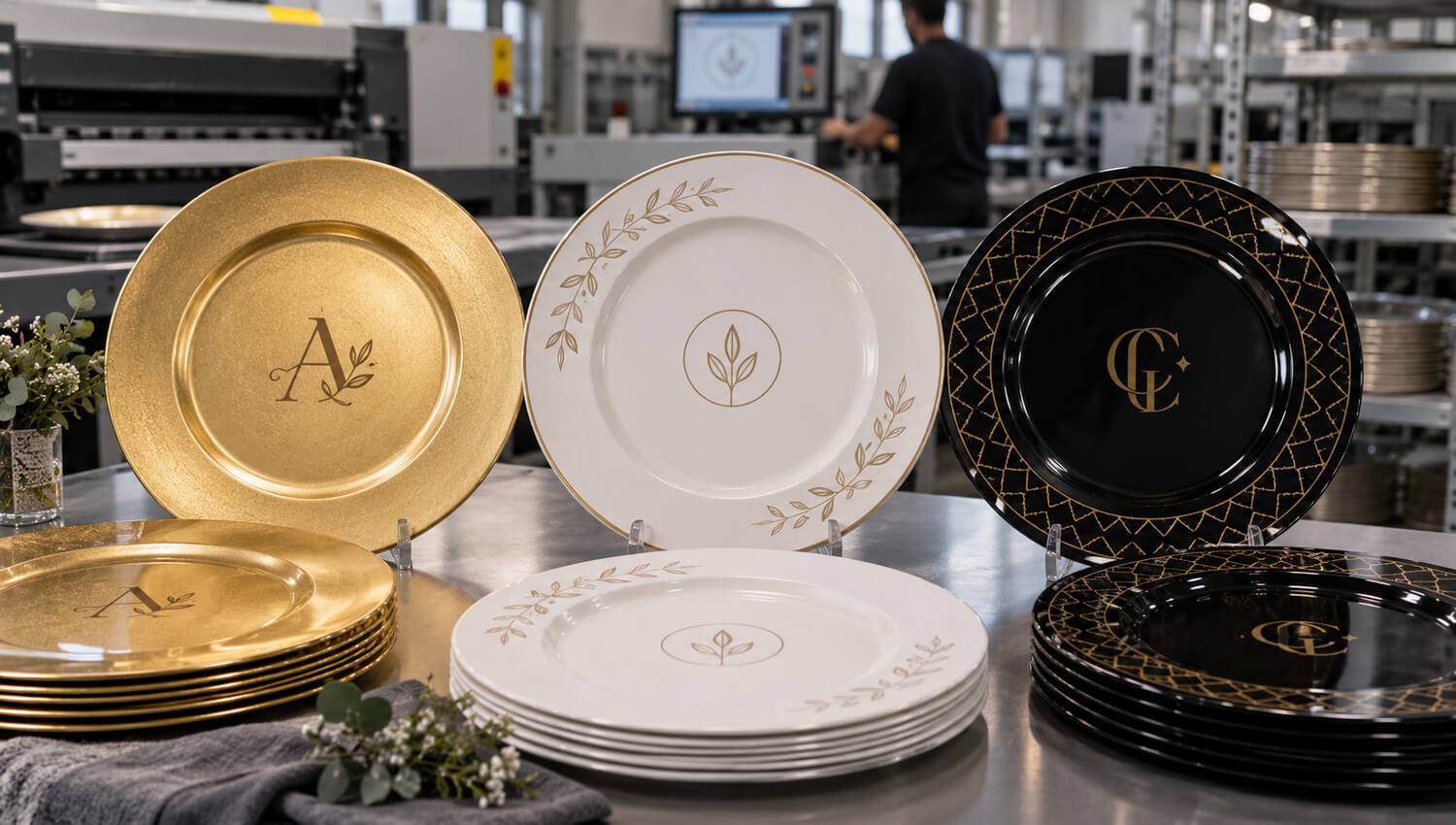
Custom Logo Charger Plates can be decorated through UV printing, screen printing, pad printing, heat transfer, decals, and other surface processes. The right method depends on your artwork, plate material, quantity, required durability, color accuracy, and target price. For buyers, choosing the process before mass production helps control cost while reducing color, adhesion, and appearance problems.
For importers, distributors, event suppliers, restaurant suppliers, and private-label brands, the printing technology is more important than it may first appear.
A logo that looks perfect on a computer screen may behave very differently on a plastic surface. Fine lines may disappear. A metallic background can change the appearance of printed colors. Some inks work well on one plastic but need additional surface treatment on another.
That is why professional customization starts with the plate material and decoration process—not simply with the artwork.
This guide explains the major printing technologies used for plastic charger plates and shows how you can choose an appropriate process for your next wholesale or OEM project.
Custom Logo Charger Plates
Custom charger plates allow buyers to turn a standard tableware accessory into a branded product. Logos, hotel names, wedding graphics, restaurant identities, promotional messages, patterns, and private-label designs can all be applied to the plate.
For B2B programs, customization usually has one of three goals.
- Create recognizable brand identity
- Develop an exclusive product for resale
- Produce event-specific or hospitality tableware
The best decoration method depends heavily on the design.
A simple one-color restaurant logo has very different production requirements from a photographic wedding pattern. Likewise, printing a small logo in the center of a plate is easier than decorating the entire rim.
Order quantity matters too.
For example, digital processes can make sense for smaller runs because they need less physical tooling. Traditional printing methods may become more economical when thousands of identical plates are required.
Another important factor is the plate itself.
Plastic charger plates may use materials such as PP or PS. Their surfaces can also be glossy, matte, metallic, textured, transparent, or coated. Printing ink must bond properly to that specific surface.
From a manufacturing point of view, therefore, the following information should be confirmed before quoting:
| Buyer Information | Pourquoi est-ce important ? |
|---|---|
| Plate material | Affects ink adhesion |
| Logo dimensions | Determines printable area |
| Number of colors | Influences printing process |
| Artwork complexity | Affects method and cost |
| Order quantity | Changes unit economics |
| Finition de surface | Changes color and adhesion |
| Required durability | Determines ink/coating requirements |
| Packaging method | Helps prevent printed surfaces from rubbing |
When buyers provide these details early, factories can recommend a process rather than simply quoting the cheapest option.
That usually results in a more reliable product.
Custom Logo Charger Plates: Printing Methods Explained
There isn’t one printing technology that is best for every charger plate.
In practical production, manufacturers select the process by balancing design detail, production quantity, surface shape, color requirements, durability, and cost.
Six decoration approaches are commonly considered:
| Printing Method | Meilleure application | Design Complexity | Typical Order Suitability |
|---|---|---|---|
| UV digital printing | Multicolor artwork and detailed images | Très élevé | Small to medium runs |
| Screen printing | Simple logos and solid colors | Low–medium | Medium to large runs |
| Pad printing | Small logos or limited areas | Moyen | Medium to large runs |
| Heat transfer | Detailed decorative graphics | Élevé | Medium to large runs |
| Decal transfer | Decorative patterns and special designs | Élevé | Medium runs |
| Surface coating + printing | Premium decorative effects | Medium–high | Large customized projects |
UV printing is attractive when artwork contains gradients, several colors, or fine detail.
Screen printing works well when the customer needs a simple logo in one or several solid colors. Once the screen is prepared, production can be efficient for repeat orders.
Pad printing is useful when the printable area is relatively small or has a shape that is difficult for conventional flat printing.
Transfer technologies offer another option when buyers want more elaborate patterns.
The decision should not be based only on unit price.
For example, a process that saves a few cents per plate but cannot accurately reproduce your logo could create a much larger problem after 10,000 units have been produced.
For this reason, we normally recommend approving an actual decorated sample whenever a new combination of plate material + finish + ink + artwork is being produced.
Think of the sample as the final technical standard.
Once approved, it gives both buyer and manufacturer a clear reference for mass production.
UV Printing for Detailed Full-Color Designs
UV printing has become an important option for customized plastic products because it allows detailed digital artwork to be printed directly onto a surface.
The process uses specially formulated inks that are rapidly cured with ultraviolet light.
One major benefit is artwork flexibility.
UV printing can reproduce:
- Multicolor logos
- Fine text
- Gradients
- Photographic images
- Complex illustrations
- Personalized graphics
This makes the method attractive for private-label products or promotional collections where visual detail is important.
Because the artwork is digitally controlled, physical printing screens are usually not required in the same way they are for screen printing. This can make UV printing practical for samples and smaller customized batches.
However, buyers should not assume that a digital file will look exactly the same on every plate.
The base color matters.
Imagine printing a light blue logo on a white charger plate. The result may appear bright and clean. Print exactly the same color on a gold plate, and the visual result can change significantly.
White ink or an underbase may therefore be required for some designs.
Adhesion also needs attention.
Plastic surfaces can have relatively low surface energy. Depending on the substrate and coating, surface preparation may be needed before printing.
A responsible sample evaluation should therefore check more than visual appearance.
Vérifier :
- Emplacement du logo
- Fine-line clarity
- Color appearance
- Surface adhesion
- Scratching resistance
- Edge definition
UV printing can be an excellent choice when your artwork is complex and your order does not justify several separate screens or printing plates.
For simple one-color logos in very high quantities, however, another process may offer better economics.
Screen Printing for Simple Logos and Large Orders
Screen printing remains one of the most useful decoration processes for simple branding.
The basic principle is straightforward. Ink passes through selected areas of a prepared mesh screen and transfers the graphic onto the product.
For charger plates, screen printing works particularly well with:
- Company logos
- Restaurant names
- Short text
- Simple icons
- Solid-color graphics
- Repeating promotional designs
One of its strengths is strong solid-color coverage.
If your artwork uses one or two clearly defined colors rather than photographs or complex gradients, screen printing deserves serious consideration.
It can also become cost-effective at higher volumes.
The reason is tooling.
Preparing screens creates an initial setup cost. Once the screens are ready, however, the same artwork can be repeated across a large production batch.
This spreads the setup cost across more units.
Color specification is especially important.
A buyer shouldn’t simply request “dark blue.” Different people may interpret dark blue differently.
A defined Pantone reference provides a much clearer production target. Pantone explains that its color systems are used to communicate and control colors between designers and manufacturers across different materials and production environments.
Buyers can learn more through the official Pantone Color Systems guide.
Even with a Pantone reference, buyers should remember that substrate and printing process affect the final visual result.
A Pantone swatch printed on paper isn’t the same physical surface as a plastic charger plate.
For important brand colors, approve a physical production sample rather than relying only on a computer monitor.
That extra step can prevent a surprisingly common sourcing problem: technically correct artwork but visually unacceptable finished products.
Pad Printing for Small and Precise Branding Areas
Pad printing uses a flexible silicone pad to transfer ink from an engraved printing plate onto a product.
Its key advantage is its ability to print on surfaces that aren’t completely flat.
This can be useful for charger plates because some designs include curved centers, raised rims, recessed areas, or decorative shapes.
Rather than decorating the complete plate, pad printing is normally more suitable for a focused area.
Typical uses include:
- Small brand marks
- Center logos
- Short text
- Product identifiers
- Promotional marks
For B2B buyers, logo size is an important consideration.
A very detailed logo that looks excellent on a 100 mm-wide design may lose clarity when reduced to 20 mm. Tiny letters may fill in, while fine lines may become difficult to reproduce.
That is why artwork should be evaluated at its actual printing size.
A useful rule during product development is simple: never approve artwork only while looking at a highly enlarged version on a computer.
Print the design at actual size first.
Can you still read the text?
Are the thin lines visible?
Does the trademark symbol remain clear?
These small checks save time later.
Pad printing also requires good positioning control. If the logo needs to align precisely with an existing molded pattern, fixture accuracy becomes particularly important.
For high-volume repeat orders, the buyer should define an acceptable position tolerance during sample approval if alignment is critical.
A golden master sample can then be retained as a production reference.
Pad printing isn’t automatically better than screen printing or UV printing. Its value comes from the specific geometry of the product and the location of the graphic.
For a small logo on a difficult area, though, it can be a very practical solution.
Heat Transfer and Decal Printing for Decorative Patterns
When customization moves beyond a small logo, transfer decoration can become attractive.
Heat transfer uses pressure and heat to move a printed design from a carrier film onto the product surface.
The process can reproduce more complex decorative patterns than simple one-color printing.
Depending on the product design and transfer system, buyers may use it for:
- Multicolor patterns
- Decorative borders
- Repeating artwork
- Fashion-oriented collections
- Seasonal products
- Private-label designs
Decals work on a similar idea from a buyer’s perspective: artwork is first produced on another carrier and then transferred to the finished product.
The exact production technique varies.
For sourcing purposes, what matters is understanding that transfers often provide greater decorative freedom but involve additional process controls.
Temperature, pressure, positioning, curing, film quality, and substrate compatibility can all influence the final result.
The edge of the decoration deserves attention too.
Ask your supplier whether the transfer edge will be visible on the finished product.
This is particularly important when the design is intended to create a premium appearance.
Buyers should also think about repeatability.
Suppose you order a collection this year and want the same pattern twelve months later. The manufacturer needs properly archived artwork, color standards, process specifications, and approved references.
For private-label programs, it’s therefore useful to assign a product code to each approved decoration.
Par exemple :
Plate Model + Base Color + Decoration Version + Packaging Version
This simple system reduces confusion when several similar products are reordered.
For complex decorative charger plates, the appearance of the sample remains more meaningful than a digital rendering.
Approve the real product under normal lighting before authorizing the full production quantity.
How Plastic Material and Surface Finish Affect Printing
Two plates with exactly the same shape can behave differently during printing if their materials or surface finishes are different.
This is one of the most important technical points for B2B buyers.
PP and PS, for example, do not have identical surface characteristics. Coated products introduce another variable because the ink is bonding to the coating rather than directly to the original plastic.
Surface texture matters as well.
Consider these examples:
| Surface | Printing Consideration |
|---|---|
| Glossy | Smooth appearance but adhesion must be confirmed |
| Matte | Can provide a different visual color result |
| Metallic | Base color can affect printed color appearance |
| Textured | Fine graphics may lose definition |
| Transparent | White underbase may be necessary |
| Coated | Compatibility with coating must be tested |
Surface preparation can sometimes improve adhesion.
The exact approach depends on the material and printing system, so manufacturers should test the production combination rather than apply one universal rule.
This is particularly important for PP products, where surface treatment may be considered depending on the ink system.
Another common issue is metallic finishes.
A gold or silver charger plate reflects light differently from a plain white plate. The same printed logo can therefore appear darker, warmer, or less opaque.
When brand identity is important, buyers should specify both the plate base finish and the target logo color during sample development.
Don’t approve the logo separately from the plate.
Approve the combination.
This is one reason experienced sourcing teams keep physical samples from previous orders. They provide a much more practical reference than photos.
When requesting a quotation, you can also ask your manufacturer:
- What plastic is used?
- Is the plate painted, plated, coated, or molded in color?
- Does this decoration require pretreatment?
- Has the proposed ink been tested on this finish?
- Can a printed sample be produced before mass production?
Those questions help identify technical risks before they become expensive production problems.
Printing Method Comparison for B2B Buyers
The right decoration method is usually a compromise between appearance, order quantity, production cost, and technical suitability.
The following comparison provides a useful starting point.
| Facteur | Impression UV | Screen Printing | Pad Printing | Heat Transfer | Decal |
|---|---|---|---|---|---|
| Full-color graphics | Excellent | Limité | Limité | Excellent | Excellent |
| Fine details | Excellent | Bien | Bien | Très bien | Très bien |
| Simple logo | Très bien | Excellent | Excellent | Bien | Bien |
| Curved/small area | Limited by equipment | Limité | Excellent | Depends on shape | Depends on shape |
| Small production runs | Très bien | Fair | Fair | Fair | Bien |
| Large repeat orders | Bien | Excellent | Excellent | Très bien | Bien |
| Setup requirement | Low–medium | Moyen | Moyen | Medium–high | Moyen |
| Uniformité des couleurs | Very good with controls | Excellent for spot colors | Très bien | Très bien | Très bien |
| Artwork flexibility | Excellent | Moyen | Moyen | Élevé | Élevé |
This table should not be treated as a universal engineering specification. Equipment, ink, product geometry, and factory processes vary.
Instead, use it as an initial purchasing framework.
For example, imagine you need 500 plates with a full-color event graphic.
UV printing may be worth evaluating first.
Now imagine you need 30,000 plates with one white logo repeated in exactly the same position.
Screen or pad printing may offer a more practical production model, depending on logo location and plate geometry.
For buyers, total project cost is more useful than printing cost alone.
Réfléchissez à ceci :
Tooling + sample cost + printing cost + defect risk + packaging + repeat-order consistency
A method with a slightly higher unit price can sometimes produce the lower overall sourcing cost if it reduces rejection and improves repeatability.
Ask your supplier for a recommendation based on the actual artwork and quantity.
A serious manufacturer should be able to explain why a method is recommended rather than simply naming one.
Artwork, Pantone Color Matching and Pre-Production Samples
Good manufacturing begins with good artwork.
Sending a small JPEG taken from a website often creates unnecessary problems. Logos intended for commercial printing should ideally be provided as editable vector files.
Common formats include:
- AI
- EPS
- PDF vector artwork
- SVG
Vector graphics allow the manufacturer to resize artwork without losing edge quality.
Fonts should also be outlined or converted to paths before the file is released for production. Otherwise, a missing font can change the appearance of your logo.
Color information is equally important.
For spot-color printing, provide a recognized color reference whenever possible rather than describing the color verbally.
Pantone notes that color appearance can vary depending on the material and production process, which is precisely why physical proofing remains valuable.
A good artwork approval file should confirm:
| Approval Item | Example |
|---|---|
| Plate model | 13-inch round charger |
| Plate color | Metallic gold |
| Logo width | 55 mm |
| Emplacement du logo | Center |
| Référence des couleurs | Specified PMS color |
| Printing method | Screen printing |
| Artwork version | V3 |
| Emballage | Individual protective bag |
Once this information is confirmed, the next stage should be a physical sample when the project requires precise visual control.
Photographs can help with quick communication, but they shouldn’t replace a sample for critical colors. Camera settings, screens, and lighting all change the appearance.
For a new OEM project, the safest approval sequence is:
Artwork → digital layout → decorated sample → buyer approval → mass production
That workflow may seem slower at the beginning.
In reality, it often saves time because disagreements are resolved before thousands of plates have been printed.
Quality Control for Custom Printed Charger Plates
A printed charger plate isn’t finished simply because the logo looks correct.
Quality inspection should evaluate both appearance and consistency.
A practical inspection normally begins with visual checks.
Inspectors can verify:
- Emplacement du logo
- Missing printing
- Smearing
- Uneven edges
- Variation de couleur
- Foreign particles
- Rayures
- Défauts de surface
- Incorrect artwork
Adhesion is another important area.
The appropriate test method depends on the coating and printing system. Buyers with specific durability requirements should define those requirements before production instead of assuming every print technology performs identically.
Packaging also affects print quality.
A perfectly printed plate can still arrive scratched if two decorated surfaces rub together throughout ocean transportation.
For this reason, protective packing needs to be considered as part of the decoration project.
Possible solutions include:
- Protective bags
- Tissue or foam separation
- Stacking orientation control
- Boîtes intérieures
- Séparateurs
- Outer cartons sized to limit movement
From a factory perspective, repeatability is just as important as the first sample.
The goal isn’t to produce one perfect piece. It is to produce thousands of pieces that remain reasonably consistent with the approved reference.
For recurring orders, both sides should maintain the final artwork and approval information.
At minimum, keep records of:
SKU, plate finish, printing method, artwork version, logo dimensions, color reference and packaging specification.
That creates a simple product control file.
It becomes especially valuable for distributors managing dozens of private-label SKUs.
Good quality control isn’t an inspection added at the end. It begins when the buyer and manufacturer define the product clearly.
How to Choose the Right Custom Printing Method
For most buyers, choosing the process becomes easier when you answer five questions.
How complex is the artwork?
Photographs, gradients, and many colors point toward digital or transfer methods. Simple spot-color logos often suit screen or pad printing.
How many pieces are required?
Tooling costs matter more on small runs. At larger volumes, those setup costs are spread across more pieces.
Where will the logo be printed?
A flat central area, curved rim, recessed area, and complete plate surface may require different techniques.
How accurate must the color be?
Corporate branding programs may require tighter control than one-time decorative products.
What level of durability is expected?
An event product used occasionally has different requirements from products handled repeatedly by a restaurant or rental company.
You can use this simple decision chart:
Simple logo + high quantity
→ Evaluate screen printing
Small logo + difficult surface position
→ Evaluate pad printing
Full-color detailed artwork + flexible quantity
→ Evaluate UV printing
Large decorative pattern + complex visual effect
→ Evaluate heat transfer or decal decoration
However, final process selection should still be based on a real sample.
A manufacturer’s job isn’t only to accept an artwork file.
A capable OEM supplier should review whether that design is practical for production and identify risks before mass manufacturing begins.
If lettering is too small, the supplier should flag it.
If a metallic surface could change the logo appearance, the buyer should know.
If another process would provide better repeatability, it should be discussed.
That technical communication is often what separates a smooth custom order from a frustrating one.
OEM Custom Charger Plate Manufacturing Process
A well-organized OEM project follows a clear sequence.
Requirement Review
Send the manufacturer your:
- Plate style
- Diamètre
- Base color
- Order quantity
- Logo file
- Logo size
- Printing location
- Packaging requirement
- Destination market
Artwork Review
The factory evaluates whether the artwork is suitable for the proposed printing technology.
Potential problems can then be corrected.
Quotation
Pricing should identify major customized elements and any necessary setup or sample charges.
Pre-Production Sample
A physical decorated sample allows the buyer to approve color, position, proportion, and overall appearance.
Mass Production
Production begins against the approved specifications.
Contrôle qualité
The manufacturer checks plate appearance, decoration, quantity, and packaging according to the agreed standard.
Packing and Shipping
Printed surfaces should be adequately protected to reduce scratching during handling and transportation.
For international B2B projects, this structured workflow gives both parties clear checkpoints.
It also makes repeat orders easier.
Instead of starting again from a photograph or old email conversation, the buyer can provide the existing SKU and request another production run according to the approved specification.
For wholesalers and distributors developing a series of custom products, this becomes especially useful.
You may have the same charger plate in five base colors and three logo designs.
Without version control, mix-ups are easy.
With a proper SKU and artwork system, managing the program becomes much simpler.
For a quotation, send your charger plate size, quantity, preferred finish and vector logo artwork to the manufacturer. A suitable printing process can then be recommended before sampling.
Foire aux questions
What is the best printing method for a custom logo charger plate?
There is no single best method. Screen printing is often suitable for simple logos and larger quantities, while UV printing is better suited to detailed multicolor artwork. Plate material, surface shape, quantity, and durability requirements should also be considered.
Can you print a Pantone logo color on plastic charger plates?
Yes, many printing processes can work toward a specified Pantone reference. However, the plastic color, surface finish, ink, and printing method can affect the final appearance. A physical sample is recommended when exact brand color is important.
Can full-color photographs be printed on charger plates?
Yes. UV digital printing and some transfer processes can reproduce photographs, gradients, and detailed multicolor artwork. The final result depends on image resolution, plate background color, printable area, and the compatibility of the decoration process with the surface.
What artwork file should I send to a charger plate manufacturer?
Vector files such as AI, EPS, SVG, or vector PDF are preferred. They allow the manufacturer to resize the logo without losing quality. Fonts should be outlined, and Pantone references should be provided when accurate spot colors are required.
Can I get a sample before placing a bulk order?
For customized products, a pre-production sample is strongly recommended. It allows you to check logo size, location, color, surface appearance, and printing quality before approving mass production, particularly when developing a new private-label design.
Does custom printing increase the MOQ?
It can. Some printing methods require screens, printing plates, transfer films, fixtures, or other setup work. Digital printing may offer greater flexibility for smaller quantities, while traditional methods can become more economical as production volume increases.
How durable is a printed logo on a plastic charger plate?
Durability depends on the plastic substrate, ink system, surface preparation, printing technology, and product use. Buyers with specific abrasion or handling requirements should tell the manufacturer before sampling so the decoration method can be evaluated accordingly.
Can the logo be printed on a gold or silver charger plate?
Yes, but metallic backgrounds can influence printed colors. Some designs may require an opaque white base layer or another technical solution. Always evaluate a physical printed sample if brand-color accuracy is important.
Conclusion
Custom decoration can turn an ordinary charger plate into a private-label product, hospitality accessory, promotional item, or recognizable branded collection.
The most important lesson is that printing should not be separated from product engineering.
UV printing offers excellent flexibility for detailed designs. Screen printing is highly practical for clean spot-color graphics and repeat production. Pad printing solves many small-area and shaped-surface challenges, while transfer and decal processes provide greater freedom for decorative patterns.
Yet printing technology is only one part of the decision.
Successful Custom Logo Charger Plates also depend on:
- Correct plastic and surface selection
- Suitable artwork
- Defined color standards
- Realistic logo dimensions
- Pre-production sampling
- Consistent quality control
- Protective packaging
For buyers, the safest approach is to send the actual artwork and project requirements to the manufacturer before selecting the decoration method.
That allows the factory to evaluate the complete product—not just the logo.
Planning a wholesale or private-label charger plate project? Send us your logo artwork, required quantity, plate size, target finish and packaging requirements. Our manufacturing team can evaluate the design and recommend a practical customization method for sampling and mass production.
A well-approved sample today can prevent thousands of inconsistent printed plates tomorrow.