Plating and spray painting create very different finishes on decorative charger plates. Plating is usually preferred when you need a bright, reflective, metallic appearance, while spray painting offers greater flexibility in colors, textures, and lower-volume customization. For B2B buyers, the better choice depends on your target price, required appearance, order volume, packaging, durability expectations, and end-use market.
This distinction matters more than it may seem.
A charger plate may have the correct size, shape, and base material, yet a poor surface finish can make the entire product look low grade. Uneven color, scratches, weak adhesion, dust particles, or inconsistent metallic tones are immediately visible on large decorative surfaces.
For importers and distributors, these problems can lead to customer complaints, rejected shipments, or costly sorting after arrival.
From a manufacturer’s point of view, surface finishing also changes production planning. Different finishes require different preparation processes, production equipment, inspection points, lead times, and minimum order considerations.
That is why buyers shouldn’t choose a finish only from a catalog photo.
You should consider:
- Your target retail and wholesale price
- Required metallic or solid-color effect
- Expected order quantity
- Custom color requirements
- Scratch and handling expectations
- Packaging method
- Target customers
- Sample approval requirements
- Acceptable color variation
This guide compares the two major decorative finishing methods from a practical B2B sourcing perspective.
Plating vs Spray Painting Charger Plates
Plating vs Spray Painting Charger Plates mainly comes down to a choice between metallic visual performance and flexible decorative customization.
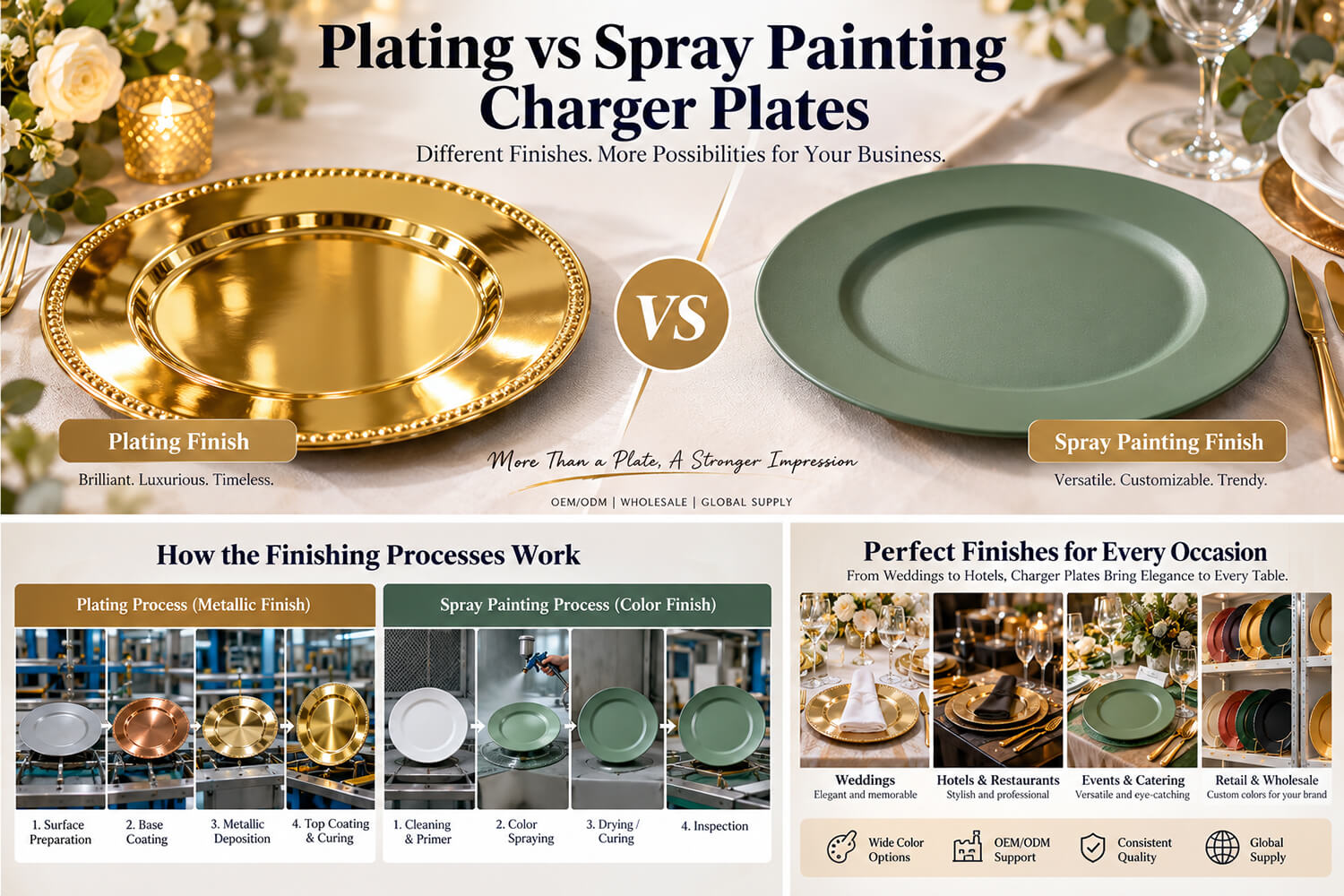
Plating produces a thin metallic-looking surface over the prepared charger plate. Depending on the manufacturing system, decorative plastic parts may use vacuum metallization or related metallic coating processes rather than traditional metal electroplating. The result can resemble polished gold, silver, rose gold, chrome, or other reflective metallic finishes.
Spray painting works differently. A liquid coating is sprayed across the surface and then dried or cured. Manufacturers can adjust pigments, gloss levels, metallic particles, textures, and other coating properties to produce a much wider color range.
Here is a simplified buyer comparison:
| Omil | Plated Finish | Spray Painted Finish |
|---|---|---|
| Metallic appearance | A'lo | Yaxshi dan a'lo |
| Mirror-like reflection | Kuchli | Cheklangan |
| Solid color selection | Cheklangan | Juda keng |
| Pantone matching | More difficult | Osonroq |
| Mat pardozlar | Possible but less common | A'lo |
| Texture options | Cheklangan | Wide |
| Small custom runs | Less flexible | More flexible |
| Setup complexity | Yuqori | Lower for many projects |
| Surface preparation | Very important | Very important |
| Premium visual effect | A'lo | Depends on coating |
| Scratch visibility | Often obvious | Depends on coating system |
| Color switching | More complicated | Relatively easy |
Neither process is automatically better.
If your customer wants a bright gold charger plate for weddings or luxury table settings, plating can create the strong metallic appearance they expect.
If your customer wants sage green, navy blue, champagne matte, ivory, terracotta, or a brand-specific Pantone color, spraying usually provides more practical options.
The correct decision should therefore start with your target market rather than the production method.
How Electroplating and Spray Coating Processes Work
Understanding the production process helps buyers identify where quality problems may occur.
For plastic charger plates, the metallic process often begins with injection-molded or molded plastic substrates. The surface must be clean and smooth because metallic coatings can highlight small scratches, flow marks, dust, or molding defects.
A typical metallic finishing workflow may include:
Surface preparation → cleaning → base coating → metallic deposition → protective top coating → curing → inspection
The exact process depends on the material, factory equipment, desired finish, and decorative system being used.
Spray painting normally follows another workflow:
Surface cleaning → pretreatment → primer if required → color spraying → drying or curing → topcoat if required → inspection
The quality of the finished product depends heavily on preparation.
In production, buyers sometimes focus almost entirely on paint color. Yet the most expensive problems often begin before the color coat is applied.
Dust may become trapped under the finish. Oil contamination can reduce adhesion. Inconsistent spraying distance can produce uneven thickness. Poor curing may make the coating softer than expected.
Metallic finishes can be even less forgiving because reflective surfaces make defects easier to see.
For this reason, our manufacturing approach is to evaluate the substrate before finishing rather than relying only on final inspection.
Important checkpoints include:
- Molded surface condition
- Oil and dust removal
- Edge condition
- Qoplama qoplamasi
- Rang izchilligi
- Drying or curing
- Adhesion
- Yuzadagi tirnalishlar
- Qadoqlash himoyasi
A buyer comparing quotations should therefore ask more than, “Is it plating or paint?”
Ask the supplier to explain the full finishing system.
Two factories may both describe a product as “gold plated,” but their preparation, protective coating, curing process, inspection standards, and packaging can be very different.
Those differences often determine how the product actually performs after shipment.
Metallic Appearance, Color Depth, and Premium Visual Effect
Appearance is one of the strongest reasons buyers choose plated charger plates.
A good metallic coating can create a clean, reflective surface that resembles polished metal. Gold and silver are particularly popular because they work well in weddings, banquets, hotels, catering events, and holiday table settings.
Under strong lighting, plated surfaces can create highlights that painted products may struggle to reproduce.
This makes the finish attractive for photography and premium table displays.
Spray painting, however, shouldn’t be dismissed as a lower-grade option.
Modern decorative coatings offer impressive effects, including:
- Metallic gold
- Shampan oltin
- Atirgul oltin
- Mat qora
- Pearl white
- Antik bronza
- Copper
- Satin silver
- Frosted colors
- Soft-touch effects
- Multicolor decorative finishes
The real advantage is flexibility.
Imagine a distributor developing six charger plate collections for different seasons. One requires classic mirror gold. Another requires Christmas red. A third requires matte forest green.
Using metallic finishing for every design may not be practical.
Spray coating makes it easier to develop product families around changing trends.
Color control is another consideration.
For private-label projects, customers may provide Pantone references. Liquid coatings can generally be adjusted more easily to approach specific color requirements than reflective metallic treatments.
However, buyers should always approve physical samples.
Screen colors aren’t reliable enough for final production approval because monitor settings, lighting conditions, gloss level, and substrate color can all change how the finished product appears.
We normally recommend evaluating color samples under several lighting conditions.
A champagne finish that looks subtle under factory lighting may look warmer or darker under hotel lighting.
For buyers, the key question should therefore be:
Do you need maximum metallic reflection or maximum decorative flexibility?
Your answer usually points toward the appropriate finishing method.
Scratch Resistance, Adhesion, and Long-Term Finish Durability
Durability is often misunderstood when comparing decorative finishes.
Neither plating nor spraying is completely scratch-proof.
Charger plates are large decorative items that are frequently stacked together. This creates surface-to-surface contact during production, packing, transportation, storage, and repeated use.
Even a strong finish can be damaged if plates are stacked without proper protection.
For metallic finishes, scratches can be especially noticeable because they interrupt the reflective surface.
The durability of a plated product therefore depends not only on the metallic layer but also on:
- Substrate preparation
- Base coating
- Metallic layer consistency
- Himoyalovchi shaffof qoplama
- Curing
- Handling
- Qadoqlash
Spray-painted charger plates follow the same principle.
A good coating system with correct preparation and curing may perform very well. A poorly prepared product can develop peeling or adhesion problems even if expensive paint is used.
This is why buyers should consider simple quality tests before approving bulk orders.
Depending on the project, manufacturers may perform:
Adhesion testing: Checks whether the coating remains bonded to the substrate.
Rub testing: Evaluates surface resistance to repeated contact.
Scratch evaluation: Compares how easily visible marks develop.
Color consistency inspection: Checks different production batches against approved samples.
Visual inspection: Identifies bubbles, dust, orange peel, missing coating, uneven color, or marks.
It is also important to separate decorative durability from structural durability.
The charger plate itself might remain perfectly usable even if its decorative surface is scratched.
For rental companies and event suppliers, this difference is important because products may be handled frequently.
Better packaging can often improve real-world results as much as improving the coating itself.
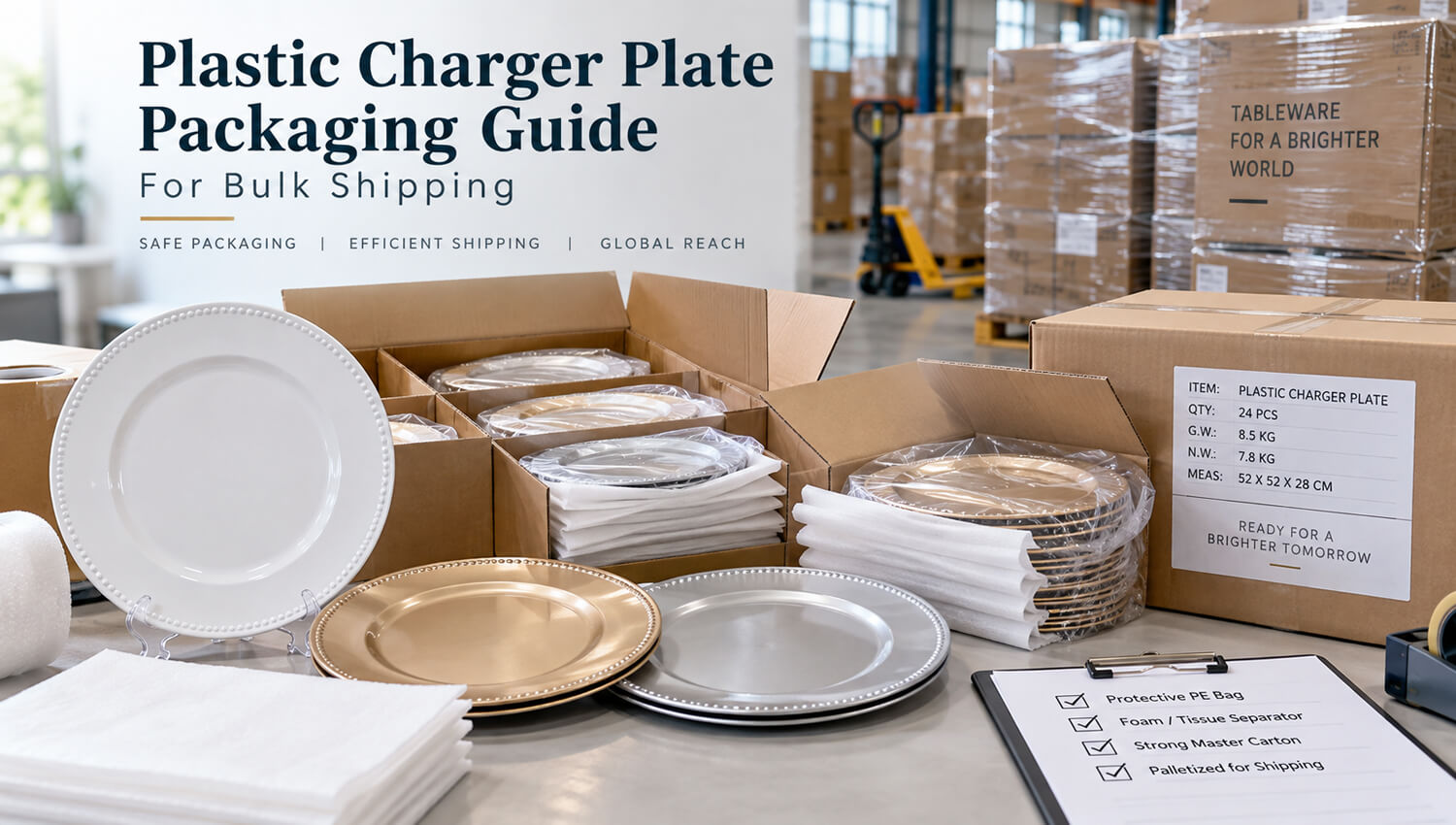
Interleaving paper, protective film, tissue, foam, or individual bags may prevent surfaces from rubbing together during shipment.
For B2B buyers, coating durability and packaging should therefore be evaluated as one system rather than two separate purchasing decisions.
Production Cost, MOQ, Tooling, and Order Volume Considerations
Cost is rarely determined by the finishing material alone.
The final price includes surface preparation, labor, coating consumption, production setup, curing, inspection, reject rate, packaging, and order quantity.
Plated metallic finishes often involve more process steps. This can increase setup requirements and make very small custom production runs less economical.
Spray painting is often more flexible for custom colors and smaller production batches, although costs can rise when an order includes many different colors.
Consider a 10,000-piece order divided into ten colors.
The total volume sounds large, but the factory may need to stop production repeatedly to clean equipment, change coatings, prepare samples, adjust settings, and confirm colors.
Those changeovers add cost.
For purchasing managers, a useful approach is to compare cost per sellable design, not just cost per piece.
Several factors influence your quotation:
| Xarajat omili | Effect on Pricing |
|---|---|
| Order quantity | Higher quantities usually reduce unit cost |
| Number of colors | More colors can increase changeover cost |
| Metallic complexity | Special metallic finishes may increase processing |
| Gloss requirements | Additional coating may be needed |
| Custom color matching | Sampling and adjustment may add cost |
| Qadoqlash | Individual protection increases cost |
| Inspection standard | Stricter inspection can increase labor |
| Reject tolerance | Tight visual standards can affect yield |
| Custom labeling | Adds material and labor |
| Carton requirements | Export cartons may increase packaging cost |
MOQ also deserves attention.
There may be several MOQs within one charger plate project:
- MOQ per model
- MOQ per color
- MOQ per finishing method
- MOQ per logo
- MOQ per packaging design
A supplier saying “MOQ 500 pieces” doesn’t necessarily mean you can order 100 pieces each in five colors.
Ask for the MOQ breakdown before finalizing your product range.
This simple step can prevent expensive changes after sample approval.
Custom Colors, Patterns, and Private Label Options
Customization is where spray-painted finishes can become particularly attractive for B2B programs.
Retailers and distributors increasingly build collections around specific color themes rather than selling only traditional gold and silver products.
A private-label buyer might want charger plates matching:
- Wedding themes
- Restaurant interiors
- Bayram kollektsiyalari
- Home décor trends
- Brand colors
- Seasonal catalogues
- Event themes
Spray coating allows manufacturers to work with a broad range of pigments and finishes.
That makes it easier to develop matte, satin, gloss, pearl, metallic, and special-effect colors.
Pantone references can also serve as development targets.
However, there is an important B2B detail: Pantone matching should be treated as a physical sample approval process rather than a digital promise.
Plastic substrate color, primer, coating thickness, gloss, metallic particles, and lighting can all influence the final appearance.
For that reason, a sensible development workflow is:
- Buyer provides the desired color reference.
- Manufacturer prepares a color sample.
- Buyer reviews the physical sample.
- Adjustments are made if required.
- Approved sample becomes the production reference.
- Bulk production is checked against that reference.
Besides color, buyers can combine finishing with other customization options.
Depending on the plate design and factory capabilities, these may include:
- Custom molded patterns
- Bosilgan teksturalar
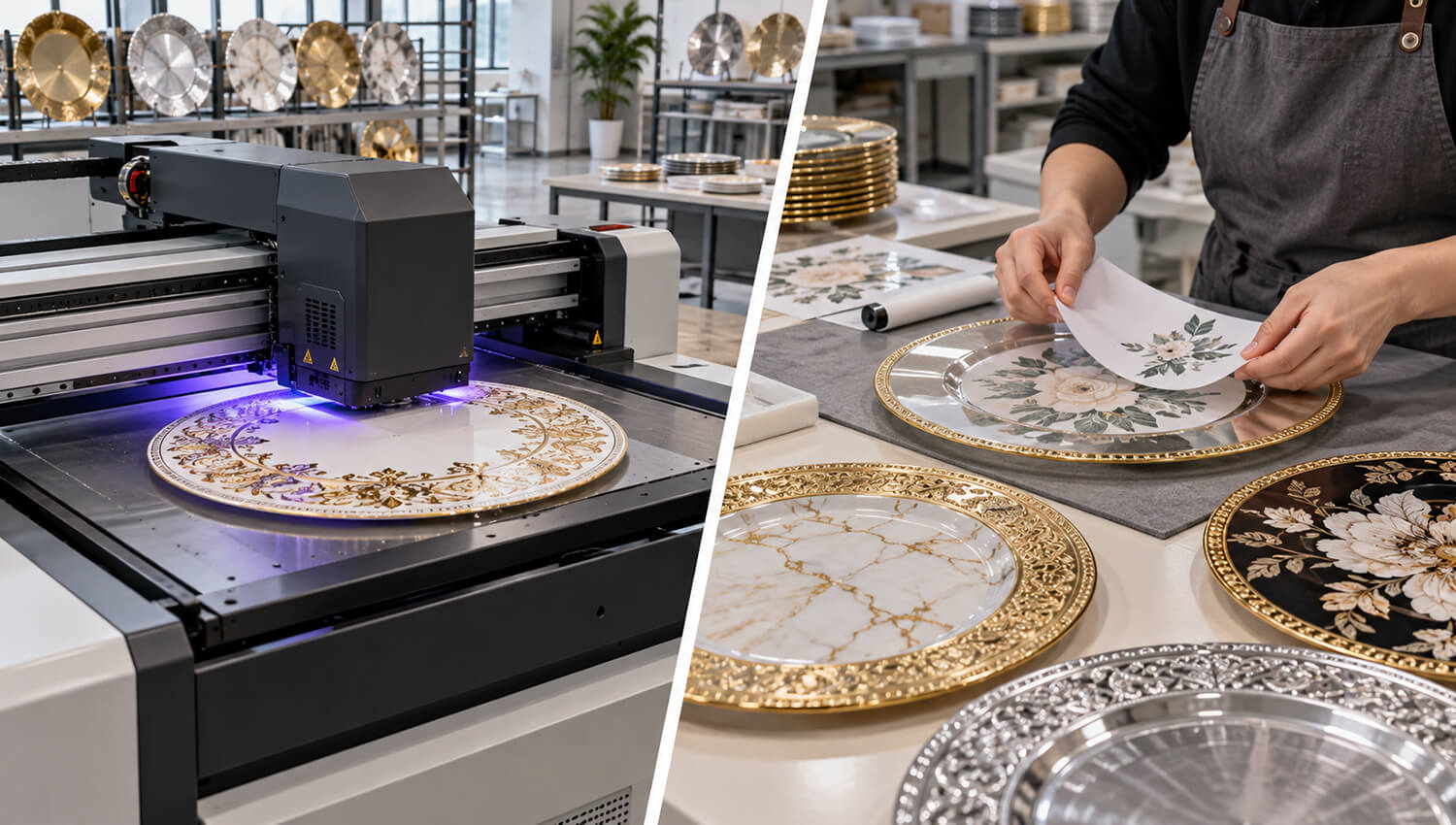
- Printed decorations
- Logotip bosib chiqarish
- Shtrixkod yorliqlari
- Brand stickers
- Custom polybags
- Color boxes
- Master carton printing
- Chakana qadoqlash
Plating works especially well when the product concept itself depends on metallic luxury.
For example, a geometric gold plate or reflective silver charger may gain most of its value from the metallic surface.
Spray painting is more useful when color differentiation is the primary design feature.
From a manufacturer’s perspective, the best OEM programs usually define the desired visual outcome first and choose the process second.
That avoids forcing a finishing method onto a design that would be better produced another way.
Surface Defects and Quality Control for Decorative Charger Plates
Large decorative surfaces are demanding because minor defects can be easy to see.
A tiny coating defect may be acceptable on a hidden component but unacceptable in the center of a charger plate.
Common spray-finish defects include:
- Dust particles
- Uneven color
- Paint runs
- Orange peel
- Thin coverage
- Pinholes
- Overspray
- Poor adhesion
Metallic finishes may show:
- Uneven reflection
- Cloudiness
- Yuzaki belgilar
- Color variation
- Edge defects
- Chiziqlar
- Local coating differences
This is why quality standards should be agreed upon before mass production.
One common purchasing mistake is using words such as “perfect surface” without defining inspection conditions.
No industrial decorative product is inspected under unlimited magnification from every possible angle.
Instead, buyers and manufacturers should establish reasonable criteria for normal viewing conditions.
Important factors can include:
- Inspection distance
- Lighting
- Viewing angle
- Acceptable minor marks
- Critical inspection zones
- Sample acceptance standard
- AQL requirements where applicable
The approved production sample is particularly valuable.
It gives both sides a physical reference when judging color, gloss, texture, and overall appearance.
For larger orders, pre-shipment inspection can also help verify consistency before the products leave the factory.
From practical manufacturing experience, packaging inspection should be part of surface-quality control.
Imagine passing 100% visual inspection and then stacking every finished plate directly against the next one.
By the time the shipment reaches the importer, surfaces may be scratched even though they left the finishing line in excellent condition.
Quality control therefore continues through:
finishing → curing → inspection → handling → packing → carton loading.
Buyers sourcing decorative products should always evaluate the complete process.
The finishing technology may create the appearance, but disciplined handling preserves it.
For environmental information related to industrial metal-finishing operations, buyers can also review the U.S. Environmental Protection Agency’s metal finishing guidance.
Which Surface Finish Is Better for Weddings, Hotels, and Event Supply?
The best finish often depends on where the charger plate will be sold or used.
For wedding and event suppliers, metallic gold and silver remain attractive because they photograph well and match many decorative themes.
Plated or highly reflective metallic finishes may therefore support premium-looking collections.
A wedding wholesaler might prioritize:
- Bright gold
- Kumush
- Atirgul oltin
- Shampan
- Mirror effects
Hotels and restaurants may have different priorities.
They may prefer products that coordinate with existing interior design and tableware. Matte black, cream, bronze, olive, or custom colors can therefore become more important than maximum reflection.
Rental businesses should pay particular attention to handling resistance.
Their charger plates may be:
- Transported repeatedly
- Stacked every week
- Washed or wiped frequently
- Stored in large quantities
- Handled by different employees
In these environments, finish selection cannot be separated from maintenance procedures and packing systems.
Retailers face another challenge: trend cycles.
A retail customer may introduce new colors every year. Spray finishing gives buyers greater freedom to follow seasonal demand without redesigning the entire product.
An importer might use the same molded plate in:
- Matte black for Halloween
- Red for Christmas
- Gold for weddings
- White for spring
- Navy for formal collections
That strategy reduces the need for new molds while expanding the SKU range.
For distributors, this can be commercially useful.
Instead of asking which process is objectively better, ask:
Which finish makes this specific SKU easier to sell to its intended customer?
A premium event supplier and a value-focused retailer may select completely different finishes for the same charger plate design.
Successful product development starts with the end market.
Plating vs Spray Painting Charger Plates: B2B Selection Guide
When evaluating Plating vs Spray Painting Charger Plates, buyers should use several commercial factors together rather than focusing on one specification.
Here is a practical sourcing framework.
| Buyer Requirement | Recommended Direction |
|---|---|
| Strong mirror gold effect | Plating / metallic finishing |
| Bright chrome-like silver | Plating / metallic finishing |
| Custom Pantone color | Purkash orqali bo'yash |
| Matte or satin color | Purkash orqali bo'yash |
| Seasonal color collections | Purkash orqali bo'yash |
| Premium metallic presentation | Plating |
| Many color variations | Purkash orqali bo'yash |
| Small customized runs | Usually spraying |
| Highly reflective décor | Plating |
| Brand-specific colors | Purkash orqali bo'yash |
Start by defining your customer.
If you sell primarily to wedding rental companies, reflective gold may create stronger commercial value.
If you’re developing private-label table décor for retailers, color flexibility may matter more.
Next, define the expected price position.
A premium finish only creates value when your customer is willing to pay for it.
Then review order volume.
Large, stable orders can justify production processes that require more setup. Smaller or frequently changing collections may benefit from flexible coating methods.
Packaging comes next.
A beautiful finish that scratches during shipment is not a commercially successful finish.
Finally, test the actual sample rather than making a decision from photographs.
Ask for samples that represent realistic production quality.
When comparing suppliers, place them under similar lighting and evaluate:
- Rang
- Reflection
- Surface smoothness
- Edge coverage
- Scratch visibility
- Qoplama yopishishi
- Overall appearance
A buyer should also consider consistency across future repeat orders.
Matching a single sample is useful.
Being able to reproduce the finish six months later is even more important for distributors running long-term product programs.
That is where documented samples, color references, production records, and reliable quality-control procedures add value.
What B2B Buyers Should Confirm Before Placing an Order
A clear RFQ can save several rounds of emails and reduce misunderstandings during product development.
Instead of sending only a product photograph and asking for the price, provide enough information for the manufacturer to understand your commercial requirements.
A useful charger plate RFQ should include:
Product information
- Plataning diametri
- Plate shape
- Base material
- Target weight if required
- Existing design or custom mold
- Required quantity
Finishing information
- Plated or sprayed appearance
- Desired color
- Gloss, satin, or matte finish
- Metallic reference
- Pantone reference if applicable
- Surface texture requirements
Commercial information
- Quantity per color
- Total order quantity
- Maqsadli bozor
- Intended application
- Repeat-order expectations
- Required delivery schedule
Packaging information
- Individual bag requirement
- Protective interlayer requirement
- Inner box requirement
- Kartondagi dona soni
- Custom label
- Shtrixkod
- Private-label carton artwork
Buyers should also request samples before large orders.
A production-quality sample allows you to verify details that aren’t easy to judge from photographs.
For example, two gold colors can look almost identical online while appearing very different next to each other in person.
Also confirm whether the sample represents the exact bulk-production process.
Handmade development samples sometimes differ slightly from mass-produced parts.
Your supplier should explain any expected differences before approval.
For repeat programs, retain an approved sample at both the buyer’s and manufacturer’s locations.
This creates a common reference for future orders and reduces subjective disputes about color or surface appearance.
A well-prepared specification may take an extra hour at the beginning of the project.
It can save days of communication later.
Tez-tez so'raladigan savollar
Is plating better than spray painting for charger plates?
Not in every situation. Plating is usually better for highly reflective gold, silver, or chrome-like effects. Spray painting is generally more flexible for Pantone colors, matte surfaces, seasonal collections, and private-label customization.
Which charger plate finish looks more expensive?
A well-made plated metallic finish often creates a stronger luxury impression because of its reflection and depth. However, high-quality matte, pearl, or metallic spray coatings can also support premium retail collections when properly designed.
Do plated charger plates scratch easily?
Reflective surfaces can make scratches easier to notice. Actual scratch resistance depends on surface preparation, metallic coating, protective layers, curing, handling, and packaging. Protective separators between stacked plates can significantly reduce shipping damage.
Can spray-painted charger plates match Pantone colors?
Manufacturers can normally develop coatings based on Pantone references, although exact visual results depend on substrate, gloss, coating thickness, and lighting. Buyers should approve a physical color sample before mass production.
Can charger plates be customized with different finishes in one order?
Yes, but each color or finish may have its own MOQ and setup cost. Buyers should confirm the MOQ per color rather than assuming the total order quantity can be freely divided.
Which finish is better for wedding charger plates?
Gold, silver, rose gold, and champagne metallic effects are especially popular in wedding applications. Reflective metallic finishes may suit premium settings, while sprayed finishes provide broader theme colors and matte options.
Can painted charger plates peel?
Poor adhesion, contamination, insufficient surface preparation, incorrect coating selection, or inadequate curing can cause peeling. Reliable manufacturers control pretreatment and curing conditions and should evaluate coating adhesion during quality inspection.
Are decorative charger plates designed for direct food contact?
Charger plates are generally used beneath dinnerware as decorative base plates rather than as eating surfaces. Buyers should clearly define intended use and request applicable material or compliance documentation for their destination market.
Choosing the Right Charger Plate Finishing Process
There is no universal winner between plating and spray painting.
The correct finishing process depends on the commercial objective of your product.
Choose metallic plating or related metallic finishing when you need strong reflection, classic gold or silver styling, and a premium decorative appearance.
Choose spray painting when you need broader color choices, matte or satin finishes, easier color development, or flexible private-label collections.
For overseas B2B buyers, four factors deserve particular attention:
- Appearance: What does your customer expect to see?
- Durability: How will the product be handled and stored?
- Commercial volume: How many pieces and colors will you order?
- Consistency: Can the supplier reproduce the approved finish in repeat orders?
Don’t evaluate finish cost in isolation.
A slightly cheaper coating can become expensive if it produces high defect rates, scratches during transportation, or fails to match future repeat orders.
The most reliable sourcing approach is to communicate your target market, finish expectation, order quantity, packaging, and quality requirements before sample development begins.
That gives your manufacturer enough information to recommend an appropriate production method instead of simply quoting the lowest-cost process.
B2B Manufacturer Support
If you’re developing charger plates for wholesale, distribution, event supply, retail, or private-label programs, send us your target design, finish reference, color requirement, estimated order quantity, and packaging specification.
Our manufacturing team can evaluate the suitable surface-finishing route, prepare samples, and develop a production proposal based on your target market.
Send your charger plate specifications or reference photos to our team for an OEM/ODM quotation and finishing recommendation.