
Private Label Charger Plates are decorative underplates manufactured for importers, wholesalers, retailers, event suppliers, and hospitality brands under their own branding or packaging. A successful private-label program requires more than selecting a design and negotiating a low unit price. You need to control materials, dimensions, finishes, logo details, packaging, inspection standards, compliance requirements, and landed cost before mass production starts.
For an importer, that distinction matters.
Two charger plates can look almost identical in a supplier’s photo but perform very differently after shipping. One may arrive with a consistent metallic finish and clean edges. Another may show scratches, warped rims, color differences, coating marks, or broken pieces.
The purchasing decision therefore shouldn’t begin with, “What’s your lowest price?”
It should begin with:
- What specification are you actually buying?
- Can the manufacturer reproduce it consistently?
- How will quality be measured?
- What packaging will survive international shipping?
- Which customization creates value for your customers?
- What will the product really cost after it reaches your warehouse?
This guide approaches those questions from a manufacturer and importer perspective. It is designed for purchasing managers, distributors, tableware wholesalers, hospitality suppliers, event-product companies, and private-label brands that want a repeatable sourcing program rather than a one-time cheap order.
Private Label Charger Plates: What Importers Need to Know
Private label production means a manufacturer supplies charger plates that are sold under your company’s brand, collection, SKU system, or packaging.
The degree of customization can vary widely.
At the simplest level, you may select an existing factory design and add your barcode, label, carton mark, or branded box. This normally requires less development work and often supports a lower minimum order quantity.
At the other end, you can develop a highly customized collection. You may specify the plate diameter, rim profile, decorative pattern, surface color, finish, back label, retail packaging, master carton, and sometimes even a completely new mold.
This difference is important because buyers sometimes use OEM, ODM, custom, and private label as if they mean exactly the same thing.
In practical B2B sourcing:
| Supply Model | Typical Customization | Development Cost | Oddiy minimal buyurtma miqdori |
|---|---|---|---|
| Existing product | Packaging or label only | Past | Pastroq |
| Existing mold + custom color | Color, coating, label, carton | Pastadan o'rtacha | O'rta |
| Existing mold + special finish | Surface effect, color, packaging | O'rta | O'rta |
| Modified design | Structure and decorative changes | O'rta–yuqori | Yuqori |
| New mold project | Shape, dimensions, texture, branding | Yuqori | Highest |
For many importers, using an existing proven mold is the safest starting point.
You can differentiate the product through color, surface treatment, assortment, labeling, and packaging without paying immediately for new tooling.
Once sales volume becomes predictable, developing exclusive shapes can make more commercial sense.
From a manufacturer’s perspective, the best private-label programs are usually built step by step. Buyers first validate the product, finish, shipping performance, and customer demand. Only then do they increase customization.
That approach lowers your development risk while preserving room for future differentiation.
Why Importers Choose Custom-Branded Charger Plates
Charger plates are visually driven products. That makes private labeling especially useful because customers aren’t buying only a round plate. They’re buying a table setting, event style, seasonal collection, or brand presentation.
For distributors and retailers, this creates several opportunities.
First, private labeling makes direct price comparison harder. If you sell exactly the same item with exactly the same packaging as several competitors, customers can easily compare prices.
A differentiated collection changes that equation.
You might offer:
- Antique gold wedding charger plates
- Hammered silver banquet plates
- Matte black modern table chargers
- Beaded-rim Christmas collections
- Clear acrylic wedding underplates
- Rustic wood-look designs
- Luxury metallic hospitality collections
Second, branded packaging improves consistency across your range. A buyer purchasing dinnerware, napkin rings, serving accessories, and charger plates can see one unified identity.
Third, customization can help you build repeat business.
Instead of constantly searching for whatever design is available from different factories, you establish approved specifications. When inventory drops, you reorder the same SKU.
That makes purchasing easier.
It also makes quality easier to manage because each repeat order can be compared with an approved reference sample.
However, private labeling doesn’t automatically make a product better.
A logo on a weak product is still a weak product.
For that reason, experienced buyers normally develop the physical specification first and branding second. Confirm dimensions, weight, structure, color, finish, and packaging before spending too much time on decorative branding details.
Your brand promise ultimately depends on what your customer receives when the carton is opened.
Charger Plate Materials and Construction Options
Material selection affects appearance, weight, breakage risk, price, packaging, transportation cost, and customer positioning.
For high-volume decorative table settings, plastic charger plates are common because they provide a favorable balance between visual impact, cost, and shipping efficiency.
Different plastic materials and construction methods can produce significantly different results, however.
A buyer shouldn’t specify only “plastic charger plate.”
Ask the manufacturer exactly what material and construction are proposed.
Common Material Choices
| Material Type | Main Advantages | Key Considerations | Typical Positioning |
|---|---|---|---|
| PP plastic | Lightweight, practical | Surface appearance depends on design and finishing | Value / commercial |
| PS plastic | Good decorative possibilities | Can be more brittle depending on structure | Events / retail |
| Acrylic-style material | Clear visual appearance | Higher cost and scratch sensitivity | Premium decorative |
| Melamine-type material | Solid feel | Intended-use and compliance must be confirmed | Hospitality |
| Shisha | Premium ko'rinish | Heavy and breakable | Premium dining |
| Metall | Durable, distinctive | Weight and price | Luxury / specialty |
| Wood/MDF-style | Natural appearance | Moisture and finish need attention | Rustic / event |
Diameter is another basic specification.
Many decorative chargers are approximately 13 inches, but you should never purchase based on an assumed market size.
Specify dimensions in millimeters.
Masalan:
Outer diameter: 330 ± X mm
You should also identify:
- Overall weight
- Rim kengligi
- Center diameter
- Plate height
- Wall thickness where relevant
- Stak balandligi
- Surface texture
- Bottom construction
Why does stack height matter?
Because you’re importing volume, not just individual pieces.
A difference of several millimeters per plate can substantially change the number of pieces per carton and the cubic volume of thousands of plates.
That eventually affects freight and warehouse cost.
This is one reason experienced importers evaluate the entire supply chain rather than comparing only factory unit prices.
Surface Finishes, Colors, and Decorative Effects
The surface treatment often determines whether a charger plate looks inexpensive, commercial, rustic, or premium.
Gold isn’t simply gold.
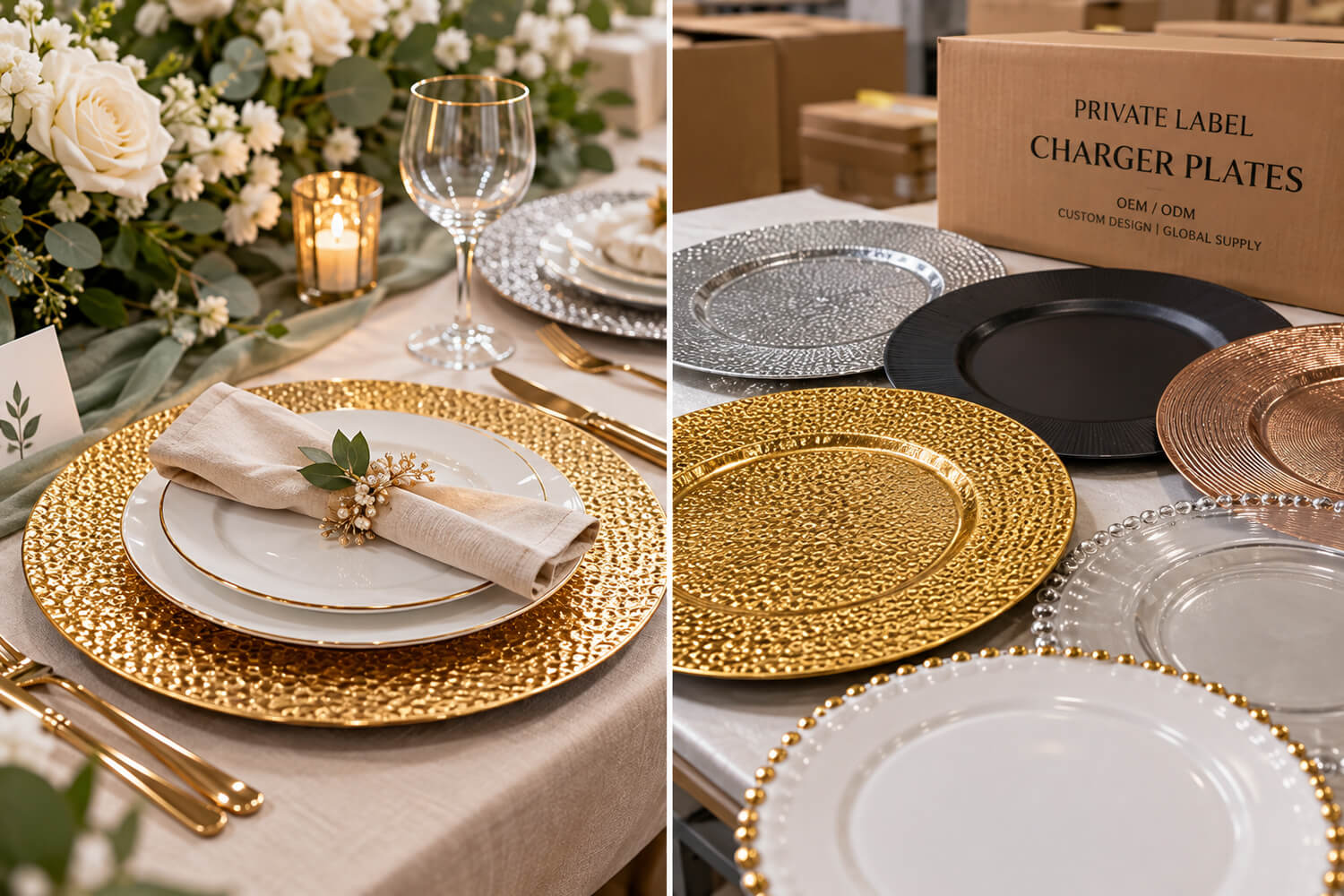
A collection may use bright gold, champagne gold, antique gold, brushed gold, distressed gold, rose gold, or another custom tone. The same principle applies to silver, copper, bronze, black, white, and colored finishes.
Before production, define visual requirements as precisely as possible.
Where practical, use:
- Physical reference samples
- Approved color chips
- Pantone references for applicable colors
- Finish photographs under controlled lighting
- Signed production samples
Digital photographs alone are risky.
Phone screens, cameras, lighting, image editing, and monitors all influence perceived color.
Metallic surfaces are even harder to judge digitally because reflected light changes their appearance.
From the factory side, we therefore recommend keeping a physical approved sample when color consistency is commercially important.
Your purchase specification might identify:
| Attribute | Approved Requirement |
|---|---|
| Base color | Approved reference sample |
| Yuzaki | Matte / glossy / metallic |
| Decorative effect | Antique / brushed / distressed |
| Nusxa | Approved mold/reference |
| Edge appearance | No obvious flashing |
| Color difference | Within approved visual tolerance |
| Visible scratches | Not acceptable beyond agreed limit |
| Coating defects | Defined inspection standard |
Buyers should also understand natural production variation.
For example, an antique finish is intentionally irregular. If you demand that every distressed mark appear in exactly the same position, you’re asking for something that may conflict with the nature of the decoration process.
The solution is not vague quality control.
It is an approved tolerance range.
Agree on what variation is acceptable before placing the purchase order. That prevents arguments after production is complete.
Private Label Branding and Packaging Options
Private labeling doesn’t mean your logo must be permanently printed on the front of every plate.
For charger plates, subtle branding is often more appropriate.
Your options may include:
- Backside product labels
- Brand stickers
- Barcode or UPC/EAN labels
- Printed polybags
- Color boxes
- Kraft boxes
- Printed sleeves
- Product information cards
- Care instruction inserts
- Customized master cartons
- Yuborish belgilar
- SKU labels
Each method affects MOQ and cost differently.
A customized master carton is usually easier to implement than a fully printed retail gift box because carton printing is relatively simple.
Premium retail packaging may require larger quantities due to printing setup requirements.
Before asking your supplier for a packaging quotation, tell them how the product will actually be sold.
A wholesaler shipping cartons to event rental companies may prioritize transport protection.
An Amazon or e-commerce seller may need individual packaging and strong drop protection.
A department-store supplier may require barcode positioning, shelf presentation, warning statements, carton labels, and packaging artwork approval.
These aren’t the same packaging problem.
One practical factory-side principle is simple: design packaging around the distribution channel, not around appearance alone.
A beautiful package that allows plates to rub against each other during ocean transportation is poor packaging.
For metallic or glossy surfaces, separator protection can be particularly important.
Possible systems include:
- Tissue or protective sheets between plates
- Individual bags
- Foam sheets
- Pufakcha himoyasi
- Ichki qutilar
- Reinforced outer cartons
- Corner protection
- Palletization when required
Before mass production, confirm both the visible packaging artwork and the hidden protective structure.
Your customers see the first one.
Your claims department feels the second one.
MOQ, Tooling, Sampling, and Product Development
MOQ is one of the first questions importers ask, but there isn’t one universal minimum quantity for custom charger plates.
The practical MOQ depends on what you’re changing.
Using an existing mold in an existing color may allow a relatively small production run.
Requesting a special color can require a larger batch because the factory must prepare material, paint, coating, or finishing specifically for your order.
Custom printed packaging introduces another MOQ.
A new mold creates an entirely different economic calculation.
Therefore, instead of asking only:
“What is your MOQ?”
So'rang:
“What is the MOQ for this design, this finish, and this packaging configuration?”
That produces a useful answer.
Sampling should follow the same logic.
A Practical Sample Approval Sequence
- Reference sample: Confirms the basic existing product.
- Color sample: Confirms the requested finish.
- Logo or packaging proof: Confirms artwork.
- Pre-production sample: Represents the agreed production specification.
- Golden sample: Becomes the comparison standard for mass production.
A common importer mistake is approving different elements separately without creating one final approved specification.
For example, the buyer approves a gold sample in March, a revised packaging layout in April, and a label by WhatsApp in May.
When mass production begins, nobody has one controlled reference.
A better approach is to create a final approval sheet containing the SKU, material, dimensions, weight, finish, artwork revision, packing method, carton quantity, carton marks, and approved sample date.
If you’re developing several SKUs, create one record per item.
That simple discipline prevents surprisingly expensive mistakes.
Quality Control Standards for Wholesale Charger Plates
Quality inspection should turn subjective expectations into measurable checkpoints.
“Good quality” isn’t a useful QC standard.
“No scratches” sounds clearer, but even that may require definition. A tiny mark visible only under strong light isn’t the same as a deep scratch visible from one meter away.
For volume production, inspection should cover several categories.
Typical Incoming and Final Inspection Points
| QC Item | What to Check |
|---|---|
| Material | Correct material and approved construction |
| O'lchamlar | Diameter, height, rim dimensions |
| Og'irlik | Within agreed tolerance |
| Shakl | Flatness, warping, symmetry |
| Yuzaki | Scratches, contamination, dents |
| Rang | Comparison with approved sample |
| Yakunlash | Coating consistency and appearance |
| Edges | Flashing, sharp points, incomplete trimming |
| Logo/label | Correct artwork and position |
| Qadoqlash | Quantity, separators, bagging, carton strength |
| Karton belgilar | SKU, quantity, destination information |
| Drop protection | Performance where required |
AQL-based third-party inspection may also be useful for larger orders, especially when you’re dealing with a new supplier.
But an inspection company can’t fix a poor specification.
They can only inspect against criteria that have been defined.
Before inspectors arrive, your supplier should know what counts as:
- Critical defect
- Major defect
- Minor defect
For example, the wrong color might be considered major because it prevents you from selling the product as the intended SKU.
A tiny mark on the underside may be minor.
A sharp edge that could injure a user could be critical.
The classification should reflect your market and product requirements.
For repeat orders, inspection becomes even more powerful because the new batch can be measured against previous approved production.
Consistency—not perfection—is often what professional wholesale customers value most.
Food Contact, Labeling, and Import Compliance
This area deserves careful attention because the term “charger plate” can create confusion.
A charger plate is commonly used beneath dinnerware as a decorative base. It isn’t automatically intended for direct food contact.
That distinction affects product descriptions, labels, testing requirements, and regulatory evaluation.
Don’t ask a manufacturer to print “food safe” simply because it sounds attractive.
First determine the product’s intended use.
If your product will have direct food contact, discuss the destination market and applicable material requirements with your testing laboratory, customs specialist, or compliance adviser.
If it is decorative only, ensure marketing claims don’t misrepresent its intended use.
Importers should also confirm:
- Product material declaration
- Kelib chiqish mamlakati
- Intended-use statements
- Label requirements
- Customer-specific testing
- Packaging statements
- Local chemical or material requirements
- Documentation needed by the destination market
For U.S. imports, country-of-origin marking is particularly important. U.S. Customs and Border Protection states that foreign-origin goods generally must indicate their country of origin to the ultimate purchaser, subject to applicable requirements and exceptions.
Importers serving the United States can review official guidance directly through U.S. Customs and Border Protection country-of-origin information.
Don’t treat a generic test report supplied by a factory as automatic proof that your own shipment complies.
Check whether the report covers:
- The same material
- The same product construction
- Relevant substances
- The correct market
- A valid test method
- The relevant version or production batch where required
Compliance responsibility varies by market and transaction structure. Confirm requirements before production rather than after goods reach customs.
How to Calculate the Real Landed Cost
The cheapest FOB quotation isn’t necessarily the lowest-cost purchase.
Professional importers evaluate landed cost.
A simple model is:
Landed Cost = Product + Customization + Packaging + Tooling Allocation + Inspection + Freight + Duty/Tax + Local Charges + Storage + Expected Quality Loss
Imagine two quotations:
| Xarajat omili | Supplier A | Supplier B |
|---|---|---|
| Plate price | Pastroq | Slightly higher |
| Pieces/carton | 12 | 18 |
| Carton volume | Yuqori | Pastroq |
| Protective packaging | Basic | Improved |
| Defect risk | Unknown | Nazorat qilingan |
| Inspection records | Cheklangan | Mavjud |
| Real landed cost | ? | ? |
Supplier A looks cheaper until shipping, breakage, repacking, and customer claims are included.
For charger plates, cubic volume deserves special attention.
Suppose one design stacks efficiently while another has a deeper rim.
The second product may consume considerably more container space even if both weigh almost the same.
That can materially change your cost per sellable unit.
Ask the supplier for:
- Pieces per inner carton
- Asosiy karton qutiga tushadigan dona soni
- Karton o'lchamlari
- Umumiy og'irlik
- Sof og'irlik
- Har bir karton uchun CBM
- Estimated loading quantity
Then calculate shipping cost at the SKU level.
You should also spread one-time expenses across realistic sales volume.
If a custom mold costs several thousand dollars but supports hundreds of thousands of units over its lifetime, the tooling allocation per plate can become small.
If you sell only one small batch, the economics are different.
Don’t optimize factory price in isolation.
Optimize the cost of getting a saleable product into your customer’s hands.
Production Lead Time and Supply Chain Planning
Private-label production has several lead times, not one.
When a factory tells you production takes a certain number of days, that may start after artwork, samples, deposits, materials, and specifications have been approved.
Your real project schedule may look like this:
RFQ → Specification → Quotation → Sample → Revision → Approval → Packaging Artwork → Material Preparation → Production → Inspection → Packing → Shipment
Each stage can create delays.
Seasonal collections require even more planning.
Wedding, Christmas, Thanksgiving, New Year, and hospitality programs may have fixed selling windows. Arriving one month late can be much more damaging than paying a few cents more per plate.
For repeat purchases, provide forecasts whenever possible.
A manufacturer can plan better when it knows:
- Estimated annual demand
- Expected reorder frequency
- Seasonal peaks
- Number of SKUs
- Color mix
- Qadoqlash talablari
- Target shipping dates
You don’t always need to issue a purchase order months in advance.
Even a non-binding forecast helps suppliers plan materials and production capacity.
For successful SKUs, consider keeping packaging artwork and approved specifications stable across repeat orders.
Constantly changing small details creates hidden work and increases error risk.
The goal of a mature private-label program should be boring repeatability.
The first order involves development.
The fifth order should be much easier.
If every repeat shipment still requires dozens of corrections and explanations, either your specifications aren’t controlled or the manufacturing relationship isn’t mature enough.
How to Evaluate a Charger Plate Manufacturer
A professional manufacturer evaluation goes beyond website photographs and quotation sheets.
Start by examining how the supplier handles technical questions.
Ask for a detailed specification rather than only a price.
A capable supplier should normally be able to discuss material, dimensions, weight, finishing method, packaging, carton size, loading information, customization, and production limitations.
Pay attention to what happens when you ask difficult questions.
A supplier that says “yes” to everything isn’t always the safest supplier.
Sometimes the more reliable response is:
“This finish can be produced, but the color variation needs an approved tolerance.”
That shows production understanding.
Supplier Evaluation Scorecard
| Omil | What You Want to See |
|---|---|
| Product capability | Similar charger plate experience |
| Technical communication | Specific, consistent answers |
| Samples | Close to mass-production capability |
| QC | Documented inspection points |
| Traceability | SKU/order/batch records |
| Moslashtirish | Clear limits and costs |
| Packaging engineering | Export-shipment awareness |
| Capacity | Appropriate for your volume |
| Corrective action | Ability to investigate defects |
| Commercial reliability | Clear quotation and terms |
Video factory tours can help, but don’t rely on presentation alone.
Request practical evidence.
Masalan:
- Dimension measurements
- Packing-line photographs
- Carton specifications
- Production samples
- Inspection sheets
- Packaging drop-test records where applicable
- Material information
- Recent shipment experience for similar products
You aren’t trying to find a factory with impressive marketing.
You’re trying to find one capable of reproducing your specification order after order.
Common Private Label Importing Mistakes
One common mistake is selecting a supplier primarily on unit price.
Saving $0.05 per plate looks meaningful across 20,000 pieces.
But a small difference disappears quickly if cartons use more container space, products require repacking, or customer complaints increase.
Another mistake is developing too many SKUs on the first order.
Importers become excited by dozens of colors and patterns. They order a little of everything and discover later that several designs move slowly.
For a new collection, a smaller set of commercially distinct styles often produces better inventory efficiency.
Another problem is specification drift.
Someone approves “antique gold.” Months later, a different employee places the repeat order using only that phrase.
But which antique gold?
The original physical reference matters.
Other common mistakes include:
- Ordering from catalogue photographs alone
- Ignoring stack height and freight volume
- Approving color only through phone photos
- Requesting custom packaging too late
- Failing to define inspection criteria
- Assuming a test report applies to every SKU
- Changing artwork after production preparation begins
- Not checking carton markings
- Skipping pre-shipment inspection on a first order
- Forgetting replacement or claim procedures
Perhaps the most expensive error is waiting until mass production to solve development questions.
A production line is a terrible place to discover that your logo is too small, your gold tone is wrong, or six plates don’t fit the intended retail box.
Spend more attention during approval.
It usually costs much less than correcting finished goods.
Private Label Charger Plates Ordering Workflow
A structured ordering process makes custom manufacturing far easier.
The first stage is your RFQ.
Tell the manufacturer who you’re selling to and what you’re trying to build.
You don’t need to reveal confidential commercial information. However, knowing whether the product is intended for wholesale events, hospitality, retail stores, or online sales helps the factory propose a more suitable solution.
Then lock down the basic product.
Tasdiqlang:
Product → Material → Size → Weight → Pattern → Color → Finish → Branding → Packaging
Next, request samples.
Do not use sampling only to answer, “Do I like it?”
Use samples to verify measurable details.
Measure the diameter.
Check weight.
Stack several plates together.
Observe the finish in different lighting.
Place a dinner plate on top.
Inspect the underside.
Test your packaging concept.
If the product passes, record the approval.
The mass-production purchase order should then reference that approved version.
Before shipment, inspect the batch according to the agreed specification.
For new suppliers or important programs, a third-party pre-shipment inspection can add another layer of control.
A useful workflow is:
RFQ → Factory Review → Quote → Sample → Specification Approval → PO → Pre-production Confirmation → Mass Production → QC → Inspection → Shipment → Receiving Feedback → Repeat Order
Finally, give your manufacturer feedback after arrival.
Tell them about carton damage, customer comments, color consistency, packing efficiency, or unexpected defects.
Good manufacturers use this information to improve repeat production.
Private labeling works best when each order creates better data for the next one.
Importer RFQ Checklist for Custom Charger Plates
A detailed RFQ usually receives a more accurate quotation than a message saying:
“Please quote charger plate.”
Before contacting a factory, prepare as much of the following information as possible.
Product Requirements
- Product reference photo or drawing
- Target material
- Outer diameter
- Approximate target weight if known
- Rim style
- Yuzaki naqsh
- Rang
- Yakunlash
- Direct-food-contact requirement, if applicable
Moslashtirish talablari
- Logo method
- Label artwork
- Shtrixkod
- To'lov kodi
- Individual packaging
- Retail box
- Insert card
- Master carton printing
Commercial Requirements
- Quantity per SKU
- Number of colors
- Kutilayotgan yillik hajm
- Boriladigan mamlakat
- Trade terms requested
- Target shipment date
- Sample requirements
The destination country matters because compliance, labeling, freight, and commercial requirements can change by market.
If you’re uncertain about part of the specification, identify it clearly instead of guessing.
Masalan:
Required: antique metallic gold finish. Exact color not yet fixed. Please propose two standard factory options before custom matching.
That’s far more useful than giving an arbitrary color reference.
A good manufacturer can then determine which elements are fixed and which can still be optimized.
When comparing quotations, make sure you’re comparing equivalent specifications.
One quote may include individual protective bags while another doesn’t.
One may include printed cartons.
Another may assume plain export cartons.
Normalize those differences before choosing a supplier.
Otherwise, the lowest figure on your spreadsheet may not represent the same product.
Ko'p beriladigan savollar
What is the typical MOQ for private-label charger plates?
MOQ depends on the mold, material, surface treatment, color, and packaging. Existing designs with standard finishes usually support lower quantities, while exclusive colors, printed retail boxes, or new molds often require larger production runs.
Can I put my own logo on charger plates?
Yes. Depending on the design and material, branding may be added through backside labels, stickers, printing, packaging, inserts, or customized cartons. For decorative products, discreet backside or packaging branding is often preferable to a large front logo.
Can a manufacturer match a specific Pantone color?
Many finishes can be developed toward a Pantone or physical reference, but metallic, antique, textured, and reflective surfaces may not reproduce ordinary printed colors exactly. Approving a physical production sample is therefore strongly recommended.
How long does custom charger plate production take?
Lead time depends on raw materials, finish complexity, order quantity, packaging, tooling, and factory workload. Importers should separate sample-development time from mass-production time and leave additional room for inspection, booking, and international transport.
Should I inspect my order before shipment?
Inspection is strongly recommended for a first order, a new design, or a commercially important shipment. Inspection should compare production with an agreed specification covering dimensions, color, surface appearance, defects, quantity, packaging, and carton information.
Zaxira plastinkalar bevosita oziq-ovqat bilan aloqa qilish uchun xavfsizmi?
Not necessarily. Charger plates are often decorative underplates and may not be designed for direct food contact. If your application requires food contact, confirm material, intended use, applicable destination-market requirements, and appropriate testing before placing the order.
Can I customize the retail packaging?
Yes. Common options include labels, barcodes, individual bags, sleeves, printed boxes, inserts, and custom master cartons. Packaging MOQ may differ from the charger plate MOQ, so confirm both requirements during quotation.
Is developing a new mold worthwhile?
It can be worthwhile when your sales volume supports the tooling investment and exclusivity has clear commercial value. New importers often reduce risk by validating demand with existing molds before funding an exclusive shape.
Conclusion: Build a Repeatable Private Label Program
Successful Private Label Charger Plates programs aren’t built around one attractive sample or one low quotation.
They’re built around repeatability.
You want a factory that can reproduce the correct material, dimensions, finish, color, packaging, and labeling when you reorder the same SKU six months later.
That requires more work at the beginning.
Define the product carefully. Approve a physical sample. Record your specification. Establish defect criteria. Confirm packaging. Check compliance requirements. Calculate landed cost rather than unit price alone.
Then evaluate the manufacturer based on manufacturing capability, communication, process control, and consistency.
For importers, this approach protects more than product quality. It protects inventory turnover, customer relationships, margins, and your private-label reputation.
For manufacturers, the same approach creates healthier long-term relationships. Clear specifications reduce misunderstandings. Controlled samples reduce disputes. Repeat orders become easier to execute.
If you’re sourcing Private Label Charger Plates for wholesale, distribution, hospitality, events, retail, or your own tableware brand, send your supplier a complete RFQ instead of only requesting a catalogue price.
NOTE: Send us your target design, reference photo, size, finish, quantity, destination market, and packaging requirements. Our manufacturing team can review the specification and prepare a private-label production proposal covering product options, customization, sample development, packaging, and quotation.